

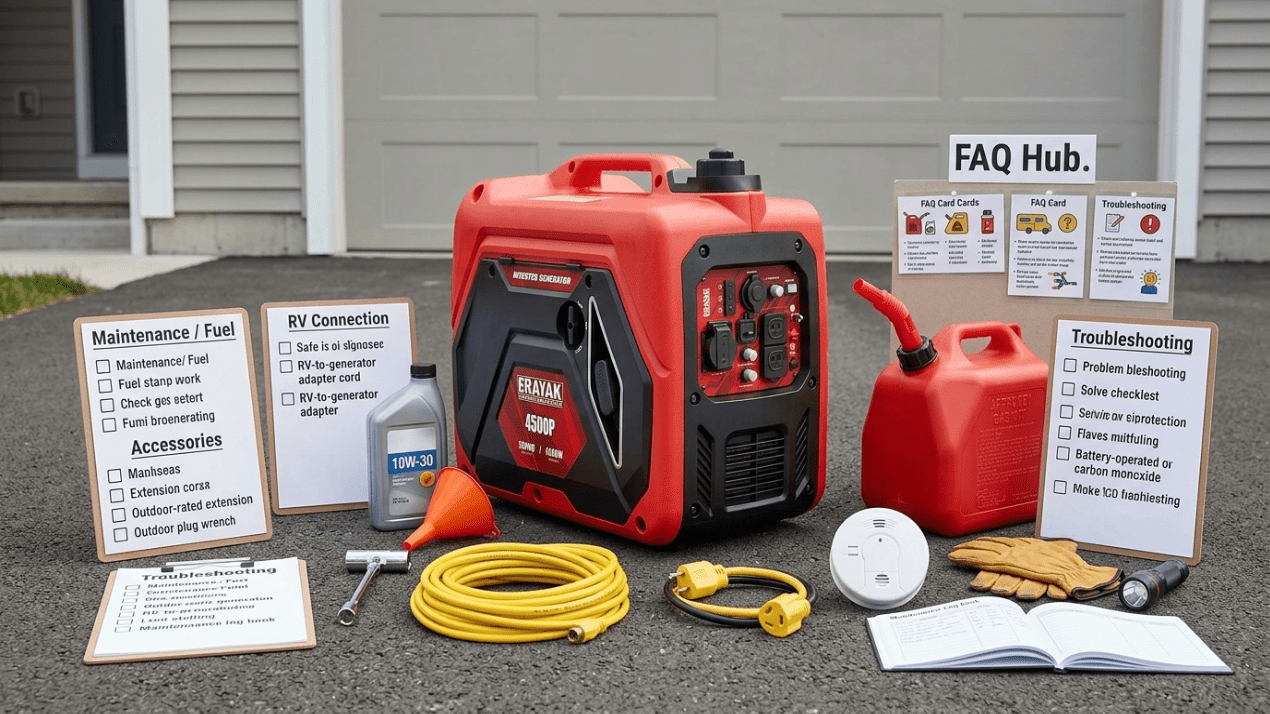
Generator FAQ Hub: Maintenance, Fuel, RV Connection and Accessories
This generator FAQ hub answers the most common questions about portable generator maintenance, generator troubleshooting, fuel storage, oil changes, RV connection, extension cords, adapters, and generator accessories. Use it as a quick reference before storm season, camping season, RV travel, or home backup planning.
Quick Answer
Most generator problems come from a few basics: stale fuel, low or dirty oil, blocked air filters, worn spark plugs, overloaded circuits, damaged extension cords, incorrect adapters, or unsafe placement. A good generator FAQ should help owners check fuel, oil, airflow, spark, load, cords, accessories, and safety setup before assuming the generator is defective.
For home backup and RV use, your core checklist should include maintenance tools, approved fuel storage, properly rated outdoor extension cords, compatible adapters, carbon monoxide alarms, a printed load plan, and a safe outdoor generator placement plan.
Generator Troubleshooting FAQ
Generator troubleshooting should start with simple checks before moving to deeper service. Many issues are caused by fuel, oil, air, spark, overload, or storage problems.
| Problem | Common Causes | First Checks |
|---|---|---|
| Generator will not start | Stale fuel, low oil, clogged fuel system, dirty air filter, worn spark plug | Check fuel, oil level, air filter, spark plug, choke setting, and fuel valve |
| Generator starts then shuts off | Low oil sensor, fuel restriction, overload, dirty carburetor, blocked airflow | Remove load, check oil, fuel flow, vents, and restart according to the manual |
| Generator surges or runs rough | Old fuel, dirty carburetor, air filter issue, unstable load | Use fresh fuel, check filter, reduce load, and inspect maintenance history |
| Breaker trips | Overload, appliance startup surge, damaged cord, wrong adapter | Disconnect loads, restart one appliance at a time, inspect cords and ratings |
| No power at outlet | Tripped breaker, overload, bad cord, damaged outlet, incorrect switch position | Check breaker/reset, outlet label, cord condition, and manual instructions |
Generator Maintenance FAQ
Generator maintenance keeps your unit ready after months of storage. The most important maintenance areas are oil, fuel, air filter, spark plug, cooling vents, cords, outlets, and test operation.
| Maintenance Question | Short Answer | Owner Tip |
|---|---|---|
| How often should I check generator oil? | Check oil before each use and follow the manual for change intervals | Keep a simple oil change log with date and operating hours |
| Should I change oil after storage? | Inspect it first; change it if dirty, old, low, contaminated, or due | Use the oil type and capacity listed in the manual |
| Do inverter generators need maintenance? | Yes, they still have engines, oil, fuel systems, filters, and spark plugs | Do not confuse inverter output with maintenance-free operation |
| What should I check every 6 months? | Oil, fuel, air filter, spark plug, battery if equipped, cords, outlets, vents, test run | Do the check before hurricane or winter storm season |
| Can I wash a generator? | Avoid spraying water into outlets, vents, engine, or panel | Wipe clean after cooling and store dry |
Generator Fuel FAQ
Fuel questions are common because stored fuel can age, fuel systems can clog, and outage preparation often depends on having enough fuel ready before the grid fails.
| Fuel Question | Short Answer | Safety Note |
|---|---|---|
| Can old fuel stop a generator from starting? | Yes. Stale or contaminated fuel is a common starting problem | Use fresh fuel and follow the manual for storage guidance |
| Should I use fuel stabilizer? | It can help with stored gasoline when used correctly | Follow stabilizer label instructions and your generator manual |
| Where should I store gasoline? | Use approved containers in a safe, ventilated storage area | Keep fuel away from living areas, heat, sparks, and flame |
| Can I refuel while the generator is running? | No. Shut it down and let it cool first | Fuel spilled on hot engine parts can create fire risk |
| Is propane easier for storage? | Propane can simplify some fuel planning on compatible dual-fuel models | Inspect hoses, regulator, cylinder condition, and connections |
RV Generator Connection FAQ
RV generator questions often involve adapters, 30 amp cords, TT-30 connections, air conditioner startup, converter charging, and load management. A plug that fits is not always a complete compatibility answer.
| RV Question | Short Answer | Connection Tip |
|---|---|---|
| Can I connect my RV directly to a generator? | Yes, if voltage, adapter, cord, outlet, and load are compatible | Use properly rated cords and add loads gradually |
| Does a 30 amp adapter give full 30 amp power? | No. Available power depends on generator output and outlet rating | An adapter does not increase wattage |
| Can a generator run an RV air conditioner? | It depends on AC size, startup demand, generator capacity, and other loads | Turn off microwave, electric water heater, and other high-load appliances first |
| Where should I place a generator near an RV? | Outdoors, away from windows, doors, vents, awnings, and occupied areas | Point exhaust away from RV and neighboring campsites |
| What should I check before plugging in? | Outlet type, adapter rating, cord condition, voltage, amperage, and load plan | Keep plug connections dry and elevated |
Generator Accessories FAQ
Generator accessories can make the difference between a generator you own and a generator you can actually use during an outage. The right cords, adapters, fuel containers, CO alarms, and maintenance tools should be prepared before an emergency.
| Accessory Question | Short Answer | Checklist Note |
|---|---|---|
| What accessories do I need first? | Fuel can, extension cords, CO alarms, oil, funnel, maintenance tools, load list | Prepare these before storm season |
| What extension cord should I use? | Outdoor-rated, grounded, properly sized for load and distance | Replace cords with cuts, fraying, heat damage, or missing ground pins |
| Do I need a transfer adapter? | Only if it matches proper transfer-ready equipment | Never use adapters to backfeed a wall outlet |
| Do I need a generator cover? | Useful for storage; running covers must be designed for safe operation | Never block ventilation or exhaust |
| Should I keep spare maintenance parts? | Yes. Spark plug, air filter, oil, funnel, drain pan, and basic tools are useful | Use model-compatible parts only |
Generator Safety FAQ
Generator safety is part of every FAQ topic: troubleshooting, fuel, RV connection, accessories, maintenance, and home backup. Unsafe placement, damaged cords, overload, wet connections, and backfeeding are the most important issues to avoid.
- Run portable generators outdoors only.
- Keep generators away from doors, windows, vents, garages, sheds, porches, crawlspaces, RV openings, and enclosed areas.
- Use working carbon monoxide alarms inside the home or RV.
- Use outdoor-rated, grounded extension cords that are rated for the connected load.
- Inspect cords and adapters before use.
- Keep plugs, adapters, and cord connections dry and elevated.
- Never plug a generator into a wall outlet to power home wiring.
- Use properly installed transfer equipment for home circuit backup.
- Turn off and cool the generator before refueling.
- Do not overload the generator; add loads gradually.
Recommended Erayak Setup by FAQ Need
Erayak 2400P: Compact FAQ for Essentials
Choose the Erayak 2400P for compact emergency power, camping electronics, phones, laptops, lights, WiFi, fans, and light-duty accessories. It is a practical fit for owners asking basic generator FAQ questions around charging, small loads, maintenance, and accessories.
- Good fit for compact emergency and outdoor power
- Accessory focus: small fuel kit, outdoor extension cord, oil funnel, CO alarms, and maintenance log
- Best for low-load essentials and simple backup planning
Erayak 4500P: FAQ for Home Backup, Camping, and General Use
Choose the Erayak 4500P when your FAQ needs include refrigerator backup, freezer rotation, lights, fans, phones, WiFi, small appliances, camping, and managed home essentials.
- Gas-only portable inverter generator
- Manual recoil start
- 55 lb lightweight design
- 2.25 gal fuel tank
- Up to 8 hours runtime
- THD < 1.2% for sensitive electronics
- 60.5 dB noise level
Erayak 4500PD: FAQ for Fuel Flexibility
Choose the Erayak 4500PD when your FAQ needs include gasoline and propane fuel planning, longer outages, RV travel, outdoor events, and more flexible backup power operation.
- Gasoline and propane flexibility
- Useful for longer outage planning and flexible fuel storage
- Good fit for maintenance, fuel, RV connection, and accessory planning
Erayak 6800PD / 6800PT: FAQ for Larger Loads and RV Adapter Support
Choose the Erayak 6800 series when your FAQ needs include larger emergency loads, selected 120V/240V planning, sump pump support, RV adapter planning, and more outlet flexibility.
- 6800W peak power
- 5000W rated power on gasoline at 100% output
- 30A L5-30R outlet
- 30A 120V/240V L14-30R outlet
- Dual 120V household outlets
- TT-30R RV adapter accessory included
Use This Generator FAQ Before the Next Outage or Trip
Whether your question is about generator troubleshooting, fuel storage, oil changes, RV connection, extension cords, adapters, or accessories, the best answer starts with safe placement, correct sizing, proper maintenance, compatible cords, and a clear load plan.
Full FAQ: Generator Maintenance, Fuel, RV Connection and Accessories
Why will my generator not start?
Common reasons include stale fuel, low oil, dirty air filter, worn spark plug, clogged fuel system, incorrect choke setting, closed fuel valve, weak battery if equipped, or long storage without maintenance.
Why does my generator start and then shut off?
Possible causes include low oil shutdown, overload, fuel restriction, dirty carburetor, blocked airflow, or an appliance load that is too large. Disconnect loads, check oil and fuel, then restart according to the manual.
What maintenance does a portable generator need?
Check oil, fuel, air filter, spark plug, cooling vents, outlets, extension cords, battery if equipped, frame hardware, and test operation. Follow the maintenance schedule in your owner’s manual.
How often should I change generator oil?
Follow the owner’s manual for oil change intervals. Change oil sooner if it is dirty, low, contaminated, smells like fuel, looks milky, or the generator has been used heavily.
Can old fuel damage generator performance?
Yes. Old or contaminated fuel can cause hard starting, rough running, surging, shutdowns, or fuel-system issues. Use fresh fuel and follow storage instructions in the manual.
What generator accessories should I keep for home backup?
Keep approved gas cans, fuel stabilizer, outdoor-rated extension cords, CO alarms, oil, oil funnel, drain pan, spark plug, air filter, gloves, flashlight, maintenance log, and a printed load list.
What extension cord should I use with a generator?
Use an outdoor-rated, grounded extension cord rated for the appliance load and distance. Do not use cords with cuts, fraying, crushed insulation, loose plugs, heat damage, or missing ground pins.
Can I connect a generator to my RV?
Yes, if the generator outlet, RV cord, adapter, voltage, amperage, and load plan are compatible. Place the generator outdoors away from RV openings and add loads gradually.
Does an RV generator adapter increase available power?
No. An adapter only changes the connection format when used correctly. Available power is limited by generator capacity, outlet rating, cord rating, adapter rating, and RV load.
Can I plug a generator into a wall outlet?
No. Never plug a generator into a wall outlet to power home wiring. This is unsafe backfeeding. Use direct appliance cords or properly installed transfer equipment.
Where should I place a generator?
Place it outdoors on dry stable ground, away from doors, windows, vents, garages, sheds, porches, crawlspaces, RV openings, and enclosed areas. Point exhaust away from people and structures.
What Erayak generator fits most common FAQ needs?
Choose the Erayak 2400P for compact essentials, the Erayak 4500P for home backup and general use, the Erayak 4500PD for fuel flexibility, and the Erayak 6800 series for larger loads, selected 120V/240V planning, and included TT-30R RV adapter support.


