

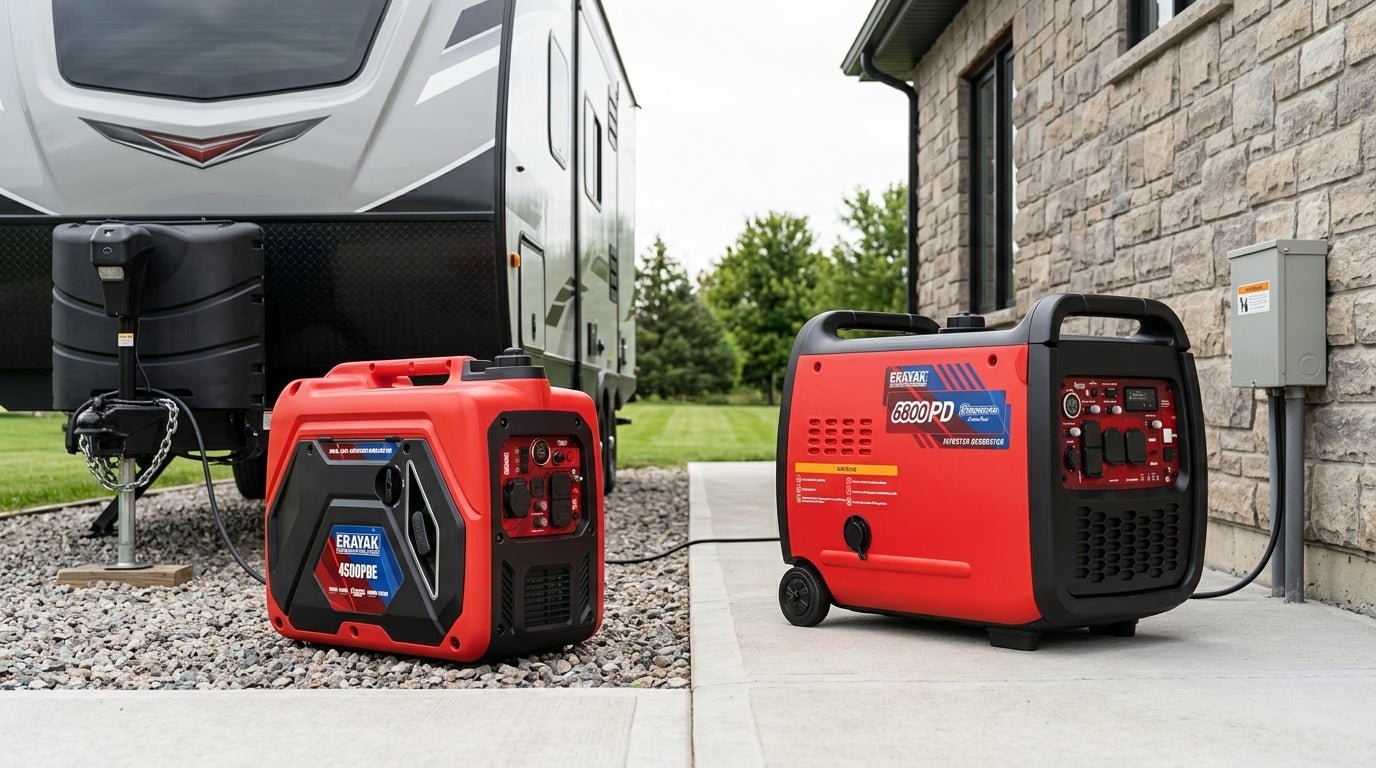
Best RV Generators 2026: 30 Amp, AC & Quiet Picks
The best RV generator is not simply the biggest one you can lift into a truck bed. For most campers, the right choice depends on three things: your RV electrical service, whether you need to run a rooftop air conditioner, and how much noise and fuel flexibility matter at camp.
Quick Answer: What Is the Best RV Generator for Most Campers?
For most 30 amp travel trailers, Class C RVs, toy haulers, and camper vans, a 4,000W to 4,500W inverter generator is the best practical size. It gives enough surge capacity for many 13,500 BTU RV air conditioners, enough running wattage for everyday camp loads, and better noise control than a conventional open-frame generator.
If you camp light and only need battery charging, lights, laptops, and small appliances, a compact 2,000W to 2,400W inverter generator can be enough. If you own a larger RV or want 120V/240V planning for selected larger loads, move into the 6,000W to 7,000W class, but do not confuse that with a full 50 amp campground pedestal replacement.
Best RV Generator Picks by Camping Situation
Before comparing models, start with your camping pattern. A weekend camper charging batteries needs a very different generator than a 30 amp trailer running an air conditioner in summer heat.
| RV situation | Best generator class | Why it fits | Erayak fit |
|---|---|---|---|
| Light camping and battery charging | 2,000W to 2,400W inverter | Good for charging RV batteries, laptops, lights, fans, small kitchen loads, and quiet campsite power. | Erayak 2400P |
| Most 30 amp RVs | 4,000W to 4,500W inverter | Best balance for one rooftop AC, RV converter, refrigerator, microwave planning, and normal camping comfort. | Erayak 4500PD or 4500P |
| Dual-fuel boondocking | 4,500W dual-fuel inverter | Propane is convenient for RVers who already carry propane, while gasoline gives another fuel option. | Erayak 4500PD |
| Larger RV and 120V/240V planning | 6,000W to 7,000W inverter class | Useful for selected larger loads, 120V/240V needs, and more complex power planning. | Erayak 6800PD / 6800PT |

What Size Generator Do You Need for an RV?
RV generator sizing depends on running watts and starting watts. Running watts are what an appliance uses after it is already on. Starting watts are the short surge required by motors and compressors, especially air conditioners.
| Generator size | Best for | Usually not enough for |
|---|---|---|
| 2,000W to 2,400W | Battery charging, lights, fans, laptops, router, small appliances, light camping. | Most rooftop RV air conditioners without careful soft-start planning. |
| 3,000W to 3,500W | Some smaller RV AC setups, especially with a soft start and limited other loads. | Comfortable 30 amp camping with AC plus microwave or other heavy loads. |
| 4,000W to 4,500W | Most 30 amp RV shoppers, one rooftop AC, refrigerator, converter, and managed appliance use. | Running everything in a 50 amp RV at the same time. |
| 6,000W to 7,000W | Larger RV planning, selected 120V/240V loads, and more power headroom. | A full 12,000W 50 amp pedestal replacement. |
For a 30 amp RV, remember the math: 120V x 30A = 3,600 watts. That does not mean you must buy exactly a 3,600W generator, because air conditioners need starting surge and generators also need breathing room. This is why many RV owners land in the 4,000W to 4,500W inverter class.
Best Generator Size for RV Air Conditioners
Air conditioners are the load that usually decides the generator size. A coffee maker or laptop charger is easy. A rooftop AC compressor is not.
| RV AC size | Typical running watts | Typical starting watts | Generator planning note |
|---|---|---|---|
| 11,000 BTU | 1,000W to 1,300W | 2,200W to 2,800W | May work with a smaller inverter generator if other loads are limited. |
| 13,500 BTU | 1,300W to 1,600W | 2,800W to 3,500W | A 4,000W to 4,500W inverter generator is the more comfortable target. |
| 15,000 BTU | 1,500W to 1,800W | 3,300W to 4,000W+ | Use a 4,500W-class generator, reduce other loads, and consider a soft start. |
| Two rooftop ACs | 3,000W to 3,600W+ | Can be much higher | Requires careful load management and a larger power plan. Do not assume a portable generator equals full 50 amp service. |
A soft start can reduce air conditioner startup surge, but it does not make wattage unlimited. You still need to manage the microwave, water heater, hair dryer, converter, and other high-draw loads.
30 Amp vs. 50 Amp RV Generator Planning
A 30 amp RV and a 50 amp RV are not just different plug shapes. A 30 amp RV is typically 120V service with up to 3,600W available from shore power. A 50 amp RV pedestal can provide far more total power because it has two 120V legs.
Best match: 4,500W class
For many 30 amp RV owners, a 4,500W inverter generator is the best balance of AC startup capacity, portability, and campsite usability.
Think load management
A portable generator can support selected loads, but it should not be described as the same thing as full 50 amp campground service.
120V/240V may matter
For larger RVs or crossover home-backup use, a 120V/240V inverter generator can be useful when the connection plan is correct.
Key Features to Compare Before Buying an RV Generator
1. Inverter Power
An inverter generator is usually the better choice for RVs because it is quieter, more fuel-aware at partial loads, and better suited for sensitive electronics than many conventional open-frame generators. RVs now include smart thermostats, converter/chargers, TVs, routers, control boards, and battery systems, so clean power matters.
2. Noise Level
Quiet RV generators matter because campground and boondocking etiquette matter. Enclosed inverter generators are usually a better fit than loud open-frame jobsite generators. Always check local campground rules and place the generator away from neighboring sites when possible.
3. Fuel Type
Gasoline is widely available and often gives strong output. Propane stores well and is already part of many RV setups. A dual-fuel RV generator is useful when you want the flexibility to use either fuel depending on the trip.
4. Outlet and Connection Fit
For many 30 amp RVs, a generator with a TT-30R RV-style outlet is convenient. For larger 120V/240V planning, an L14-30R outlet may matter. Use the right rated cord and adapter for your RV, and do not overload an adapter beyond its rating.
5. Real Portability
Portable does not only mean “has a handle.” Think about the weight, storage space, fuel handling, who will lift it, and whether it fits your campsite routine. A lighter generator may be best for battery charging, while a larger generator may be justified if RV AC is a must-have.
Erayak RV Generator Recommendations
These recommendations are organized by use case, not just by wattage. That is the best way to avoid buying either too little generator for your AC or too much generator for light camping.
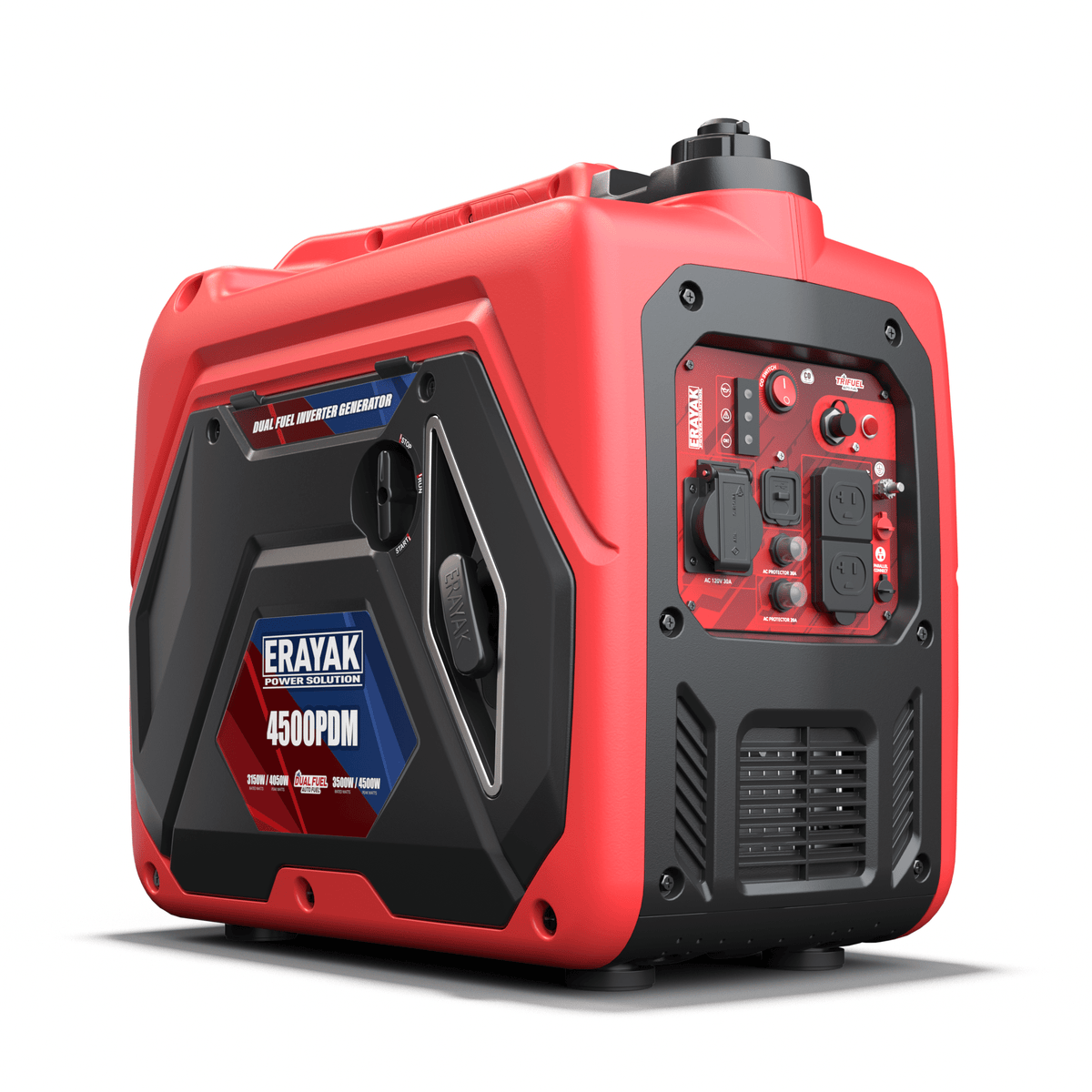
Best Overall for 30 Amp RVs: Erayak 4500PD
The Erayak 4500PD is the strongest fit for most RV shoppers in this guide because it combines 4,500W-class inverter power with dual-fuel flexibility. It is the natural pick for 30 amp RVs, one rooftop AC with managed loads, RV battery charging, refrigerator support, and propane-friendly boondocking.
See the 4500PD for 30 Amp RV Power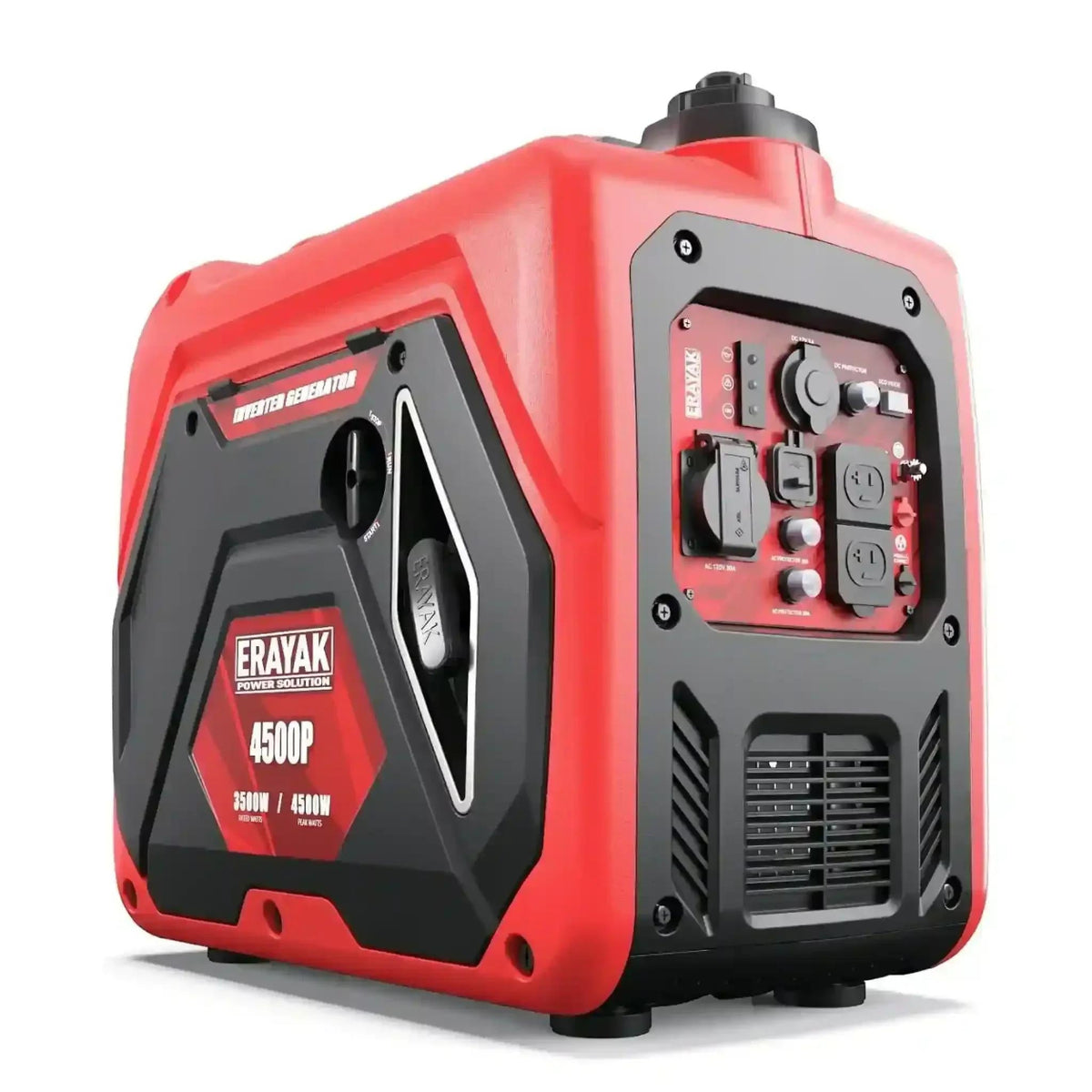
Best Gas-Only 4500W Option: Erayak 4500P
The Erayak 4500P is the cleaner fit for shoppers who want a 4,500W-class enclosed inverter generator but do not need propane. It is a gas-only, manual recoil-start option for RV camping, home essentials, and portable power planning.
See the 4500P Gas Inverter Generator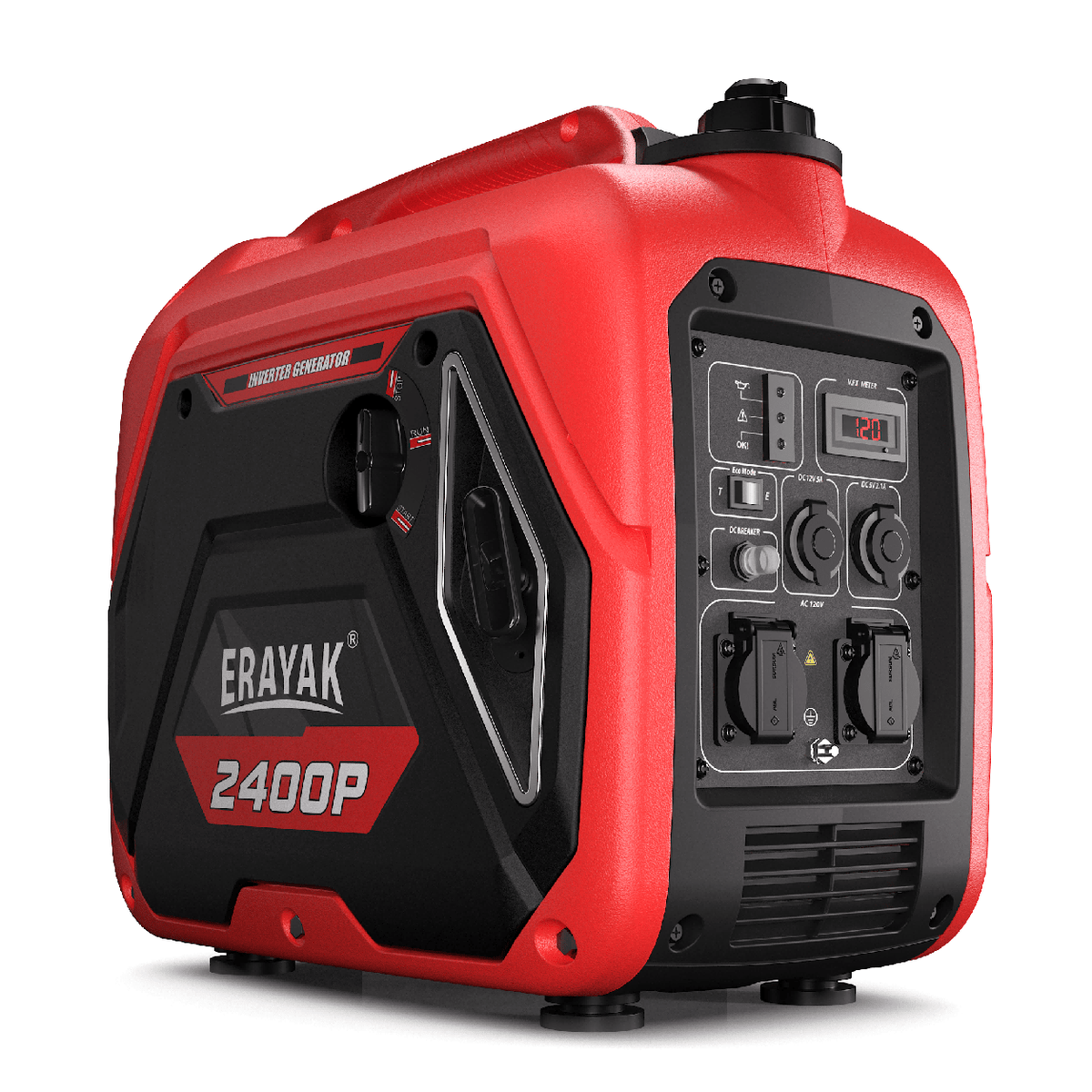
Best Lightweight Camping Pick: Erayak 2400P
The Erayak 2400P is best for lighter RV and campsite loads: charging batteries, running small electronics, lights, fans, laptops, and compact camping appliances. It is not the default choice for a standard rooftop RV AC, but it is a strong fit when portability is the priority.
See the 2400P for Light RV Camping
Best Larger RV and Backup Planning Path: Erayak 6800PD / 6800PT
The Erayak 6800PD and 6800PT series is the larger-capacity route when you need 6800W peak output, 5000W gasoline rated output, 120V/240V planning, and more fuel flexibility. Choose 6800PD for dual fuel and 6800PT for tri-fuel planning.
Compare 6800PD and 6800PT OptionsSafe RV Generator Setup
- Run the generator outdoors only. Never operate it inside an RV, garage, tent, storage bay, or enclosed space.
- Keep exhaust away from people and openings. Point exhaust away from doors, windows, vents, slide seals, and neighboring campsites.
- Use carbon monoxide alarms. RVs should have working CO alarms, especially when generator power is being used nearby.
- Use the right cord and adapter. Match the generator outlet, RV cord, adapter rating, and load. Do not overload dogbone adapters.
- Start large loads one at a time. Let the generator stabilize before adding an air conditioner, microwave, or battery charger.
- Protect the generator from rain safely. Use only well-ventilated covers or tents designed for generator use, and never block exhaust airflow.
- Follow the manual. Break-in, oil changes, fuel storage, grounding, and maintenance requirements can vary by model.
Carbon Monoxide Safety Notice
Fuel-powered generators must be operated outdoors with proper ventilation. Never run a generator indoors, inside an RV, in a garage, under the RV, or near open windows or doors. Carbon monoxide can build up quickly and can be deadly.
FAQ: Best RV Generators
What is the best RV generator for most campers?
For most 30 amp RV campers, a 4,000W to 4,500W inverter generator is the best balance of AC startup capacity, campsite noise, portability, and usable running power. The Erayak 4500PD is the primary Erayak fit for this use case.
What size generator do I need for a 30 amp RV?
A 30 amp RV can use up to 3,600W from 120V shore power, but generator sizing should also account for air conditioner starting surge. Many 30 amp RV owners are best served by a 4,000W to 4,500W inverter generator.
Can a 2,000W generator run an RV air conditioner?
Sometimes, but it is usually tight. A 2,000W generator may work for very small AC units or soft-start setups with minimal other loads, but it is not the comfortable default for most 13,500 or 15,000 BTU rooftop RV air conditioners.
What generator size is best for a 13,500 BTU RV AC?
A 13,500 BTU RV air conditioner often needs roughly 2,800W to 3,500W of starting surge, depending on the unit and conditions. A 4,000W to 4,500W inverter generator gives more comfortable headroom for startup and normal RV loads.
Are inverter generators better for RVs?
Yes, inverter generators are usually better for RV camping because they are quieter, more fuel-aware at partial loads, and better suited for sensitive electronics than many conventional open-frame generators.
Is a dual-fuel generator worth it for RV camping?
Yes for many RVers. A dual-fuel generator lets you run on gasoline or propane, which is useful because many RVs already carry propane and propane stores well between trips.
Can a portable generator fully replace a 50 amp RV pedestal?
Usually no. A 50 amp RV pedestal can provide much more total power than most portable generators. A larger portable generator can support selected loads, but you still need to manage appliances and understand outlet limits.
Can I run an RV generator in the rain?
Do not expose a portable generator directly to rain. If generator use is necessary in bad weather, use only a properly ventilated generator cover or tent designed for that purpose, and keep exhaust and cooling airflow clear.
