

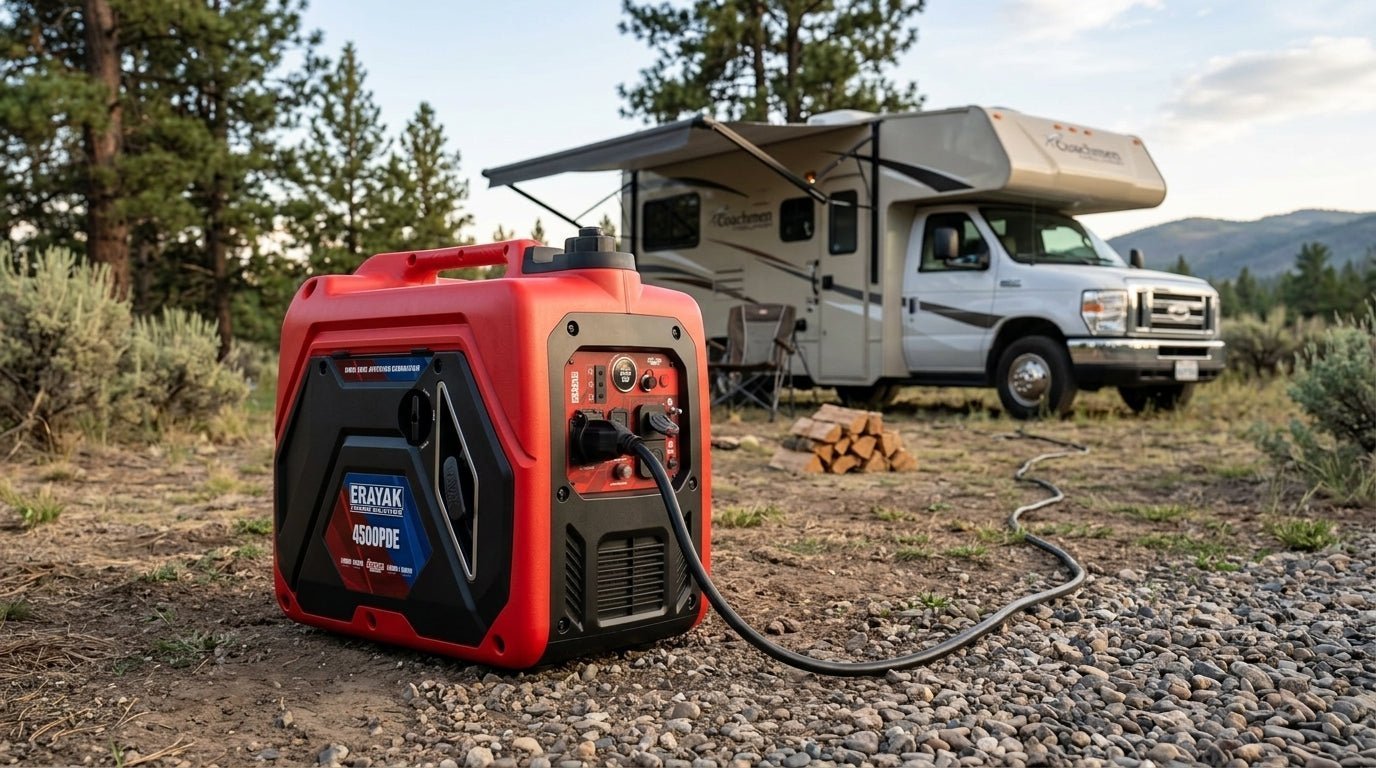
How Long to Charge an RV Battery With a Generator?
A partial RV battery recharge often takes about 2 to 5 hours on generator power. Reaching a true 100% charge can take much longer. Your actual time depends on converter output, battery chemistry, state of charge, battery-bank size, and the RV loads running while you charge.
Fast answer
- Yes, a generator can charge RV house batteries.
- Most RVs charge through the converter/charger, not directly from the generator.
- For battery charging only, a 2,000W to 2,400W inverter generator is often enough.
- Many partial recharges take 2 to 5 hours; full lead-acid charging can take longer.
- A bigger generator does not automatically charge batteries faster.
Quick Answer: How Long to Charge an RV Battery With a Generator?
For many RV owners, a practical generator charging session is about 2 to 5 hours to recover from a partial discharge. Reaching a true 100% charge can take longer, especially with lead-acid or AGM batteries, because charging slows during the absorption stage.
Once the generator can power the converter/charger, charging speed is usually limited by the charger output, battery chemistry, battery state of charge, and competing RV loads, not by buying the biggest generator available.
How Long to Charge an RV Battery With a Generator?

The most searched RV battery charging question is usually time: how long should the generator run? The honest answer is a range. A partial recharge may take only a few hours, while a full charge can take much longer because batteries accept current more slowly as they get closer to full.
| RV Battery Setup | Common Charger Output | Practical Generator Runtime | What It Means |
|---|---|---|---|
| Single 100Ah lead-acid or AGM battery | 30A to 45A converter | About 2 to 5 hours from partial discharge | Early charging is faster; the final stretch toward full is slower. |
| Two 100Ah lead-acid or AGM batteries | 45A to 55A converter | About 4 to 7 hours from 50% toward full | Many boondockers stop around 80% and let solar or shore power finish later. |
| 100Ah to 200Ah LiFePO4 battery bank | Lithium-compatible 40A to 60A charger | Often 2 to 5 hours, depending on capacity | Lithium can accept higher current for longer when the charger is matched correctly. |
| 300Ah+ lithium or upgraded battery bank | 60A+ converter or inverter/charger | Varies widely | The charger, battery management system, wiring, and battery limits become the speed limit. |
Partial charge is not the same as full charge. In one equipment-specific example, the Progressive Dynamics converter/charger FAQ reports that a 125Ah battery can reach about 90% in 2 to 3 hours with its Charge Wizard system, while a full charge takes about 15 hours. Your converter, battery bank, charging profile, temperature, wiring, and active RV loads can produce very different results.
Simple charging-time formula
Use this estimate: amp-hours to replace / actual charger amps = minimum charging hours. Then add extra time for charging losses, absorption charging, and any RV loads running at the same time.
Example: if you need to replace 100Ah and your converter can deliver about 40A to the battery bank, the math starts at 2.5 hours. In real camping conditions, lights, fans, furnace blowers, water pumps, and charging stages may stretch that runtime.
Does an RV Generator Charge House Batteries?
Yes, an RV generator can charge house batteries when the RV converter/charger receives generator power. The generator supplies 120V AC power through the shore power connection, and the converter/charger changes that power into battery-safe 12V DC charging current.
1. Generator supplies 120V AC
The portable generator powers the RV through the shore power cord, a 30A RV receptacle, or a properly rated adapter.
2. Converter handles charging
The RV converter or inverter/charger changes AC input into DC charging current matched to your battery system.
3. Batteries recover while 12V loads run
Lights, fans, water pumps, and control boards may keep running while the battery bank recharges.
Simple test: if your RV batteries charge when plugged into campground shore power, they should usually charge from a properly sized generator through the same converter/charger path. If shore power works but generator charging does not, the issue is often in the generator breaker, adapter, RV breaker panel, converter fuse, or battery disconnect position.
How to Charge RV Batteries With a Generator: Step by Step
- Place the generator outdoors. Keep it away from doors, windows, vents, slide-outs, and neighboring RVs. Point exhaust away from people and openings.
- Check oil, fuel, and airflow. Use a stable outdoor surface and follow the generator manual before starting.
- Turn off heavy RV loads. Switch off the air conditioner, microwave, electric water heater element, and space heaters before connecting.
- Start the generator with no load attached. Let the engine stabilize briefly before plugging in the RV.
- Connect the RV shore power cord. Use the correct 30A connection or a properly rated adapter for your generator outlet.
- Confirm the converter is charging. Check your battery monitor, RV control panel, or battery voltage. Charging voltage should be higher than resting voltage.
- Manage competing loads. Battery charging and appliances share generator capacity, so turn off nonessential high-draw loads for faster charging.
- Stop at the practical point. For boondocking, many RV owners recharge from about 50% to 80% because the final stage toward 100% can be slow.
Generator safety note: Never run a fuel-powered generator indoors, in a garage, in a storage bay, under the RV, under an awning with poor airflow, or near open windows. Operate portable generators outdoors with proper ventilation because carbon monoxide can be deadly and cannot be seen or smelled.
What Size Generator to Charge RV Batteries?

For charging RV batteries only, most owners do not need a large generator. Many RV converter/chargers draw roughly 600W to 1,000W during heavy charging, so a quiet 2,000W to 2,400W inverter generator is often enough. You need a larger generator when battery charging happens at the same time as air conditioning, a microwave, an electric water heater, or other high-draw loads.
| Charging Goal | Recommended Generator Class | Best Fit | Notes |
|---|---|---|---|
| Charge RV batteries only | 2,000W to 2,400W inverter generator | Boondocking, lights, fan, phones, laptops | Efficient and easier to carry. Use the correct adapter and keep large loads off. |
| Charge batteries plus small RV loads | 2,400W to 3,500W inverter generator | Converter plus TV, router, small kitchen loads | Watch total load and avoid stacking multiple heating appliances. |
| Charge batteries and run RV air conditioning | 3,500W to 4,500W inverter generator | 30A RV campers who want comfort loads | Air conditioners have high starting surge. A soft start can help, but sizing still matters. |
| RV charging plus broader outage backup | 4,500W to 6,800W+ inverter generator | RV plus refrigerator, freezer, sump pump, or selected home circuits | Choose based on total load, outlet needs, and whether 120V/240V output is required. |
If your main question is "what size generator to charge RV battery?", check your converter/charger amp rating first. A 30A converter is a different charging load than a 60A lithium-compatible charger or a large inverter/charger in an upgraded RV.
Fastest Way to Charge RV Batteries With a Generator
The fastest safe method is not automatically buying the biggest generator. The fastest method is using a converter or smart charger that your battery bank can safely accept, then reducing competing RV loads while the charger is working.
Use a modern smart charger
A multi-stage converter/charger manages bulk, absorption, and float charging better than many older single-stage converters.
Match the battery chemistry
Lead-acid, AGM, and LiFePO4 batteries need different charging profiles. Lithium batteries should use lithium-compatible charging equipment.
Turn off competing loads
Microwaves, electric heaters, and air conditioners can reduce the power available to the converter or overload a small generator.
About standalone battery chargers: A dedicated smart battery charger can be useful if your factory converter is weak or outdated, but it must be rated for your battery chemistry and connected safely. If you are unsure, have an RV technician review the setup.
How to Charge RV Batteries With a Honda Generator or Small Inverter Generator
The basic method is the same with a Honda generator, an Erayak inverter generator, or another properly sized small inverter generator: place the generator outdoors, start it with no load attached, plug in the RV shore cord with the correct adapter, and let the RV converter/charger recharge the batteries.
For a small inverter generator with standard household outlets, many RV owners use a properly rated 15A-to-30A RV adapter for battery charging and light loads. That setup is not the same as a full 30A RV pedestal, so do not expect to run every RV appliance at once.
When comparing small inverter generators for this job, focus on running watts, outlet type, noise level, weight, fuel flexibility, warranty, and whether the generator can handle the converter plus the loads you want to run while charging.
Why Are My RV Batteries Not Charging From the Generator?
If the generator runs but your RV batteries do not charge, the problem is usually somewhere between generator output and the RV converter/charger. Start with the simple checks before assuming the battery bank has failed.
| Symptom | Likely Cause | What to Check |
|---|---|---|
| Generator runs, but RV has no AC power | Tripped generator breaker, wrong adapter, loose cord, or outlet issue | Generator breaker, outlet, shore cord, adapter rating, and RV main breaker. |
| RV outlets work, but batteries do not charge | Converter breaker, converter fuse, battery disconnect, or converter failure | Converter breaker/fuse, battery disconnect switch, and charging voltage at the battery. |
| Charging starts but is very slow | Small converter, weak batteries, high RV loads, or absorption-stage charging | Converter amp rating, battery state of charge, battery age, and loads running at the same time. |
| Lithium batteries do not charge correctly | Non-lithium charging profile or battery management system limit | Charger compatibility, battery manual, low-temperature protection, and BMS status. |
Best Erayak Generator Matches for RV Battery Charging
For this search intent, the right Erayak match depends on whether you only need to recharge RV house batteries or you also want to run larger 30A RV loads while charging.
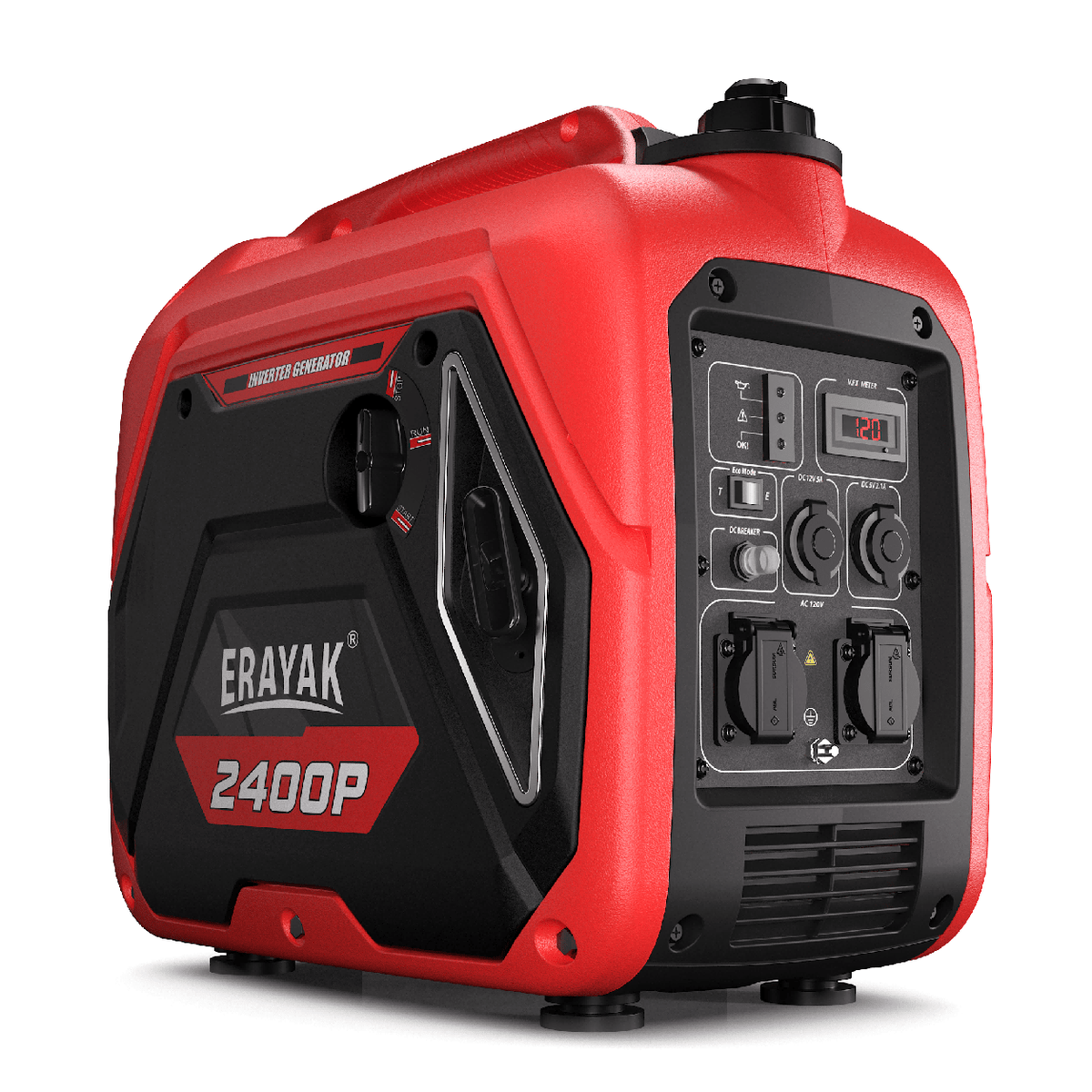
ERAYAK 2400P: Best Fit for Battery Charging and Light Boondocking Loads
The ERAYAK 2400P is the cleanest fit when your main job is charging RV house batteries, keeping small campsite essentials powered, and staying portable. It is a practical match for converter charging, lights, fans, phones, laptops, and lighter camping use.
- Best Erayak match for charging-focused boondocking routines.
- Useful when portability matters more than running large RV appliances.
- Clean inverter output supports sensitive RV electronics when used correctly.
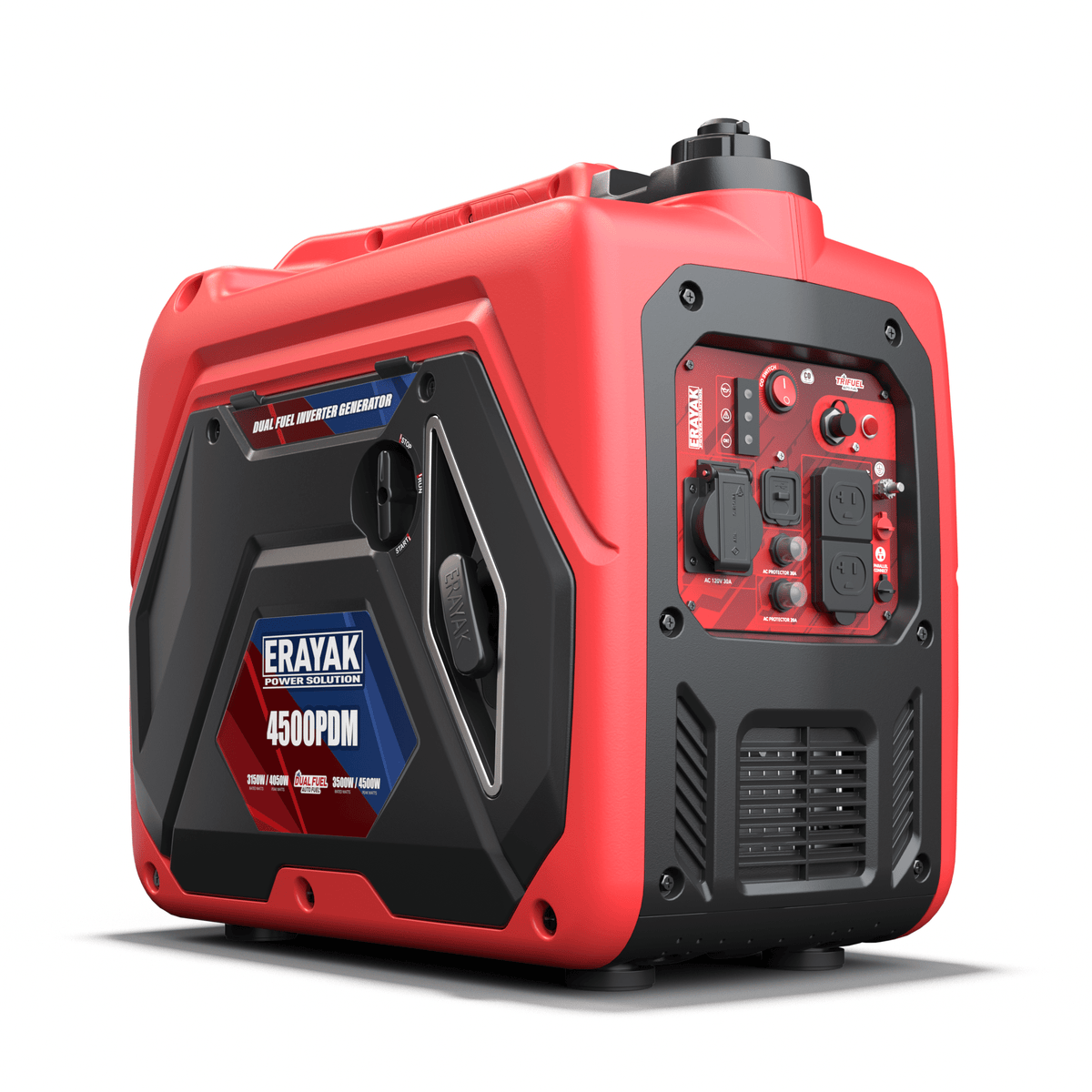
ERAYAK 4500PD: Better Fit for Charging Plus 30A RV Comfort Loads
The ERAYAK 4500PD is the stronger match when battery charging competes with larger RV loads. Its dual-fuel gasoline and propane flexibility makes sense for campers who want more headroom for RV comfort loads and storm-backup planning.
- Better fit when battery charging overlaps with RV air conditioning or other larger loads.
- Dual-fuel flexibility helps when propane storage is part of your camping or outage plan.
- Useful upgrade path for 30A RV owners who do not want to run a small generator near its limit.
Product-fit note: Do not oversize only for battery charging. Once the generator can power the converter, the converter and battery bank usually set charging speed. Choose more generator only when you also need RV AC, microwave use, or broader outage loads.
RV Battery Charging Mistakes to Avoid
Using the generator's small 12V outlet as the main charger
Many portable generators include a small DC outlet, but it is usually not the best way to recharge an RV house battery bank. It is often low-amperage and slower than letting your RV converter/charger work through the shore power cord.
Assuming a bigger generator always charges faster
Once the generator can supply the converter, the charger output and battery acceptance rate become the speed limit. A 4,500W generator will not make a 30A converter charge like a 60A converter.
Running too many appliances while charging
If your converter is charging hard and you also turn on the microwave, electric water heater, or air conditioner, you can overload a small generator or reduce the power available for charging.
Ignoring battery chemistry
Lead-acid, AGM, and LiFePO4 batteries do not all charge the same way. If your RV has been upgraded to lithium, make sure the converter or charger has a lithium-compatible charging profile.
Putting the generator too close to the RV
Never place a running generator indoors, in a garage, under an awning with poor airflow, under the RV, or near windows. Use working carbon monoxide detectors inside the RV, but do not treat them as permission to run the generator too close.
FAQ: Charging RV Batteries With a Generator
How long should I run my generator to charge RV batteries?
Many RV owners run the generator for about 2 to 5 hours to recover from a partial discharge. Reaching 100% can take longer, especially with lead-acid or AGM batteries, because charging slows during the absorption stage.
Does an RV generator charge house batteries automatically?
Usually yes, if the RV converter/charger is powered and working, the battery disconnect is in the correct position, and the breakers and fuses are not tripped. The generator supplies AC power, and the converter/charger handles battery charging.
What size generator do I need to charge an RV battery?
For battery charging only, a 2,000W to 2,400W inverter generator is often enough. If you want to charge while running an RV air conditioner, microwave, or other large loads, a 3,500W to 4,500W generator class gives more headroom.
Can I charge my RV battery with the generator's 12V outlet?
It may be possible on some generators, but it is usually slow and not the best main method for an RV house battery bank. In most RVs, the better method is plugging the RV shore cord into the generator and letting the RV converter/charger manage charging.
Why are my RV batteries not charging from the generator?
Common causes include a tripped generator breaker, wrong adapter, tripped RV breaker, converter fuse issue, battery disconnect switch being off, corroded battery connections, or a converter/charger problem. If shore power charges the batteries but generator power does not, start with the generator output and adapter path.
Can I run my RV generator while driving?
Some motorhomes with built-in generators are designed for operation while driving, but portable generators should not be run loose in or near an RV while traveling. Follow your RV and generator manuals for your exact equipment.
What is the best generator for charging RV batteries?
For charging only, a quiet 2,000W to 2,400W inverter generator is often the practical range. For charging plus larger 30A RV loads, a 3,500W to 4,500W inverter generator is a better fit. For Erayak, that points to 2400P for charging-focused use and 4500PD when you want more RV load headroom.
Choose an Erayak Inverter Generator for RV Battery Charging and Camping Loads
For light battery charging and boondocking essentials, compare the portable ERAYAK 2400P. For 30A RV use, propane flexibility, and more overhead while charging, compare the ERAYAK 4500PD dual-fuel inverter generator.


