

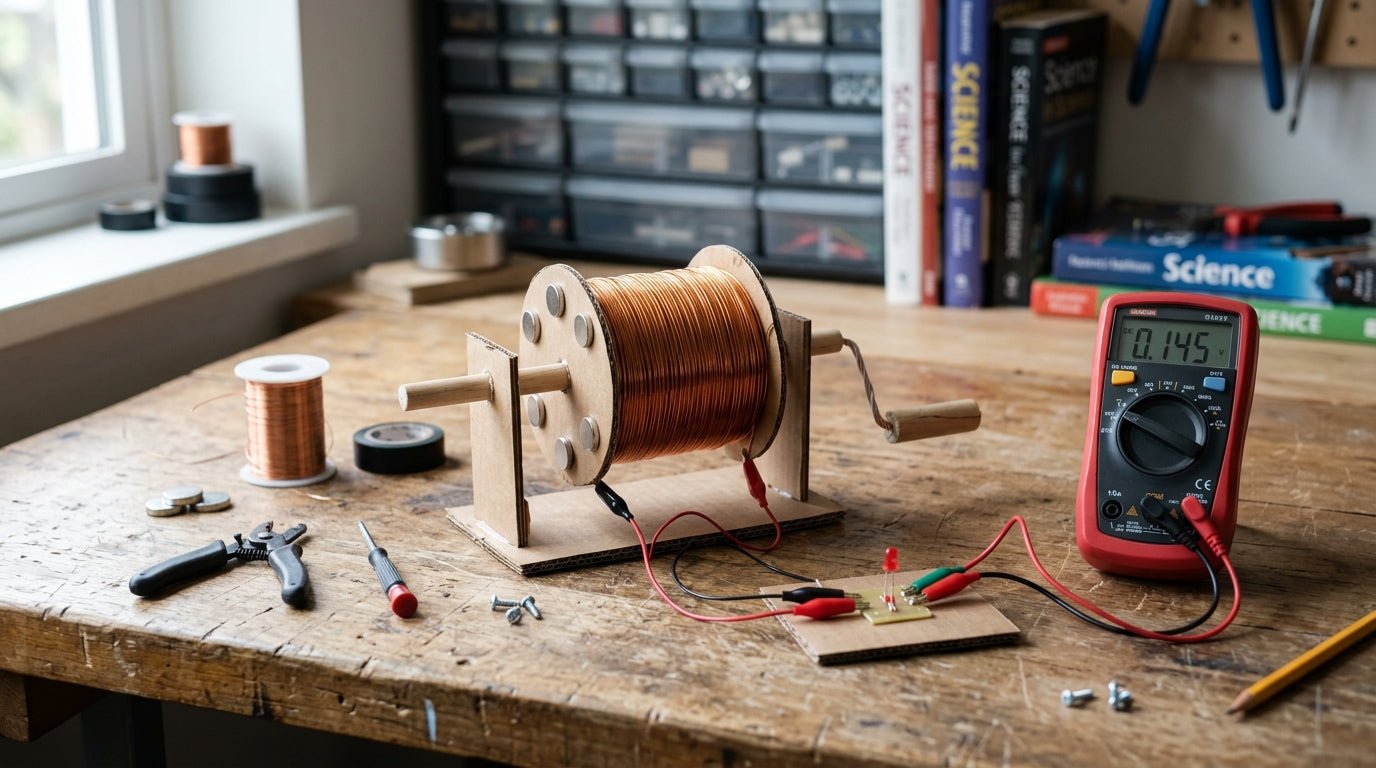
DIY Generator Project: Build a Simple Generator With Magnets and Copper Wire
This beginner-friendly project shows how electromagnetic induction works by using a magnet, copper wire, and an LED. It is a low-voltage learning activity, not a practical backup-power system for phones, appliances, RVs, or home outages.
- Teach Faraday's law and electromagnetic induction.
- Light a small LED or show voltage on a multimeter.
- Demonstrate how magnets, coils, and motion create electricity.
- It cannot safely power household loads or charge devices reliably.
Yes. You can build a simple generator by rotating a magnet near a coil of copper wire, or by moving a magnet through a coil. The changing magnetic field induces a small electrical current, which can light an LED briefly or register on a multimeter.
Keep the project low voltage and educational. Do not connect a homemade generator to wall outlets, lithium batteries, home wiring, appliances, or any circuit where shock, heat, backfeeding, or fire could occur.
How a Simple DIY Generator Works
A generator turns motion into electricity. In this project, your hand provides the motion. When a magnet moves near a coil of copper wire, the magnetic field through the coil changes. That changing magnetic field pushes electrons through the wire and creates a small current.
This is the same basic idea used in large generators, but the scale is very different. A tabletop magnet-and-coil project may create milliwatts: enough for an LED or meter reading, not enough for real-world backup power.
More motion, more coil turns, and stronger magnets can increase the voltage you see, but a small DIY generator still produces tiny amounts of usable power.
Materials and Tools
| Item | Purpose | Safety note |
|---|---|---|
| Magnet wire or insulated copper wire | Forms the coil where voltage is induced. | Use low-voltage project wire, not household wiring. |
| Strong small magnets | Create the magnetic field. | Keep strong magnets away from small children, cards, and electronics. |
| LED or small low-voltage bulb | Shows that current is being produced. | LED polarity matters; reverse the leads if it does not flash. |
| Cardboard, wood block, or plastic frame | Holds the coil and magnet in position. | Use stable, nonconductive material. |
| Multimeter | Measures voltage output. | Use the low-voltage AC setting when testing the coil output. |
| Tape, glue, scissors, or craft knife | Builds and secures the frame. | Adult supervision is recommended for cutting tools. |
This project is for low-voltage education only. Do not connect it to mains power, a wall outlet, a vehicle battery, lithium battery packs, extension cords, home wiring, inverters, or appliances.

Step-by-Step: Build a Simple Magnet and Coil Generator
Step 1: Build a Simple Frame
Use cardboard, a small wood block, or plastic to make a frame that holds the coil steady. Leave enough room for the magnet to move or rotate near the coil without scraping the wire.
Step 2: Wind the Copper Coil
Wrap insulated copper wire around the frame 100 to 300 times. More turns usually increase the voltage. Leave several inches of wire free at both ends so you can connect the LED or multimeter.
Step 3: Expose the Wire Ends
If you use magnet wire, gently sand or scrape the enamel coating from the last half inch of both wire ends. The circuit will not work if the insulation remains on the contact points.
Step 4: Position the Magnet
Place the magnet so it can move quickly near the coil. You can spin a magnet mounted on a small axle, move a magnet back and forth through the coil, or rotate a magnet near the coil opening.
Step 5: Connect the LED or Multimeter
Connect the coil ends to an LED or multimeter. If using an LED, it may flash only when the magnet moves quickly. If it does not light, reverse the LED leads or test with a multimeter first.
Step 6: Spin or Move the Magnet
Move the magnet as quickly and smoothly as possible. The faster the magnetic field changes, the stronger the effect you are likely to see.
Testing and Troubleshooting Your DIY Generator
| Problem | Likely cause | Fix |
|---|---|---|
| LED does not light | Low voltage, wrong LED polarity, or insulated wire ends. | Reverse LED leads, scrape wire ends, move the magnet faster, or use a multimeter. |
| Voltage is very low | Too few coil turns, weak magnet, or slow movement. | Add more turns, use a stronger magnet, and reduce the gap between magnet and coil. |
| Output is inconsistent | Loose connections or uneven magnet movement. | Tape connections securely and stabilize the frame. |
| Wire heats up | Short circuit or wrong test load. | Stop immediately and inspect the circuit. Do not connect to batteries or high-current loads. |
How to Improve the Output Safely
More turns of wire usually increase voltage, though resistance also increases.
A stronger magnetic field can increase the effect, but handle strong magnets carefully.
Faster magnet movement creates a faster-changing field and a stronger reading.
You can also compare coil shapes, magnet positions, and rotation speeds. Record each change and measure the voltage so the project becomes a real experiment, not just a one-time build.
DIY Generator vs Real Portable Generator
A DIY magnet-and-coil generator is excellent for learning, but it is not a substitute for a safe, engineered portable generator. If you need power for camping, an RV, a refrigerator, tools, or emergency backup, choose a properly rated generator or power station instead of scaling up a homemade build.

When You Need Real Power: Start With a Small Inverter Generator
If your goal is real-world portable power instead of a science project, the ERAYAK 2400P is a better fit for light camping, charging, small backup loads, and portable power planning. For larger RV or home-essential loads, compare the 4500P and 4500PD classes.
Real fuel-powered portable generators produce carbon monoxide. Never run one indoors, in a garage, in a shed, in a tent, near open windows, or in any enclosed or partly enclosed space. Use it outdoors only, far from doors, windows, and vents, with working CO alarms nearby.
A DIY Generator Is a Great Lesson, Not a Backup Power Plan
Build this project to understand electromagnetic induction and see electricity appear from motion. Use a real, properly rated inverter generator when you need dependable power for camping, RVs, tools, refrigerators, or emergencies.
