

RV Generator Wattage Requirements: How Much Power Do You Really Need?
Most RV owners do not need to power every appliance at the same time. The right generator size depends on your biggest starting load, your realistic running load, and whether your RV is a small camper, 30 amp travel trailer, fifth wheel, or larger motorhome.
- Light RV loads: 2,000W to 2,400W class
- 30 amp RV with one AC: usually 3,500W to 4,500W class
- Two ACs or large fifth wheel: larger managed-load plan
- Always check your appliance labels and RV manual
Quick Answer: How Many Watts Does an RV Use?
A small camper may only need 1,500 to 2,400 watts for lights, charging, fans, a small refrigerator, and light appliance use. A 30 amp RV with one rooftop air conditioner usually needs a 3,500W to 4,500W inverter generator for practical load management. Larger fifth wheels, motorhomes, two-AC setups, or home-backup crossover needs may require 5,500W to 8,000W or more depending on what runs at the same time.
The useful formula: add the running watts of everything you want on at the same time, then add the largest extra starting surge from one motor-driven appliance such as the RV air conditioner, refrigerator compressor, or pump. Do not size only by total peak watts printed on a generator box.

Starting Watts vs Running Watts: The Number That Trips People Up
Running watts are the watts an appliance needs after it is already operating. Starting watts are the temporary surge needed to start a motor or compressor. RV air conditioners, refrigerators, pumps, and some power tools can briefly pull much more power at startup than they use once running.
Continuous load the generator must support without overload.
Short surge required by motors and compressors during startup.
Running heavy appliances one at a time instead of all together.
For example, a 13,500 BTU RV air conditioner may run around 1,300 to 1,600 watts but can need roughly 2,600 to 3,000 watts or more to start. A 15,000 BTU unit often runs closer to 1,500 to 1,800 watts and may need around 3,000 to 3,500 starting watts depending on the unit and conditions.
RV Appliance Wattage Chart
Use this chart as a planning estimate, not a replacement for the nameplate on your actual appliance. RV appliance wattage changes by brand, age, efficiency, voltage, altitude, heat, and whether the device has a compressor or heating element.
| RV appliance or load | Typical running watts | Possible starting watts | Generator sizing note |
|---|---|---|---|
| 13,500 BTU rooftop RV AC | About 1,300W to 1,600W | About 2,600W to 3,000W+ | Often the biggest startup load in a 30 amp RV |
| 15,000 BTU rooftop RV AC | About 1,500W to 1,800W | About 3,000W to 3,500W+ | Usually needs more generator margin than a 13,500 BTU unit |
| Microwave | About 900W to 1,500W | Usually little surge compared with AC | Avoid running it during AC compressor startup |
| Coffee maker or electric kettle | About 900W to 1,500W | Minimal surge | Short but heavy heating load |
| RV refrigerator controls or compressor | About 150W to 600W depending on type | May briefly surge higher | Absorption refrigerators and residential-style fridges behave differently |
| Converter / battery charger | About 300W to 1,000W depending on charger output | Usually not the largest surge | Can quietly consume more generator capacity than expected |
| Electric water heater element | About 1,200W to 1,500W | Minimal surge | Turn it off when starting AC or using microwave |
| Hair dryer or space heater | About 1,200W to 1,800W | Minimal surge | High draw; run separately from AC and microwave |
| TV, router, laptops, phones, LED lights | About 20W to 300W combined in many setups | Low | Usually easy loads compared with heating and cooling |
| Water pump | About 50W to 150W | May briefly surge | Small but intermittent motor load |
Recommended Generator Wattage by RV Type
RV type is a starting point, not the final answer. A small travel trailer with a large AC may need more power than expected, while a larger RV with careful load management may not need to run everything at once.
| RV type | Practical generator range | Usually supports | Best fit |
|---|---|---|---|
| Pop-up camper or very small trailer | 2,000W to 2,400W | Charging, lights, fans, small refrigerator, light appliances | ERAYAK 2400P for light camping loads |
| Small camper with limited AC use | 2,400W to 3,500W depending on AC and soft start | Basic loads plus carefully managed cooling in favorable conditions | Check the exact AC starting requirement before choosing small |
| 30 amp travel trailer with one rooftop AC | 3,500W to 4,500W | One AC plus selected lights, converter, fridge controls, TV, and small loads | ERAYAK 4500P gas-only or ERAYAK 4500PD dual fuel |
| Fifth wheel or motorhome with heavier loads | 4,500W to 7,000W+ depending on AC count | More appliances, larger converter loads, possible two-AC planning | Consider 6800PD/PT if RV use overlaps with home backup planning |
| Large 50 amp RV with two ACs | 5,500W to 8,000W+ managed-load planning | Selected heavy loads, not necessarily full 50 amp shore-power replacement | Plan around what you will actually run together |
30 Amp vs 50 Amp RV Wattage Limits
A 30 amp RV connection is 120V x 30A, or 3,600 watts maximum through the RV service. That does not mean every 3,600W generator will start every RV air conditioner easily, because startup surge and generator rating matter. It also does not mean a 6,000W generator gives a 30 amp RV unlimited power through a 30 amp inlet.
A 50 amp RV is different because it uses two 120V legs and can theoretically draw much more power from a full shore-power pedestal. A portable generator may still be useful for a 50 amp RV, but it should be treated as a managed-load power source unless you have a properly planned high-capacity setup.
Important: generator wattage, RV inlet rating, adapter limits, breaker size, altitude, fuel type, and appliance surge all matter. When in doubt, ask a qualified RV technician or electrician before building a high-load setup.
Load Planning Examples: How Much Generator Do You Really Need?
The smartest way to size a generator is to decide what can run together and what should run separately. Here are realistic examples for common RV situations.
| Scenario | Loads running together | Generator direction | Load-management tip |
|---|---|---|---|
| Light boondocking | Battery charging, lights, phones, laptop, fan | 2,000W to 2,400W class | Use small appliances one at a time |
| 30 amp RV with one AC | AC, converter, refrigerator controls, lights, TV | 3,500W to 4,500W class | Let AC start before adding microwave or coffee maker |
| AC plus microwave | AC running plus 1,000W to 1,500W microwave | 4,500W class with careful timing, or larger | Avoid microwave during AC compressor startup |
| Hot-weather camping | AC cycling often, converter, refrigerator, fans | More margin than the minimum AC number | Heat and altitude can make small generators struggle |
| Two-AC RV | Two rooftop ACs plus selected essentials | 5,500W to 8,000W+ managed-load plan | Soft starts can help, but they do not create unlimited running watts |
For a tighter AC-focused guide, see ERAYAK's RV AC generator size guide. For a broader camper-size answer, see what size generator for a camper.
Do Soft Starts Change RV Generator Wattage Requirements?
A soft start can reduce the startup surge of an RV air conditioner, which may help a smaller generator start the compressor more reliably. It does not reduce every other appliance load, and it does not change the running watts your AC needs once it is operating.
Soft starts are useful when the AC startup surge is the bottleneck. They are not a substitute for proper generator sizing, safe wiring, or realistic load management.
ERAYAK Product Match by RV Wattage Need
Use the product path that matches your actual load profile. A smaller generator is easier to move and quieter under light loads; a larger generator gives more headroom for AC and RV comfort loads.

ERAYAK 2400P: light RV power and small camper loads
The ERAYAK 2400P is a good fit for small trailers, light boondocking, battery charging, refrigerator-only support, fans, laptops, lights, and basic campsite loads. Do not treat it as the default answer for every rooftop RV AC setup.

ERAYAK 4500P: gas-only 4,500W class for 30 amp RVs
The ERAYAK 4500P is the gas-only fit when you want a 4,500W class inverter generator for a 30 amp RV, one AC in many managed-load setups, and normal campsite comfort loads. It is not dual fuel and should not be described as propane-capable.
 ERAYAK 4500PD: dual-fuel flexibility for RV AC and backup use
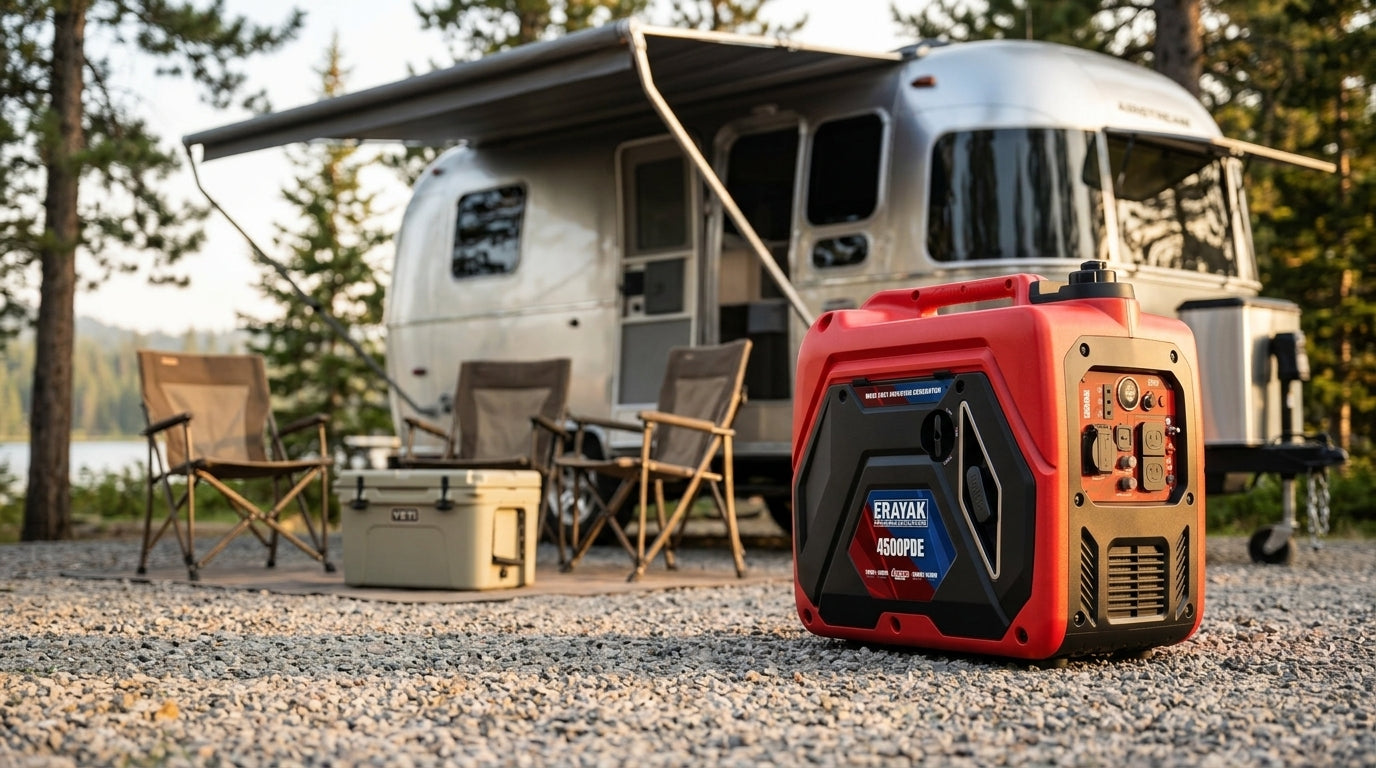
The ERAYAK 4500PD is the stronger fit if you want 4,500W class RV generator capacity plus gasoline and propane flexibility. It is a natural route for 30 amp RV comfort loads, storm preparedness, and camping users who value fuel choice.

ERAYAK 6800PD / 6800PT: larger RV and home-backup planning
If your wattage requirement includes larger RV loads, selected circuits, 120V/240V planning, sump pump, well pump, or home-backup crossover use, consider the ERAYAK 6800PD / 6800PT series. The 6800PD is dual fuel, while the 6800PT is tri-fuel.
RV Generator Safety Notice
Never run a fuel-powered generator inside an RV, tent, garage, truck bed with a covered shell, enclosed storage bay, or near open windows, doors, vents, or slide-outs. Operate it outdoors with proper ventilation, follow the owner's manual, use working carbon monoxide alarms, and keep exhaust pointed away from people and living spaces.
FAQ: RV Generator Wattage Requirements
How many watts does an RV use?
A small RV may use under 2,000 watts for light loads, while a 30 amp RV with one rooftop AC often needs a 3,500W to 4,500W generator for practical use. Larger RVs, fifth wheels, and two-AC setups can need 5,500W to 8,000W or more depending on what runs together.
How many watts do you need to run a camper?
For basic camper loads, 2,000W to 2,400W may be enough. If the camper has a rooftop air conditioner, microwave, electric water heater, or large converter load, a 3,500W to 4,500W inverter generator is often more realistic.
What size generator do I need for a 30 amp RV?
Most 30 amp RV owners should look at the 3,500W to 4,500W class if they want to run one rooftop AC plus selected normal RV loads. A 30 amp RV service is 120V x 30A, or 3,600 watts maximum through the RV connection.
How many watts does an RV air conditioner use?
A 13,500 BTU RV AC often runs around 1,300W to 1,600W and may start around 2,600W to 3,000W or more. A 15,000 BTU RV AC often runs around 1,500W to 1,800W and may need about 3,000W to 3,500W or more to start.
Can a 2,000 watt generator run an RV?
Yes, for light RV loads such as charging, lights, fans, laptops, and some small appliances. It is usually not the best default choice for a standard rooftop RV AC unless your setup has a soft start, favorable conditions, and very careful load management.
Should I size by starting watts or running watts?
Use both. Running watts tell you what the generator can support continuously. Starting watts tell you whether it can handle short motor and compressor surge. For RVs, the AC startup surge is often the deciding factor.
Match your generator to the appliances you actually run together
Start with your RV appliance wattage chart, identify the largest startup load, then choose the ERAYAK inverter generator that gives enough running power and surge margin for your real camping style.


