

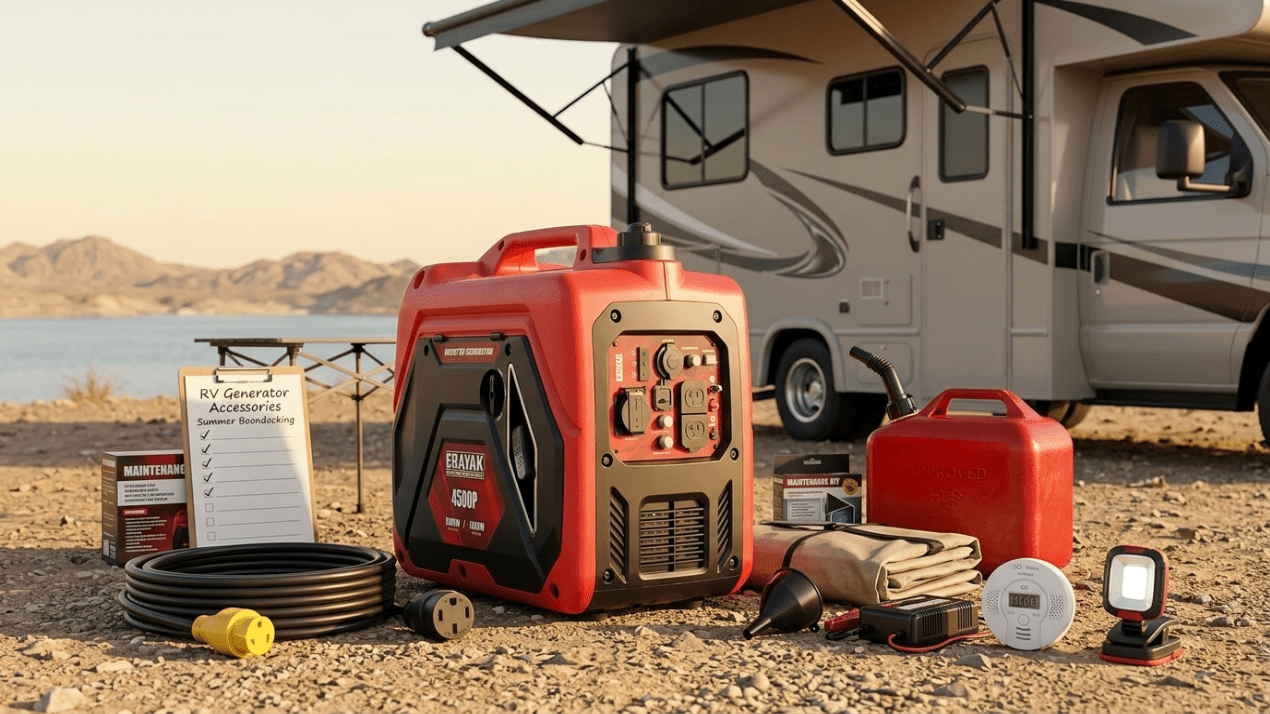
How to Connect a Generator to an RV: 30A, 50A, Cords & Grounding
To connect an RV to a generator safely, match the RV plug to the generator outlet, use an RV-rated cord or adapter, add an EMS surge protector when possible, manage heavy loads, and follow the generator manual for grounding or neutral-bonding instructions.
Quick Answer: How Do You Hook Up a Generator to an RV?
Turn off major RV loads, place the generator outdoors in a ventilated location, start the generator with nothing plugged in, connect an RV-rated power cord or the correct adapter, plug in an EMS surge protector if you use one, then connect the RV and add loads one at a time. A 30 amp RV usually uses a TT-30 style connection, while a 50 amp RV may need a generator and adapter that match its 120/240V service. Never assume an adapter increases available power.

RV Generator Hookup Checklist
1. Confirm Your RV Plug
Look at the RV shore power cord before choosing a generator adapter. Common RV setups include a 15/20 amp plug for light loads, a 30 amp TT-30 plug for many travel trailers, or a 50 amp plug for larger RVs.
2. Confirm the Generator Outlet
Do not judge by wattage alone. Check the generator outlet type, voltage, breaker rating, and manual. A 30 amp locking outlet, a TT-30 style RV outlet, and a 120/240V outlet are not interchangeable without the correct adapter and load plan.
3. Control Heavy Loads
Turn off the air conditioner, electric water heater, microwave, space heater, and converter-heavy charging loads before plugging in. After the RV is connected, add appliances one at a time.
15A, 30A, and 50A RV Connection Types
The safest RV generator hookup starts with matching the electrical system. The plug shape is only part of the story; you also need the correct voltage, amperage, cord rating, and breaker protection.
| RV connection | Typical use | What it can usually support | Key caution |
|---|---|---|---|
| 15/20 amp household-style plug | Small campers, battery charging, very light loads | Battery charging, lights, small electronics, selected low-watt appliances | Do not expect it to run an RV air conditioner or multiple heavy appliances. |
| 30 amp RV plug, commonly TT-30 | Many travel trailers and smaller motorhomes | One managed RV air conditioner plus selected essentials when generator capacity supports startup surge | 30A RV service is 120V. Do not confuse it with a 240V dryer-style or home generator receptacle. |
| 50 amp RV plug | Larger fifth wheels and motorhomes | More total RV capacity when connected to true 50A shore power | A portable generator adapter may power only part of the RV capacity. A 50A RV does not become fully powered from a small generator. |
If your RV is 30 amp, the main question is usually simple: does your generator provide the correct 120V outlet and enough wattage for your planned loads? If your RV is 50 amp, the connection question is more sensitive because many portable generators cannot supply full 50 amp RV service.
Step-by-Step: Connect an RV to a Generator
- Park and ventilate the generator. Place it outdoors on stable, dry ground with exhaust aimed away from the RV, tents, windows, doors, and neighboring campsites.
- Turn off major RV loads. Switch off the air conditioner, microwave, electric water heater, space heater, and other high-draw appliances.
- Inspect the cord and adapter. Use an RV-rated cord in good condition. Do not use damaged plugs, cracked insulation, loose blades, or undersized household extension cords.
- Start the generator unloaded. Let it warm up and stabilize before plugging in the RV.
- Connect the EMS surge protector if used. Many RV owners connect the EMS between the generator and RV cord to check voltage and wiring conditions.
- Plug in the RV cord or correct adapter. Make sure the connection is fully seated and not resting in water or loose dirt.
- Add loads one at a time. Start with light loads, then add the RV air conditioner or microwave only if the generator has enough running and starting watt capacity.
- Monitor voltage, breaker trips, and cord heat. If plugs become warm, voltage drops heavily, or breakers trip, reduce the load and inspect the setup.
Choosing the Right RV Generator Cord
Use a cord designed for RV power, outdoor use, and the amperage of the connection. The longer and thinner the cord, the more voltage drop and heat risk you can create under load.
| Cord decision | Best practice | Why it matters |
|---|---|---|
| Cord length | Use the shortest practical RV-rated cord. | Long cords can increase voltage drop, especially when starting an AC compressor. |
| Cord rating | Match the cord to the RV service and generator outlet. | An undersized cord can overheat before the generator breaker trips. |
| Outdoor protection | Use outdoor-rated cords and keep connections dry. | Wet plugs and adapters increase shock and fault risk. |
| Condition | Replace cracked, burned, loose, or damaged cords. | Heat marks and loose connections are warning signs, not cosmetic issues. |
A heavy-duty cord does not increase generator capacity. It only helps deliver available power more safely. If the generator is too small for the RV air conditioner, a larger cord will not solve the sizing problem.
Using RV Generator Adapters Safely
Adapters are useful when your RV plug and generator outlet do not match, but they do not create extra amperage. A 30 amp RV plugged into a 15 amp outlet is still limited by the 15 amp source. A 50 amp RV connected through a smaller generator adapter is still limited by the generator and adapter path.
Common RV generator adapter situations
- 15A/20A to 30A RV adapter: useful for battery charging and light loads, not for normal full RV operation.
- Generator locking outlet to TT-30 RV adapter: common when the generator has a 120V 30A locking outlet instead of a TT-30 RV receptacle.
- 30A generator to 50A RV adapter: may allow a large RV to receive limited 120V power, but it does not provide full 50A RV capacity.
- 120/240V generator outlets: require extra care. Do not force a 240V-style outlet into an RV connection without the correct adapter and understanding of how the RV is wired.
Generator Grounding vs Neutral Bonding for RVs
Grounding and bonding are often used as if they mean the same thing, but they are different. Grounding usually refers to connecting equipment to earth or a grounding system. Bonding refers to connecting conductive parts together, including the neutral-to-ground bond in the correct location.
| Question | Short answer | What to do |
|---|---|---|
| Do I always need a ground rod for an RV generator? | No. Many portable generator-to-RV setups do not require a separate ground rod. | Follow the generator manual. Do not add a ground rod as a guess. |
| Why does my RV EMS show “open ground”? | Many inverter generators have a floating neutral, and some EMS units expect a neutral-ground bond. | Check the generator manual and EMS instructions. A proper neutral-bonding plug may be used only when appropriate for that generator setup. |
| Can I make my own grounding or bonding adapter? | Not recommended unless you are qualified. | Use manufacturer guidance, listed equipment, or a qualified electrician. Incorrect bonding can create shock hazards. |
| Is RV hookup the same as home backup hookup? | No. | Home transfer switch systems have different bonding and grounding requirements. Do not use RV generator advice for home backfeeding. |
For a simple RV connection, the RV is normally bonded to the generator through the equipment grounding conductor in the RV power cord. The confusing part is whether the generator itself has a bonded neutral or floating neutral, and whether your EMS/surge protector will accept that configuration.
EMS Surge Protection and Open-Ground Warnings
An RV EMS surge protector can help detect low voltage, high voltage, reversed polarity, open ground, and other wiring problems before they reach sensitive RV electronics. It is especially useful when you move between campground pedestals and generator power.
How to use an EMS with a generator
- Plug the EMS into the generator or adapter before connecting the RV, if your setup allows it.
- Wait for the EMS to complete its startup check.
- Read any error codes instead of bypassing the device immediately.
- If the EMS reports open ground on a floating-neutral inverter generator, check the generator and EMS manuals before using any neutral-bonding solution.
If the EMS disconnects under load, the cause may be low voltage, overload, poor adapter contact, a failing cord, or a generator that is too small for the RV load.
Weather and Cord Safety at the Campsite
Generator connections often fail because of the environment, not the generator. Rain, puddles, mud, foot traffic, and loose adapters can all make a technically correct setup unsafe.
Keep Plugs Dry
Use weather-resistant covers where appropriate, keep connections off wet ground, and avoid placing adapters where water can collect.
Prevent Trip Hazards
Route cords away from walkways, steps, tires, leveling blocks, and sharp edges. Do not pinch cords under the RV or campground gear.
Protect Generator Airflow
Use only manufacturer-approved rain covers that allow proper cooling and exhaust flow. Never enclose a running generator in a sealed box or RV compartment.
Choosing an Erayak Generator for RV Connection
The right RV generator is not only about the plug. Match the generator to your RV service, expected loads, fuel preference, and whether you need light camping power or a larger RV/home backup path.

Best fit for dual-fuel RV flexibility: ERAYAK 4500PD
The ERAYAK 4500PD is the best product route for RV owners who want an inverter generator for camping comfort loads and the flexibility of gasoline or propane. It is a natural match when the article reader is comparing cords, adapters, and real RV hookup needs rather than only charging small electronics.
- Good fit for RV camping users who want dual-fuel flexibility.
- Useful for managed RV comfort loads when total wattage and startup surge are planned correctly.
- Better product match than a small generator when the RV has air conditioning or multiple essential loads.

Gas-only RV and camping option: ERAYAK 4500P
If you want a gas-only inverter generator for RV and camping use, the ERAYAK 4500P is the simpler route. It should not be described as dual fuel, propane, electric start, or remote start.

Upgrade path for larger RV and home backup planning: ERAYAK 6800PD/PT Series
For users who are thinking beyond basic RV hookup and also want larger backup capability, selected circuits, or 120V/240V planning, the ERAYAK 6800PD/PT Series is the higher-capacity path. Confirm outlet, adapter, and load requirements before using it for RV connection.
FAQ: RV Generator Hookup, Adapters, and Grounding
Can I plug my 30 amp RV directly into a generator?
Yes, if the generator has the correct 120V RV-compatible outlet or the right adapter, and enough wattage for the RV loads you plan to run. Always confirm the outlet type, breaker rating, voltage, and generator manual before connecting.
Can I run a 50 amp RV from a portable generator?
Sometimes, but usually with limited capacity. Many portable generator setups can supply a 50 amp RV through an adapter for selected 120V loads, but that does not mean the RV has full 50 amp campground-style service. Manage loads carefully.
Does an RV generator adapter increase available power?
No. An adapter only changes the plug interface. It does not increase the amperage or wattage available from the generator outlet. The smallest-rated part of the setup still limits the load.
Do I need to ground my generator when powering an RV?
Not always. Many portable generator-to-RV setups do not require a separate ground rod, but the correct answer depends on the generator design, manual, bonding configuration, and local requirements. Follow the manufacturer instructions and ask a qualified electrician if unsure.
Why does my RV surge protector say open ground on generator power?
Some inverter generators have a floating neutral, and certain RV EMS surge protectors interpret that as an open-ground condition. Do not bypass the warning blindly. Check the EMS manual and generator manual to see whether a proper neutral-bonding plug or other approved solution is appropriate.
Can a 15 amp generator outlet run my RV air conditioner?
Usually no. A 15 amp outlet may support battery charging and light loads, but most RV air conditioners require more running wattage and startup surge than a 15 amp source can safely provide.
Should I turn off RV appliances before connecting the generator?
Yes. Turn off major loads before plugging in, then add them one at a time after the generator is running and stable. This reduces startup surge, nuisance breaker trips, and voltage sag.
Connect the RV first with safety, then size the generator around real loads.
A safe RV generator setup depends on the right cord, adapter, load plan, and grounding or bonding configuration. If your RV setup includes air conditioning, dual-fuel planning, or larger backup loads, compare Erayak inverter generators before buying adapters around the wrong power source.


