

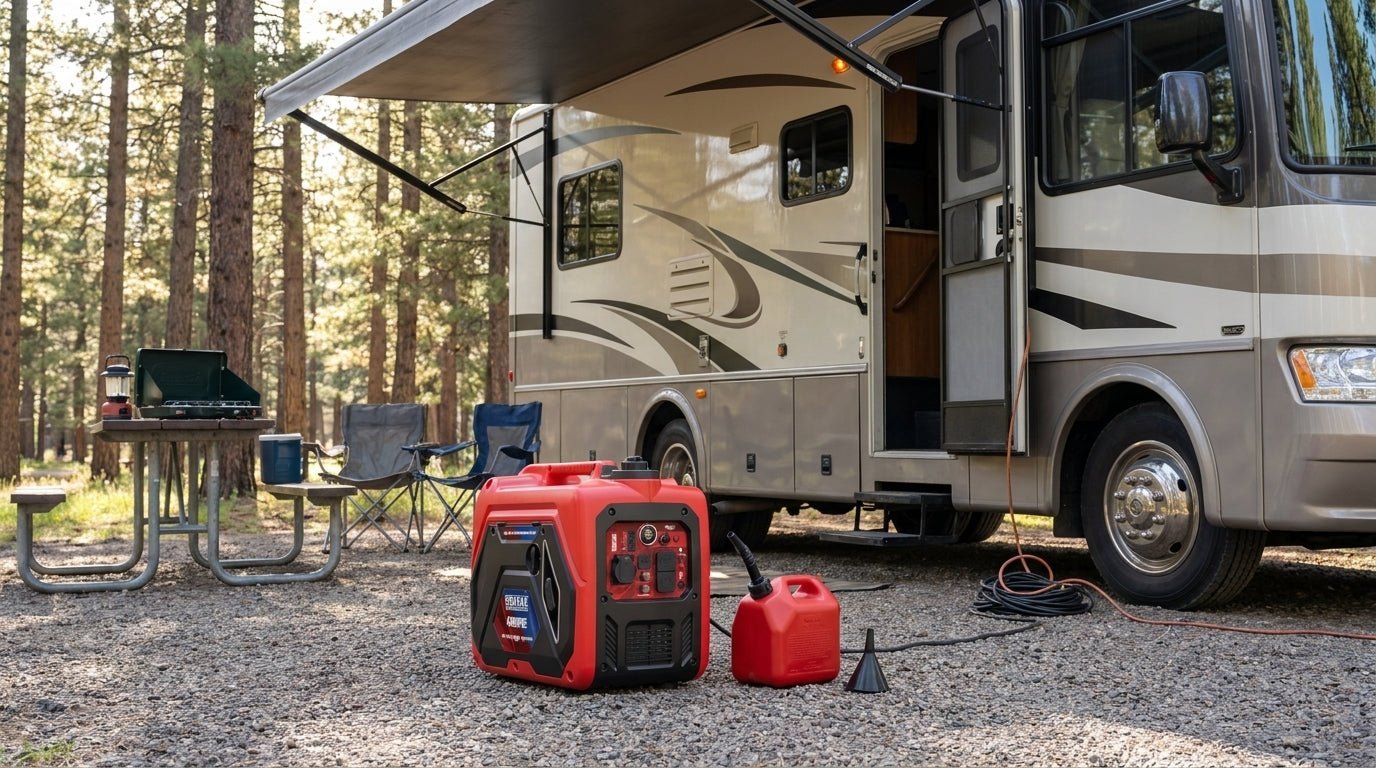
How Long Does a Generator Run on a Tank of Gas? Runtime Chart
Most portable generators run about 6 to 14 hours on a full tank of gas. The actual time depends on tank size, load percentage, generator efficiency, ECO mode, and the appliances you run. Use the charts below to plan a full tank, 1 gallon, 5 gallons, and overnight operation.
A portable generator commonly runs 6 to 14 hours on a full tank of gas. A small inverter may run roughly 6 to 11 hours per gallon at light load, while moderate or heavy loads shorten that time. Always compare the manufacturer's runtime at the same load percentage; a 25% load result is not equivalent to a 50% load result.
Typical full tank
A common planning range across portable models; exact tank sizes and test loads vary.
About 6-11 hours
A light-load estimate for a small inverter generator, not a guarantee for every model.
About 12-24 hours
A moderate-load planning range; careful light-load rotation may extend it beyond a day.
Runtime matters because it determines whether a generator can cover an overnight outage, keep refrigeration cycling, or power an RV setup without constant refueling. Tank capacity alone does not answer the question: the same generator burns fuel much faster when an air conditioner, heater, pump, or several appliances run together.
This article focuses on portable generators and inverter generators because most readers are comparing RV, camping, and outage backup options. Inverter generators can be especially useful for light and variable loads because ECO mode can reduce engine speed when demand is lower. For a broader overview of inverter technology, start with the ERAYAK Inverter Generator Guide.
How Long Does a Generator Run on a Tank of Gas? Runtime Chart

Generator runtime is usually listed at either 25% load or 50% load. That detail matters. A generator powering a few lights, a router, and a refrigerator will use far less fuel than the same generator running an air conditioner near its limit.
| Fuel Amount | Light Load Estimate | Moderate Load Estimate | Best Planning Use |
|---|---|---|---|
| 1 gallon of gas | About 6-11 hours | About 3-7 hours | Small inverter generator, refrigerator cycling, lights, router, fan, device charging |
| 2 gallons of gas | About 10-18 hours | About 5-10 hours | Overnight essentials, RV lights, refrigerator, modem, fans, occasional appliance use |
| 5 gallons of gas | About 24+ hours with careful load rotation | About 12-24 hours | Storm prep, refrigerator and freezer rotation, RV camping, selected home essentials |
| Full built-in tank | Often 6-14 hours depending on tank size | Often 3-8 hours under heavier loads | Use the model's 25% or 50% load rating, then adjust for your real appliances |
The ranges above are not manufacturer specifications for every generator. For a purchase or emergency fuel plan, use the exact model's tank capacity and published runtime at the load closest to your appliance plan.
| Load Level | What It Means | Typical Runtime Pattern | Real-World Example |
|---|---|---|---|
| 25% load | Light output compared with rated capacity | Longest runtime, often the number used in marketing specs | Phone charging, lights, router, fans, small refrigerator cycling |
| 50% load | Moderate output for common camping or outage loads | Balanced runtime and useful power | Refrigerator, lights, modem, TV, coffee maker used briefly |
| 75% load | High continuous demand | Runtime drops noticeably | RV AC plus several other appliances |
| 100% load | Near rated running output | Shortest runtime and more fuel burn | Heavy appliances running together with little headroom |
Common range per tank
Most portable inverter generators fall in this range depending on tank size and load.
Best runtime condition
Light load and ECO mode produce the longest runtime estimates.
Better planning number
For real outages and RV use, 50% load is often a more honest planning point.
How Long Will a Gallon of Gas Last in a Generator?
There is no single gallon-to-hour answer because engine size, generator efficiency, ECO mode, and wattage demand all change fuel burn. Use the exact model's fuel-consumption figure when available:
Runtime in hours = usable fuel in gallons / fuel consumption in gallons per hour at the expected load. For example, 5 gallons divided by 0.4 gallon per hour gives about 12.5 hours. Do not use a 25% load fuel-burn figure if your real load will be closer to 50%.
| Generator Size | Light Load Estimate | Moderate Load Estimate | Planning Note |
|---|---|---|---|
| 2000W-2400W inverter | About 8-11 hours per gallon | About 4-7 hours per gallon | Best for essentials, CPAP, small fridge, electronics, and light camping loads. |
| 3000W-4500W inverter | About 5-9 hours per gallon | About 3-6 hours per gallon | Better fit for RV AC, portable AC, and mixed home essentials. |
| 5000W+ inverter | About 3-7 hours per gallon | About 2-5 hours per gallon | More useful capacity, but heavy backup loads consume fuel faster. |
How long does a generator run on a full tank of gas?
For many portable generators, a full tank provides roughly 6 to 14 hours. The phrase "full tank" is not a fixed fuel amount: compact inverter tanks may hold about 1 gallon, while higher-output models often hold more. Check both the tank capacity and the load percentage attached to the published runtime.
How long will a 2500 watt generator run?
A 2500W-class portable inverter with a tank around 1 gallon may run roughly 6 to 11 hours at light load or 3 to 7 hours at moderate load. Wattage class alone cannot determine runtime, so use this only as a planning range and verify the exact model's tank size and published test load.
How long does 2 gallons of gas last in a generator?
For a mid-size inverter generator, 2 gallons of gasoline may last roughly 8 to 14 hours at light load or closer to 5 to 9 hours at moderate load. If you run a portable AC, RV air conditioner, microwave, or space heater continuously, plan for the lower end.
How long does 5 gallons of gas last in a generator?
Five gallons can cover a long outage window when you rotate loads and use ECO mode. At light loads, some inverter setups can stretch 5 gallons through more than a day. At high load, those same 5 gallons may be used in a single day. For storm prep, calculate fuel by your real appliance list, not by peak wattage alone.
Runtime means how many hours the generator runs before refueling. Lifespan means total engine life over months or years of use. If you are asking how long an inverter generator lasts as a machine, maintenance, oil changes, air filter care, load management, and storage habits matter more than one-tank runtime.
Honda EU2200i, Predator 3500, and ERAYAK Runtime Benchmarks
These current published figures show why the test load must stay attached to every runtime claim. They come from the Honda EU2200i specifications, Predator 3500 listing, ERAYAK 2400P specifications, and ERAYAK 4500PD specifications. Conditions still vary by model, fuel, altitude, temperature, and maintenance.
| Model | Peak Watts | Fuel Tank | Published Runtime Reference | Best Use Case |
|---|---|---|---|---|
| Honda EU2200i | 2200W | 0.95 gal | About 8.1 hours at 1/4 load | Quiet light-duty portable power |
| Predator 3500 Inverter | 3500W | 2.33 gal | 11 hours at 25% load | RV and enclosed inverter generator shoppers |
| ERAYAK 2400P | 2400W | 0.95 gal | 7.2 hours at 50% load | Camping, essentials, small backup loads |
| ERAYAK 4500PD | 4500W | 2.25 gal gasoline tank | 8 hours at 50% load on gasoline | RV AC, portable AC backup, flexible gas/propane use |
The practical takeaway is simple: do not compare a 25% load number against a 50% load number as if they were equal. A larger generator may show a shorter published runtime at 50% load while still being the better choice for air conditioners or mixed backup loads.
Gasoline vs Propane Runtime
Gasoline usually delivers the longest runtime for the same generator load because it has higher energy density. Propane stores better, burns cleaner, and can be connected to larger tanks, but propane runtime is typically shorter than gasoline when comparing equivalent operating conditions.
| Fuel Type | Runtime Strength | Storage Strength | Best For |
|---|---|---|---|
| Gasoline | Usually longest runtime per tank under the same load | Needs stabilizer and rotation for long storage | Maximum output, shorter emergency windows, high-demand appliances |
| Propane | Typically shorter runtime than gasoline for the same generator and load | Excellent long-term storage | RV users, emergency prep, cleaner fuel handling, larger external tanks |
| Natural gas | Runtime depends on utility supply rather than a portable tank | No stored portable fuel needed when connected properly | Home backup setups using a compatible tri-fuel generator |
How long will a generator run on propane?
Propane runtime depends on tank size, outside temperature, and load. A 20 lb propane tank can be useful for overnight essentials, while larger RV or home propane tanks can extend operating windows. For the ERAYAK 4500PD, propane is a fuel-flexibility advantage, but gasoline remains the stronger choice when maximum output and longest equivalent-runtime performance are the priority.
For fuel-choice planning, see the Dual-Fuel vs Gas Generator Guide.
Can an Inverter Generator Run Overnight?
An inverter generator may have enough fuel to run overnight, but only operate it for extended periods when the owner manual permits it and you can meet every placement, monitoring, load, oil-check, and refueling requirement. Never treat a runtime estimate as permission to run a fuel generator in or near a sleeping space.
Run a fuel-powered generator outdoors only, at least 20 feet from the home, tent, RV, doors, windows, and vents, with exhaust directed away from people and structures. Never use one in a home, garage, shed, crawl space, or other enclosed or partly enclosed area. Use working carbon-monoxide alarms, shut the generator down and let it cool before refueling, and follow the manual. Review the ESFI portable-generator safety guidance.
Why ECO mode helps overnight runtime
ECO mode lets an inverter generator lower engine speed when demand is light. This can reduce fuel burn and noise, especially when running loads that cycle on and off, such as refrigerators or small electronics. ECO mode is less helpful when a heavy appliance runs continuously and keeps the generator near high output.
What reduces runtime fast?
- Running an RV air conditioner, portable AC, microwave, heater, or pump continuously
- Operating near rated running watts for long periods
- High altitude, extreme heat, or poor airflow around the generator
- Stale gasoline, clogged air filters, low oil, or overdue maintenance
- Frequent appliance startup surges and large load swings
Which ERAYAK Generator Fits Your Runtime Plan?
The longest-running generator is not automatically the biggest one. Choose the smallest model that can safely handle your running watts and startup surges, then compare its published runtime at a realistic load.

ERAYAK 2400P: Best for light-load runtime and portable essentials
The ERAYAK 2400P is a compact fit for camping, electronics, lights, fans, and selected light outage essentials. Its official specification lists a 0.95-gallon tank and 7.2 hours of runtime at 50% load, giving shoppers a load-specific number they can compare fairly.
- Best fit: camping, electronics, lights, fans, CPAP battery recharging, and small refrigerators
- Published reference: 7.2 hours at 50% load with a 0.95-gallon gasoline tank

ERAYAK 4500PD: Best for dual-fuel runtime flexibility
The ERAYAK 4500PD fits RV air conditioners, portable AC backup, and mixed essentials when more headroom and gasoline/propane flexibility matter. Its official gasoline specification lists a 2.25-gallon tank and 8 hours of runtime at 50% load.
- Best fit: RV AC support, outage essentials, and fuel-storage flexibility
- Published reference: 8 hours at 50% load on gasoline with a 2.25-gallon tank
For broader 120V/240V home-backup planning, compare the ERAYAK inverter-generator collection after calculating your required running watts and startup surges. The 6800PD is dual fuel and the 6800PT is tri-fuel; keep those fuel options distinct when choosing.
How to Maximize Generator Runtime
Small habits can add useful hours per tank, especially during an outage or multi-day camping trip.
Reduce heavy overlap
Do not run an air conditioner, microwave, coffee maker, and heater at the same time unless your generator is sized for that combined load.
Use ECO mode when possible
ECO mode is best for light and steady loads. Turn it off if a motor load needs more stable startup response.
Plan fuel by load
Use 50% load numbers for realistic planning and 25% load numbers only for light-load scenarios.
Generator Runtime FAQ
How long does a generator last on a tank of gas?
Most portable generators run about 6 to 14 hours on a tank of gas, depending on tank size and load. Light loads at 25% last much longer than heavy loads near rated output. For realistic outage planning, use the 50% load number when available.
How long does a generator run on a full tank of gas?
A full tank commonly provides about 6 to 14 hours, but tank capacity differs widely by model. Compare the tank size and the published runtime at the load percentage closest to your appliance plan.
How long will a gallon of gas last in a generator?
One gallon of gas may last about 6 to 11 hours in a small inverter generator under light load, or closer to 3 to 7 hours under moderate load. Larger generators and heavy appliances usually use fuel faster.
How long will 5 gallons of gas last in a generator?
Five gallons of gas can last more than a day with careful light-load rotation, or about 12 to 24 hours under moderate loads. If you run an RV AC, portable AC, heater, microwave, or pump often, plan for the lower end.
How long will a 2500 watt generator run?
A 2500W-class inverter with a tank around 1 gallon may run about 6 to 11 hours at light load or 3 to 7 hours at moderate load. Verify the exact model's tank capacity and published load test before relying on that estimate.
How long can an inverter generator run continuously?
Many inverter generators can operate until the tank is empty, often about 6 to 14 hours depending on size and load. For extended operation, follow the owner manual for oil checks, cooling, refueling, and maintenance intervals.
Is it okay to run a generator all night?
Only if the owner manual permits extended operation and the generator is monitored outdoors at least 20 feet from the home, tent, RV, doors, windows, and vents. Use carbon-monoxide alarms, never refuel a hot generator, and never run it indoors or in a garage.
Does propane last longer than gas in a generator?
Usually no under equivalent conditions. Gasoline typically provides longer runtime because it has higher energy density. Propane remains useful because it stores well and can connect to larger tanks.
What is the longest running portable generator?
The longest-running choice depends on useful tank capacity, fuel consumption at your actual load, and whether the generator is correctly sized. Compare models at the same load percentage instead of selecting by the largest tank or highest wattage alone.
How do I calculate how much gas I need for a power outage?
List the appliances you must run, estimate the continuous watts, choose a realistic load percentage, then divide your available fuel by the generator's expected gallons-per-hour consumption at that load. For storms, plan conservatively and avoid relying only on 25% load marketing specs.
Find the Right ERAYAK Inverter Generator for Your Load
If you need long runtime for light camping loads, start with the ERAYAK 2400P. If you need more headroom for RV AC, portable AC backup, or flexible gasoline/propane operation, compare the ERAYAK 4500PD. For broader 120V/240V home backup planning, review the ERAYAK 6800PD/PT series.


