

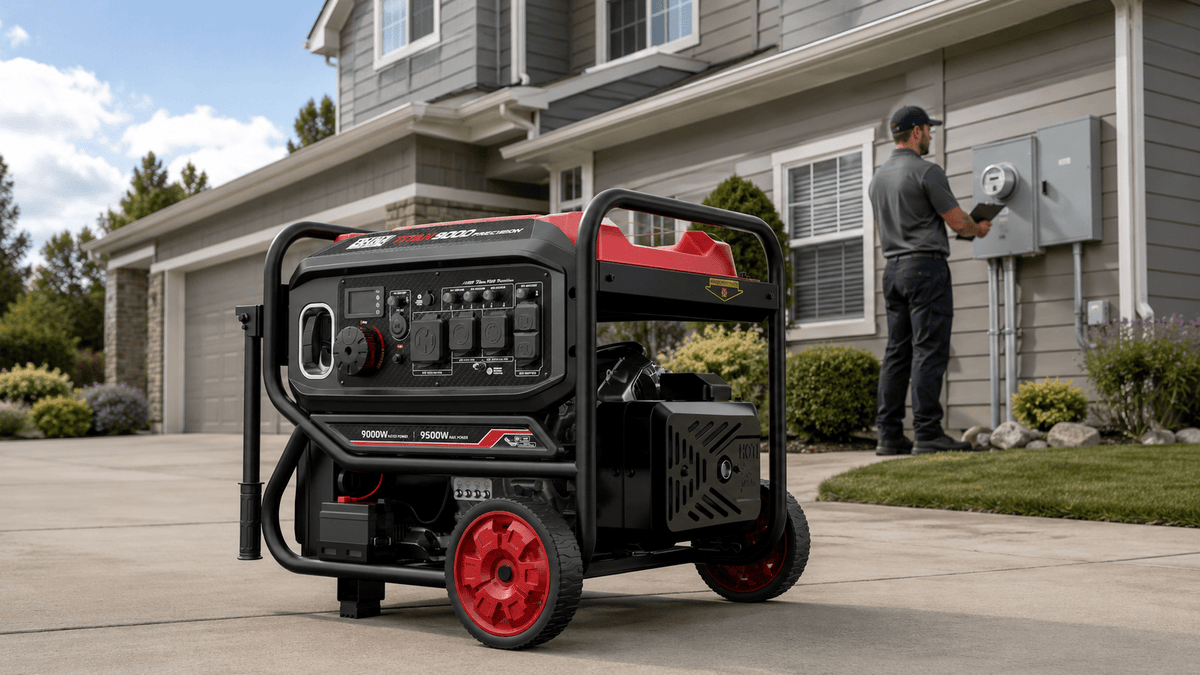
What Size Generator for 200 Amp Service? Selected Loads vs Whole-Home Backup
A 200 amp panel does not mean you need a generator that continuously supplies 200 amps. Generator size depends on the circuits you want during an outage, the largest motor startup, fuel-specific output, and whether you want selected-load or automatic whole-home backup.
Quick Answer: What Size Generator Do You Need for 200 Amp Service?
Do not size the generator from the 200 amp main breaker alone. A 200A, 120V/240V residential service has a theoretical 48,000-watt ceiling, but homes rarely use that full capacity continuously. Size backup power from the loads that must run together plus the largest motor startup.
A 6,000W-to-9,000W portable generator may support a carefully selected essential-load plan. A 9,000W-to-13,000W unit can support broader selected circuits and larger 240V loads. A home that expects automatic central AC, electric water heating, cooking, laundry, resistance heat, and nearly every circuit may require a larger permanently installed standby system and professional load management.
What Does 200 Amp Service Actually Mean?
A 200 amp service describes the maximum capacity of the home's main electrical service equipment. In a typical 120V/240V single-phase home, the simple ceiling calculation is:
That is the service ceiling, not the home's normal simultaneous demand and not the minimum generator size. Most homes have many circuits that are off, cycle intermittently, or can be deliberately disabled during an outage.
Service Capacity
The maximum the utility service and main equipment are designed to carry. It protects the normal utility-power path.
Backup Load
The appliances and circuits you actually choose to operate during an outage, including their simultaneous running demand.
Generator Capacity
The rated output and short surge output available on the selected fuel and under the operating conditions.
A manual transfer system can be service-entrance rated for a 200A utility main while using a smaller 30A or 50A generator input. Generac currently lists both configurations and explains that the user must turn off selected loads to stay within generator capacity. See the Generac 200A manual transfer-switch overview.
200A Service, Generator Output, and Inlet Rating Are Different
| Rating | What It Describes | Common Mistake |
|---|---|---|
| 200A utility main | The maximum normal service capacity entering the home. | Assuming backup power must also supply 200 amps continuously. |
| Generator rated watts | The continuous output available for the selected outage loads. | Using only headline surge watts or ignoring fuel-specific output. |
| Generator surge watts | Short extra capacity for motor and compressor startup. | Adding surge watts as if they were continuous capacity. |
| 30A or 50A receptacle/inlet | The current class and connector path for compatible equipment. | Assuming a 50A-shaped connection guarantees 12,000W from any generator. |
| Transfer switch or interlock rating | The electrical equipment used to isolate utility and generator power. | Choosing equipment without considering service rating, generator breaker, neutral, or local code. |
Selected Loads vs. Whole-Home Backup on a 200A Panel
Essential Circuits
Refrigeration, lights, internet, gas-furnace blower, sump pump, selected outlets, and limited cooking or cooling. This is the most practical portable-generator path.
Broad Selected Loads
Essentials plus larger pumps, more outlets, one planned HVAC load, or managed 240V appliances. This may point toward a 9kW-to-13kW class.
Automatic Whole Home
Many circuits available without manual load decisions, often including central HVAC and electric appliances. This usually requires a professionally sized standby system.
Generac's official sizing tool also separates "Whole Home" from "Select Circuits," which is the correct first decision before comparing wattage. Review the Generac standby generator solution finder for an example of that distinction.
How to Calculate Generator Size for 200 Amp Service
- Choose required outage circuits. Separate must-have loads from conveniences that can remain off.
- Record running watts. Use appliance labels, manuals, or measured values rather than generic guesses whenever possible.
- Identify motor startup demand. Check refrigerators, pumps, furnace blowers, air conditioners, and other compressors.
- Check voltage. Confirm which loads require 120V and which require 240V.
- Add realistic simultaneous demand. Do not include equipment you will deliberately operate at different times.
- Add the largest extra startup surge. Starting watts minus running watts for the largest motor is a useful planning method.
- Check the complete connection path. Generator breaker, outlet, cord, inlet, transfer equipment, panel balance, and fuel-specific output all matter.
Honda's generator wattage guide provides planning values for common appliances but also notes that actual wattage varies. Equipment data always takes priority.
Why Two 200 Amp Homes Can Need Different Generators
Example A: Gas-Utility Home With Selected Loads
- Refrigerator/freezer: about 192 running watts
- 1/2 HP sump pump: about 1,050 running watts
- 1/2 HP gas-furnace blower: about 875 running watts
- 10,000 BTU window AC: about 1,500 running watts
- Microwave: about 1,500 running watts when used
- LED lights, router, TV, and chargers: estimated 300 watts
Estimated running total: about 5,417 watts. Adding the largest example extra startup surge produces an estimated peak near 6,892 watts. A properly configured 9,000W-rated generator could provide useful margin for this example even though the house has a 200A main.
Example B: All-Electric Home
- Electric water heater: about 4,500 running watts
- Electric dryer: about 5,400 running watts
- One range element: about 2,100 running watts
- Central AC or heat pump: system-specific running and startup demand
The first three loads already total about 12,000 running watts before refrigeration, lights, pumps, or central HVAC. Even a 13,000W-rated generator requires aggressive load management here. Automatic broad whole-home coverage may point toward a larger standby system.
30 Amp vs. 50 Amp Generator Connection for a 200A Home
| Connection Class | Simple 240V Ceiling | Practical Use | Important Limit |
|---|---|---|---|
| 30A at 240V | 7,200W theoretical | Essential circuits, pumps, refrigeration, lighting, and selected 240V planning. | A 5,000W-rated generator still provides only about 5,000 rated watts even through a 30A connection. |
| 50A at 240V | 12,000W theoretical | Broader selected loads and higher-capacity portable-generator planning. | A 9,000W generator does not become a 12,000W generator because it has a 50A receptacle. |
| 200A utility service | 48,000W theoretical | Normal utility service for the home. | This is not the generator requirement and does not mean every circuit runs during backup. |
The Titan 13000 publishes 13,000 rated watts, while its NEMA 14-50R is a 50A receptacle. Do not assume the full nameplate output can pass through one 50A connection. Follow the generator manual, breaker ratings, and the electrician's connection design.
Which ERAYAK Generator Fits a 200 Amp Home?
The correct answer depends on the selected loads, not the service size. These are portable selected-load paths, not guaranteed full 200A-service replacements.
| ERAYAK Path | Confirmed Output / Connection | Best Fit | Limit |
|---|---|---|---|
| 6800PT | 6,800W peak; 5,000W gasoline rated; 30A 120V/240V L14-30R | Smaller selected-circuit plan, well/sump pump, refrigeration, lights, and fuel flexibility. | No 50A outlet. Not a whole-house standby replacement. |
| Titan 9500 | 9,000W rated; 9,500W surge; 120V/240V; NEMA 14-50R | Broader selected loads where a verified worksheet fits below the 9kW class. | Does not supply a full 200A service or every electric appliance at once. |
| Titan 13000 | 13,000W rated; 14,000W surge; 120V/240V; NEMA 14-50R | Larger selected-load plan, higher motor startup, and more simultaneous circuits. | Still requires load management and connection-equipment limits. |
| Permanent standby system | Professionally sized and installed for the home | Automatic backup or broad whole-home coverage without manual portable setup. | Higher equipment and installation cost; fixed system. |
ERAYAK Titan 9kW and 13kW Series
Two 120V/240V open-frame inverter capacities for homeowners who have already defined a selected-load backup plan.
Choose From the Load Worksheet
The product page lists Standard gasoline and MaxFlex tri-fuel-ready configurations. Confirm the selected version and fuel-specific output before final sizing.
Product facts are based on the current ERAYAK product pages. Confirm the selected variant, manual, breaker ratings, and fuel-specific data before use.
Connect a Portable Generator to a 200A Home Safely
Review the ERAYAK guide to connecting a portable generator to a house. The CDC power-outage guidance specifies outdoor generator placement at least 20 feet from openings.
200 Amp Service Generator FAQ
What size generator do I need for 200 amp service?
Size the generator from the selected outage loads, not the 200A main breaker. Essential-load plans may fit a 6kW-to-9kW portable class, broader selected loads may point toward 9kW-to-13kW, and automatic all-electric whole-home coverage may require a larger professionally sized standby system.
Does 200 amp service require a 48kW generator?
No. Two hundred amps at 240 volts equals a theoretical 48kW service ceiling, but that is not normal simultaneous demand. The correct generator size depends on the loads expected to run together and their startup requirements.
Can a 13,000-watt generator run a 200 amp service home?
It can support a substantial selected-load plan in many 200A homes, but it does not provide the full 200A utility capacity. Central HVAC, electric heat, water heating, cooking, laundry, and other large loads may require sequencing or a larger standby system.
Can I use a 50 amp generator inlet with a 200 amp panel?
A professionally designed system can use a service-rated transfer arrangement with a smaller generator input, but all equipment must be compatible and installed according to local requirements. A 50A inlet does not provide 200 amps of generator power.
Is a 30A or 50A generator better for a 200 amp home?
Choose from the required load, not the panel size. A 30A path may fit essential circuits, while a 50A path can support a larger selected-load plan. The generator's rated watts may be lower than the connection's theoretical ceiling.
Can I connect a portable generator to a 200 amp panel myself?
Home-panel connection requires correctly rated transfer equipment, source isolation, wiring, grounding and neutral planning, and local-code compliance. Use a qualified electrician rather than improvising a connection or backfeeding through an outlet.
Size Backup Power From the Loads You Will Actually Use
Choose required circuits, calculate running and startup demand, confirm the 30A or 50A connection path with an electrician, and then compare the ERAYAK 6800PT, Titan 9500, and Titan 13000 against the worksheet.
