

What Can a 9,000-Watt Generator Run? Home Backup Load Guide
A 9,000-watt generator can cover a strong set of household essentials, pumps, refrigeration, and selected comfort loads. The real limit is not the appliance list; it is the running total, startup surge, voltage, fuel, and what starts at the same time.
Quick Answer: What Will a 9,000-Watt Generator Run?
A 9,000-watt generator can often run a refrigerator, freezer, lights, Wi-Fi, a gas-furnace blower, a sump pump, many well-pump setups, a microwave, selected outlets, and one planned cooling load. It is a strong selected-circuit home-backup size, but it should not be assumed to run central AC, electric water heating, an electric dryer, an electric range, and every other circuit at once.
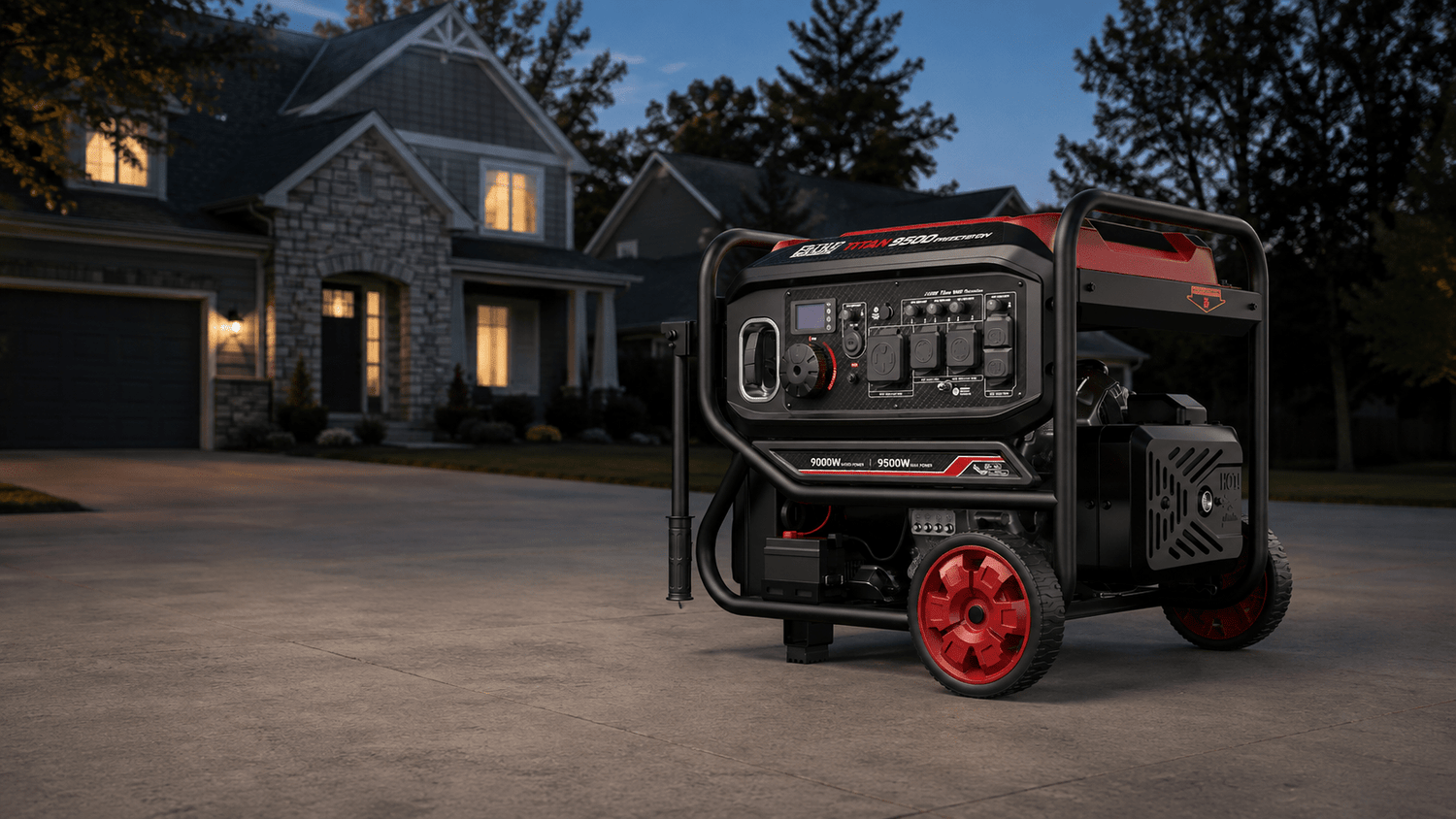
Use rated watts for continuous planning and surge watts for motor startup. The ERAYAK Titan 9500 publishes 9,000 rated watts and 9,500 surge watts. Appliance labels, fuel-specific output, altitude, temperature, outlet breakers, and connection equipment still determine the real operating limit.
What Does "9,000-Watt Generator" Actually Mean?
Rated Watts
The continuous output available for the normal running total. Use this number when deciding which appliances and circuits can remain on together.
Surge Watts
Short additional output used when motors and compressors start. Refrigerators, pumps, furnace blowers, and air conditioners can create surge demand.
Available Output
Fuel, elevation, heat, maintenance condition, individual breakers, and unbalanced 120V loads can reduce what is practically available.
Extra startup surge means starting watts minus running watts for the largest motor expected to start. Leave additional margin because automatic compressors and pumps can start close together.
9,000-Watt Generator Appliance Load Chart
These figures are planning examples, not guarantees. Check the equipment nameplate, manual, voltage, and measured startup current before relying on any generator during an outage.
| Load | Approx. Running Watts | Approx. Starting Watts | 9,000W Planning Note |
|---|---|---|---|
| ENERGY STAR refrigerator or freezer | 132-192W | About 1,200W | Easy individual load; allow more for older, larger, or multiple units. |
| Gas or oil furnace fan, 1/2 HP example | About 875W | About 2,350W | Usually realistic with essentials; confirm blower voltage and nameplate. |
| Sump pump, 1/2 HP example | About 1,050W | About 2,150W | Realistic, but preserve surge headroom during frequent storm cycling. |
| 10,000 BTU window air conditioner | About 1,500W | About 2,200W | Often manageable; start it before adding optional kitchen loads. |
| Microwave, depending on cooking output | About 1,000-1,500W | About 1,000-1,500W | Short-duration load; avoid stacking with another large resistive appliance. |
| Electric water heater | About 4,500W | About 4,500W | Can consume half the generator's rated capacity by itself. |
| Electric dryer | About 5,400W | About 6,750W | High-demand load; do not combine casually with water heating or HVAC. |
| Electric range, one 8-inch element | About 2,100W | About 2,100W | One element may fit; the full range or oven can be much larger. |
| Well pump | Check HP, voltage, and amps | Check LRA or measured startup | Many well pumps are 240V. Do not size from horsepower alone. |
| Central AC or heat pump | Check equipment electrical data | Check LRA or measured inrush | Often the deciding load; obtain professional sizing before assuming it will start. |
Planning examples are adapted from the Honda Generator Wattage Estimation Guide. Actual equipment demand can vary substantially.
What Can a 9,000-Watt Generator Run at the Same Time?
Workable Example: Essentials Plus One Window AC
- Refrigerator/freezer: about 192 running watts
- 1/2 HP sump pump: about 1,050 running watts
- 1/2 HP furnace fan: about 875 running watts
- 10,000 BTU window AC: about 1,500 running watts
- Microwave: about 1,500 running watts when used
- LED lights, router, TV, and chargers: estimated 300 watts
Estimated running total: about 5,417 watts. Adding the largest example extra startup surge, about 1,475 watts for the furnace fan, produces an estimated peak near 6,892 watts. This fits a 9,000W-rated example with margin, but real equipment and overlapping starts still need checking.
Poor Example: Dryer Plus Water Heater
An electric dryer at about 5,400 running watts plus a 4,500W electric water heater already totals about 9,900 watts before refrigeration, lights, pumps, or startup demand. A 9,000W generator is not sized for this load stack.
Use Load Sequencing
- Start the largest required motor first and let it stabilize.
- Add refrigerators, pumps, and smaller circuits in stages.
- Pause water heating, laundry, or cooking when another large load is needed.
- Remove loads if a breaker trips or a motor struggles; do not repeatedly restart the same stack.
Will a 9,000-Watt Generator Run a Whole House?
It can provide broad essential-load backup for many homes, but it should not be treated as automatic full-house power. A home with gas heat, gas water heating, LED lighting, refrigeration, pumps, and one moderate cooling load may fit well. An all-electric home with central AC, resistance heat, water heating, cooking, laundry, and EV charging can exceed 9,000 watts quickly.
Good Fit
Refrigeration, lights, internet, gas-furnace blower, sump pump, selected outlets, and one planned comfort load.
Needs Management
Well pumps, central AC, electric water heating, electric cooking, or multiple compressors.
Usually Turn Off
EV charging, electric resistance heat, pool heaters, hot tubs, and nonessential high-demand circuits.
For broader model selection, use the ERAYAK home power outage generator guide.
How Many Amps Is 9,000 Watts?
| Calculation | Theoretical Result | Important Limit |
|---|---|---|
| 9,000W / 120V | 75A | No single 120V outlet supplies the full 75 amps. |
| 9,000W / 240V | 37.5A | The total is distributed through compatible outlets, breakers, and split-phase legs. |
| 9,500W surge / 240V | About 39.6A briefly | Surge output is not continuous output. |
The Titan 9500 lists a 50A NEMA 14-50R receptacle, but a 50A receptacle does not turn 9,000 rated watts into 12,000 watts. Generator output, breaker settings, cord, inlet, transfer equipment, and panel-leg balance all remain limiting factors.
9,000W vs. 13,000W Generator for Home Backup
| Decision Point | 9,000W Rated Class | 13,000W Rated Class |
|---|---|---|
| Best fit | Essential circuits, refrigeration, pumps, gas-furnace blower, and selected cooling with load management. | Larger selected-circuit plans, more simultaneous loads, and greater startup headroom. |
| Why choose it | Enough for many realistic outage plans without buying unused capacity. | Better when larger 240V loads or several required motor loads make 9,000W tight. |
| Main caution | Central AC and stacked electric appliances can use margin quickly. | More size does not remove fuel, connection, noise, or load-management considerations. |
| ERAYAK Titan rating | 9,000W rated / 9,500W surge. | 13,000W rated / 14,000W surge. |
If the verified worksheet is comfortably below 9,000 rated watts and startup demand stays below 9,500 surge watts, the smaller model may be the more practical fit. For heavier combinations, compare the Titan 13000 option on the current Titan series page.
ERAYAK Titan 9500 for Selected Home Backup
ERAYAK Titan 9500 Precision
A high-capacity open-frame inverter option for selected home circuits, pumps, refrigeration, and planned 120V/240V outage loads.
Why It Fits This Search
The product page lists Standard gasoline and MaxFlex tri-fuel-ready configurations. Confirm the selected configuration and fuel-specific output before finalizing the load worksheet.
Specifications are based on the current ERAYAK Titan product page. Confirm the ordered variant, manual, breaker ratings, and fuel-specific data before use.
Connect and Operate a 9,000-Watt Generator Safely
The CDC power-outage guidance specifies outdoor placement at least 20 feet from openings. Review the ERAYAK guide to connecting a portable generator to a house before planning any panel connection.
9,000-Watt Generator FAQ
What can a 9,000-watt generator run?
It can often run refrigeration, lights, internet, a furnace blower, sump or well pumps, a microwave, selected outlets, and one planned cooling load. The exact combination depends on running watts, startup surge, voltage, fuel, and connection limits.
Will a 9,000-watt generator run an entire house?
It can provide broad selected-circuit backup for many homes, especially homes with gas heat and gas water heating. It may not support central AC, electric water heating, electric laundry, electric cooking, and every other circuit together.
How many amps is 9,000 watts?
9,000 watts equals 75 amps at 120 volts or 37.5 amps at 240 volts in theoretical division. Individual outlet, breaker, cord, inlet, transfer-equipment, and panel limits still apply.
Can a 9,000-watt generator run central air conditioning?
Possibly, but central AC startup demand varies widely. Check the outdoor unit's electrical data, indoor blower, other running circuits, and generator surge capacity. Professional HVAC or electrical sizing is recommended.
Is a 13,000W generator better than a 9,000W generator?
It is better only when the load plan needs the additional rated output and surge headroom. If required loads fit comfortably within 9,000 rated watts, the smaller generator may be easier to transport and more appropriate for the job.
Can I run a 9,000-watt generator in a garage?
No. Never run a fuel-powered generator in a garage or other enclosed or partially enclosed space. Operate outdoors at least 20 feet from doors, windows, and vents, with exhaust facing away.
Choose 9,000 Watts When the Worksheet Supports It
Confirm required circuits, startup demand, 120V/240V needs, and the connection path. Then compare the Titan 9500 with the Titan 13000 instead of buying from headline wattage alone.
