

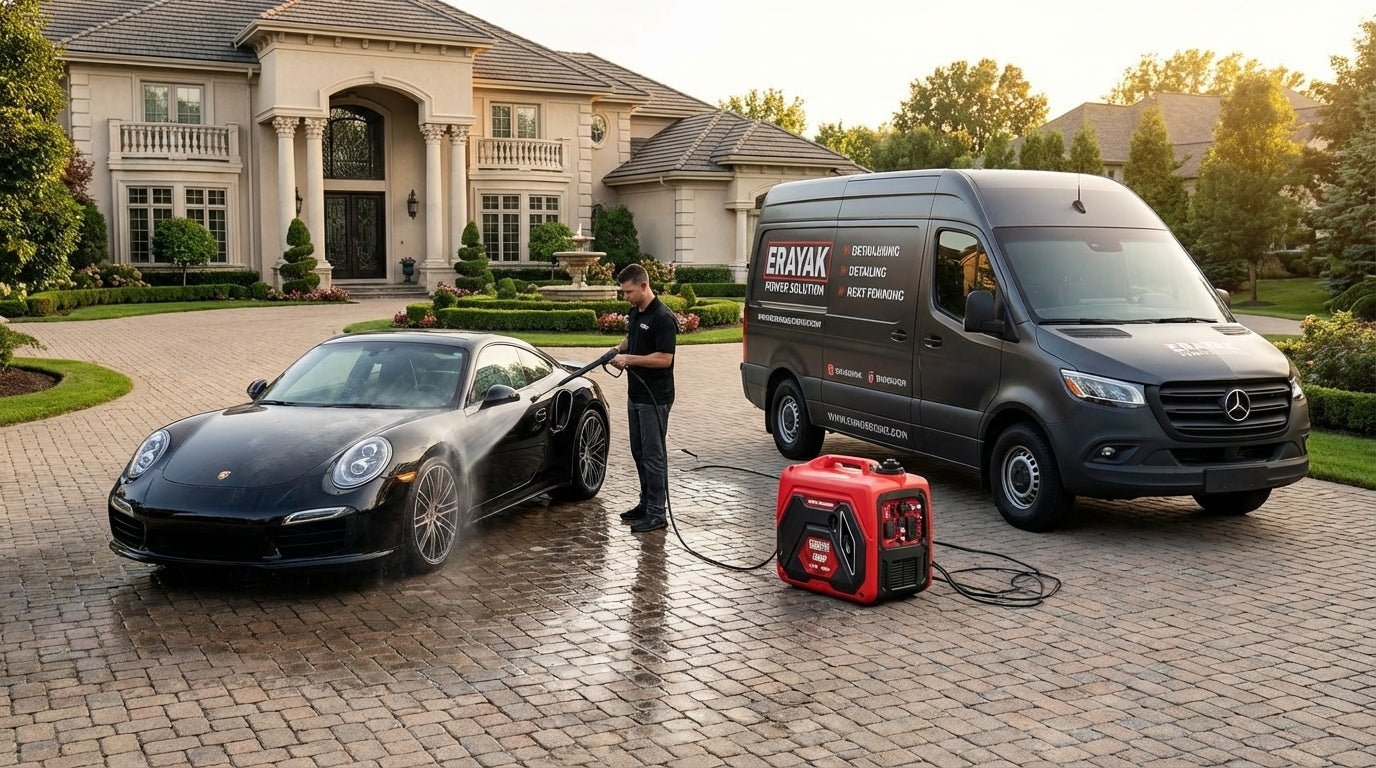
Best Quiet Generator for a Mobile Detailing Business in 2026
A mobile detailing generator has to do more than make watts. It needs enough starting power for pressure washers and vacuums, quiet operation for residential jobs, clean power for chargers and POS devices, and safe outdoor placement around vans, driveways, and customer properties.
- Solo detailers: size around the largest tool you start, not just running watts.
- Pressure washer + vacuum setups: 3500W to 4500W surge capacity is a practical target.
- Residential work: quiet inverter design looks and sounds more professional.
- Van/trailer setups: plan cord routing, ventilation, and fuel storage before buying.
Most mobile detailing businesses should look at a quiet inverter generator in the 3500W to 4500W starting-watt class. That range gives more headroom for an electric pressure washer, shop vacuum, carpet extractor, polisher, lights, chargers, and POS devices, especially when you start high-draw tools one at a time.
A 2000W generator can work for very light setups, but it can be borderline once a pressure washer pump, vacuum motor, or extractor starts. A 4500W-class inverter generator is usually the better professional fit for mobile detailing vans and trailers.
Mobile Detailing Generator Wattage Chart
Detailing tools do not all behave the same way. Motors can draw extra power at startup, while heating elements and extractors can consume a large share of your generator capacity continuously. Use the labels on your exact equipment first, then use this chart as a planning range.
| Detailing equipment | Typical running watts | Startup or planning note |
|---|---|---|
| Electric pressure washer | 1200W to 1800W | Motor startup can be 2x to 3x running watts depending on model. |
| Shop vacuum | 800W to 1400W | High-amp vacuums can surge at startup. |
| Carpet extractor | 1000W to 1800W+ | Heated extractors can require much more power than non-heated units. |
| Dual-action or rotary polisher | 500W to 1000W | Usually manageable, but avoid starting with other large tools at the same time. |
| LED lights, charger, POS device, router | Low, steady loads | Clean inverter power is useful for electronics and battery charging. |
Do not start the pressure washer, vacuum, and extractor at the same moment. Start the largest motor first, let it stabilize, then add the next tool. This habit often matters more than buying the biggest generator you can fit in the van.
Why a Quiet Generator Matters for Mobile Detailing
Mobile detailing is a customer-facing service. You may work in driveways, apartment complexes, office lots, gated communities, marina lots, or tight residential streets. Noise affects referrals, reviews, and whether customers feel comfortable booking you again.
A quieter setup feels more professional and less disruptive while you work near homes or offices.
An enclosed inverter generator looks cleaner than a loud open-frame jobsite generator beside a premium vehicle.
Some communities, lots, and venues have noise expectations, even when there is no formal HOA complaint.
Noise ratings vary by load, distance, surface, and testing method. Compare generators at similar load levels and keep the generator as far from customers and building openings as your cord ratings safely allow.
What Size Generator Is Best for a Detailing Business?
| Business setup | Recommended generator class | Best fit |
|---|---|---|
| Light detailing only | 2000W to 2500W inverter class | Polisher, lights, chargers, light vacuum, and low-draw tools. |
| Solo mobile detailer with electric pressure washer | 3000W to 4500W class | Pressure washer, vacuum, polisher, and electronics with staged startup. |
| Pro van or trailer with extractor | 4500W class or larger selected-load planning | Pressure washer plus vacuum/extractor timing, better startup headroom. |
| Two-person crew running multiple tools | 4500W+ or separate power planning | Requires strict load sequencing or a larger power system. |
For most professional mobile detailing rigs, the 4500W class is a useful sweet spot: strong enough for tool startup headroom, still portable enough for a van or trailer, and more client-friendly when built as an inverter generator.
Gas-Only vs Dual-Fuel for Mobile Detailing
Fuel choice affects how your van smells, how you store fuel, how quickly you refuel between jobs, and how much output you can expect. Gasoline usually provides maximum output. Propane stores cleanly and can be easier to keep in a service vehicle, but propane output may be lower than gasoline depending on the generator.
| Fuel setup | Pros | Tradeoffs |
|---|---|---|
| Gas-only inverter generator | Simple setup, strong output, easy refueling access. | Requires careful fuel storage and spill prevention. |
| Dual-fuel inverter generator | Gasoline plus propane flexibility, cleaner propane storage, useful for backup planning. | Propane may produce less output than gasoline; bring enough tank capacity for long jobs. |
ERAYAK Generator Picks for Mobile Detailing
The right ERAYAK choice depends on whether you want the simplest gas-only generator or dual-fuel flexibility for a van or trailer setup.

Best Gas-Only Value: ERAYAK 4500P
The ERAYAK 4500P is a strong match for mobile detailers who want quiet inverter power, enough headroom for pressure washer startup, and a simpler gasoline-only setup. Confirmed product facts include gas-only operation, manual recoil start, 55 lb class, a 2.25 gallon fuel tank, up to 8 hours runtime, 60.5 dB operation, and THD below 1.2%.
- Best for: solo detailers, driveway jobs, pressure washer plus vacuum timing, and clean electronics power.
- Why it fits: quieter enclosed inverter design and enough practical headroom for common detailing tools.
- Do not choose it for: propane, dual-fuel flexibility, electric start, or remote start.

Best Dual-Fuel Upgrade: ERAYAK 4500PD
The ERAYAK 4500PD is the better route if propane storage and fuel flexibility matter for your detailing business. It keeps the 4500W-class inverter-generator direction while adding dual-fuel planning for workdays, storm backup, or mixed-use RV/camping needs.
- Best for: detailers who want gasoline plus propane options.
- Why it fits: dual-fuel flexibility can reduce gasoline storage stress in some business setups.
- Planning note: verify propane output and runtime for your exact tools before relying on it for the longest jobs.
Mobile Detailing Generator Setup and Safety
Fuel-powered generators and gas-powered pressure washers produce carbon monoxide. Never operate them inside a van, trailer, garage, carport, enclosed wash bay, or near open doors and windows. Keep the generator outdoors, away from air intakes and occupied spaces, with exhaust pointed away from people and buildings.
- Use outdoor-rated extension cords sized for the load and distance.
- Keep cords out of standing water, traffic paths, and active wash zones.
- Do not overload a single outlet or power strip with the pressure washer and extractor.
- Start high-draw tools one at a time and watch for overload warnings.
- Store gasoline or propane according to local rules and vehicle-safety requirements.
- Place the generator where customers can see a clean, organized, professional setup.
A Quiet 4500W-Class Inverter Generator Is the Professional Sweet Spot
For a mobile detailing business, the best generator is not simply the cheapest one. It is quiet enough for residential jobs, strong enough for tool startup surge, clean enough for electronics, and practical enough to fit your van or trailer workflow. For most professional setups, compare the ERAYAK 4500P for gas-only value and the 4500PD for dual-fuel flexibility.
