

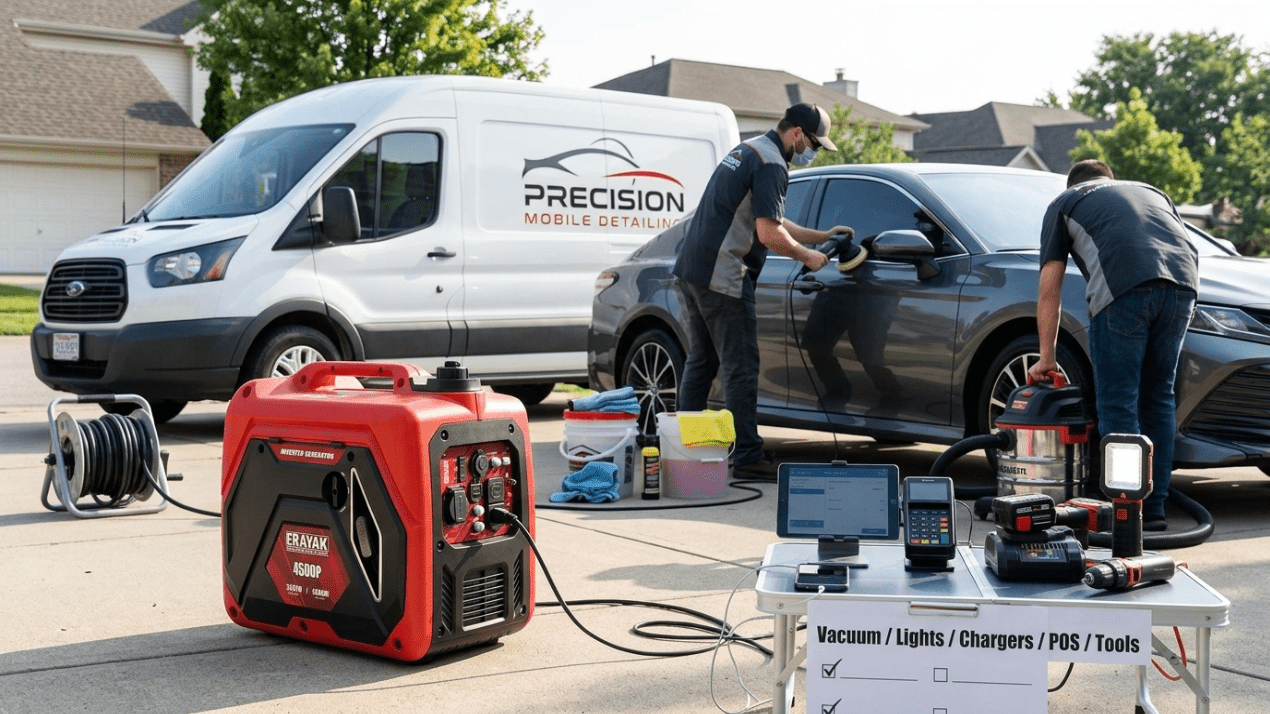
Mobile Car Detailing Power Setup: Generator Solution for Vacuums, Lights, and Tools
A mobile car detailing setup needs reliable power without relying on the customer’s outlet. The right generator workflow keeps vacuums, polishers, lighting, chargers, POS systems, water pumps, extractors, and small tools organized while protecting the vehicle, customer property, workers, and equipment.
Quick Answer
For light mobile detailing with phone charging, POS system, LED work lights, battery chargers, small fans, and occasional compact tools, the Erayak 2400P can work as a compact power station. For a more complete setup with shop vac, polisher, extractor, pump, work lights, and longer mobile service days, the Erayak 4500P or 4500PD is usually the better starting point.
For larger detailing vans, multiple work zones, higher motor-start loads, larger pumps, or selected 120V/240V planning, the Erayak 6800 series provides more headroom. The goal is to create a safe generator zone, dry power table, tool zone, wet wash zone, and cord path that keeps the job clean and professional.
Mobile Detailing Power Layout
A professional mobile detailing setup works best when power is separated into zones. Keep the generator outdoors in a safe ventilated location. Keep electronics and chargers on a dry power table. Keep vacuums, polishers, and extractors in the tool zone. Keep water, hoses, foam, and rinse work in the wet zone.
Generator Zone
Place the generator outdoors on dry stable ground, away from open garages, doors, windows, vents, vehicles, customer entrances, and enclosed spaces.
Dry Power Table
Use one dry table for phone charging, POS, card reader, battery chargers, work light chargers, and small electronics.
Tool + Wet Zones
Keep vacuums, polishers, pumps, extractors, hoses, and wash tools organized so electrical cords do not run through standing water.
Dry Power Table for POS, Chargers, and Lights
The dry power table is the control center for a mobile detailing job. It keeps customer payment tools, phones, battery chargers, rechargeable lights, cameras, tablets, and small electronics away from water spray, hoses, chemicals, and foot traffic.
| Dry-Zone Load | Role | Power Strategy |
|---|---|---|
| Phone and tablet | Scheduling, customer photos, communication, payment apps | Keep charged and protected from water and chemical overspray |
| POS system or card reader | Checkout and mobile payment | Keep on the dry table with a dedicated charging cable |
| LED work light chargers | Paint inspection and interior work | Charge during setup, polishing breaks, or low-load periods |
| Tool battery chargers | Battery-powered polishers, blowers, lights, and accessories | Batch charge and label charged vs depleted batteries |
| Camera or action cam batteries | Before/after photos and social content | Keep separate from wet towels, buckets, and cleaning chemicals |
Vacuum, Polisher, Extractor, and Tool Power
Mobile detailing tools often include motor loads. Shop vacs, polishers, extractors, pumps, and blowers can draw more power when starting or when operating under load. Use one high-demand tool at a time and avoid stacking motor starts.
| Detailing Tool | Load Type | Power Strategy |
|---|---|---|
| Shop vac / wet-dry vacuum | Motor load | Start separately and avoid stacking with extractor or pump startup |
| Dual-action polisher | Motor load | Use with stable cord routing and avoid wet floor areas |
| Carpet extractor | Motor and heating/pump load depending on model | Check the actual unit label and run high-demand functions carefully |
| Air mover or blower | Motor load | Use after wash or extraction stages, not during peak tool startup |
| Battery chargers | Low to moderate electronics load | Good for the dry table, but avoid overloading one strip |
| LED inspection lights | Low to moderate load | Easy to combine with charging and low-load electronics |
Water Pump and Wash-Zone Power Planning
The wet zone is where mobile detailing setups need extra discipline. Hoses, rinse water, buckets, foam cannons, pumps, and pressure washing equipment should stay physically separated from generator outlets, power strips, chargers, and cord connections.
| Wet-Zone Item | Use Case | Setup Strategy |
|---|---|---|
| Water transfer pump | Move water from tank to wash area | Check running and starting requirements before use |
| Electric pressure washer | Rinse and cleaning support | Confirm wattage and startup demand; avoid running with extractor startup |
| Foam cannon setup | Wash preparation | Keep hoses routed away from extension cord connections |
| Wet-dry vacuum | Interior cleanup and water extraction | Keep the power connection dry and elevated |
| LED work light near wash area | Visibility in shade or evening work | Use outdoor-rated equipment and avoid placing lights where water collects |
Cord Routing Around Vehicles and Wet Areas
A mobile detailing job often includes vehicles, hoses, towels, buckets, carts, polishers, ladders, customers, pets, and foot traffic. Cord routing should be visible, dry, protected, and separated from water paths.
| Cord Problem | Why It Matters | Better Setup |
|---|---|---|
| Cords across driveway or customer walkway | Trip hazard and customer property risk | Route along edges and use visible cord covers where appropriate |
| Connections on wet pavement | Shock and equipment risk | Keep connections dry, elevated, and away from rinse paths |
| Cords tangled with hoses | Pulling, tripping, and equipment damage risk | Separate hose path from power cord path |
| Generator too close to customer garage | Carbon monoxide and exhaust risk | Keep generator outdoors and away from doors, windows, vents, garages, and enclosed spaces |
| Power strip on the ground | Water, dust, and accidental impact risk | Use a dry power table and inspect cords before each job |
Recommended Erayak Setup by Detailing Scenario
Erayak 2400P: Compact Detailing Charging and Lighting Station
Choose the Erayak 2400P for phone charging, POS, tablets, LED inspection lights, camera batteries, tool battery chargers, small fans, and light-duty mobile detailing support.
- Strong fit for dry power table, charging, lighting, and small electronics
- Good for light mobile detailing, customer photos, POS, and battery-powered tools
- Best when shop vac, extractor, pump, and pressure washer use is limited or rotated carefully
Erayak 4500P: Best Starting Point for Mobile Detailing Work
Choose the Erayak 4500P when your detailing setup includes shop vac, polisher, LED lights, battery chargers, small fan, POS, pump planning, extractor use, and longer mobile service days.
- Gas-only portable inverter generator
- Manual recoil start
- 55 lb lightweight design
- 2.25 gal fuel tank
- Up to 8 hours runtime
- THD < 1.2% for sensitive electronics
- 60.5 dB noise level
Erayak 4500PD: Fuel Flexibility for Longer Detailing Routes
Choose the Erayak 4500PD when you want 4,500W-class mobile detailing power with gasoline and propane flexibility for longer routes, multiple customer stops, and more flexible fuel planning.
- Gasoline and propane flexibility
- Useful for longer mobile detailing workdays
- Good fit for lights, charging, POS, vacuums, polishers, pumps, and managed high-demand loads
Erayak 6800PD / 6800PT: More Headroom for Larger Detailing Vans
Choose the Erayak 6800 series when your mobile detailing setup needs more surge headroom, selected 120V/240V planning, larger pump loads, multiple tool zones, or more outlet flexibility.
- 6800W peak power
- 5000W rated power on gasoline at 100% output
- 30A L5-30R outlet
- 30A 120V/240V L14-30R outlet
- Dual 120V household outlets
- TT-30R RV adapter accessory included
Mobile Detailing Generator Safety Checklist
A mobile detailing generator must stay outdoors, dry, ventilated, and safely separated from vehicles, garages, water spray, customers, and enclosed spaces. Do not operate a fuel-powered generator inside a van, trailer, garage, shed, enclosed canopy, or customer workspace.
- Run the generator outdoors only.
- Keep it away from garages, vehicles, open doors, windows, vents, air intakes, customer entrances, and enclosed work areas.
- Point exhaust away from workers, customers, vehicles, homes, garages, and neighboring spaces.
- Never run a generator inside a van, trailer, garage, shed, enclosed canopy, or customer building.
- Keep the generator dry and away from standing water, rinse paths, hoses, buckets, and overspray.
- Use properly rated outdoor extension cords.
- Keep cord connections dry, elevated, and away from wet pavement.
- Separate hose routing from power cord routing.
- Do not overload the generator.
- Start high-demand tools one at a time.
- Let the generator cool before refueling.
- Store fuel away from vehicles, chemicals, towels, flames, heat, customer areas, and enclosed spaces.
Build a Cleaner Mobile Detailing Power Setup
For charging, POS, LED lights, phones, tablets, and light-duty support, choose the Erayak 2400P. For shop vacs, polishers, extractors, pumps, lighting, and longer mobile detailing workdays, choose the Erayak 4500P or 4500PD. For larger vans, multiple work zones, and selected 120V/240V needs, choose the Erayak 6800 series.
FAQ: Mobile Car Detailing Power Setup
Can a generator power a mobile car detailing setup?
Yes. A properly sized portable inverter generator can power phone charging, POS systems, LED lights, battery chargers, small fans, vacuums, polishers, pumps, and detailing tools when loads are managed safely.
How should I set up generator power for mobile detailing?
Place the generator outdoors in a safe ventilated area, route a properly rated outdoor extension cord to a dry power table, and keep cords separated from hoses, wet pavement, rinse paths, and customer walkways.
Can a 2400 watt generator run detailing lights and chargers?
Yes. A 2,400W-class inverter generator is a practical fit for LED work lights, phone charging, POS, tablets, camera batteries, tool battery chargers, and light-duty detailing electronics.
Can a generator run a shop vac for car detailing?
Yes, if the generator is sized for the vacuum’s running and starting requirements. Shop vacs are motor loads, so avoid starting them at the same time as pumps, extractors, or other high-demand tools.
Can a generator run a pressure washer and vacuum at the same time?
It depends on the wattage and startup demand of both tools. For most mobile setups, it is safer to run high-demand tools one at a time instead of stacking pressure washer, pump, vacuum, extractor, and polisher loads.
Where should I place a generator during mobile detailing?
Place it outdoors on dry stable ground, away from garages, vehicles, open doors, windows, vents, customer entrances, enclosed spaces, water spray, hoses, and wet pavement. Point exhaust away from people and buildings.
What Erayak generator is best for mobile detailing?
Choose the Erayak 2400P for charging, POS, LED lights, and light-duty support. Choose the Erayak 4500P or 4500PD for shop vacs, polishers, pumps, extractors, and longer mobile workdays. Choose the Erayak 6800 series for larger detailing vans, multiple work zones, and selected 120V/240V planning.
