
The U.S. Had a Major Outage Every Month of 2026 — Which Generator Do You Actually Need?
The United States experienced a major power outage every single month of 2026. March alone recorded roughly 210,000 outage events across 46 states. Two-thirds of American homeowners dealt with at least one outage this year, with affected households averaging three separate blackout events.
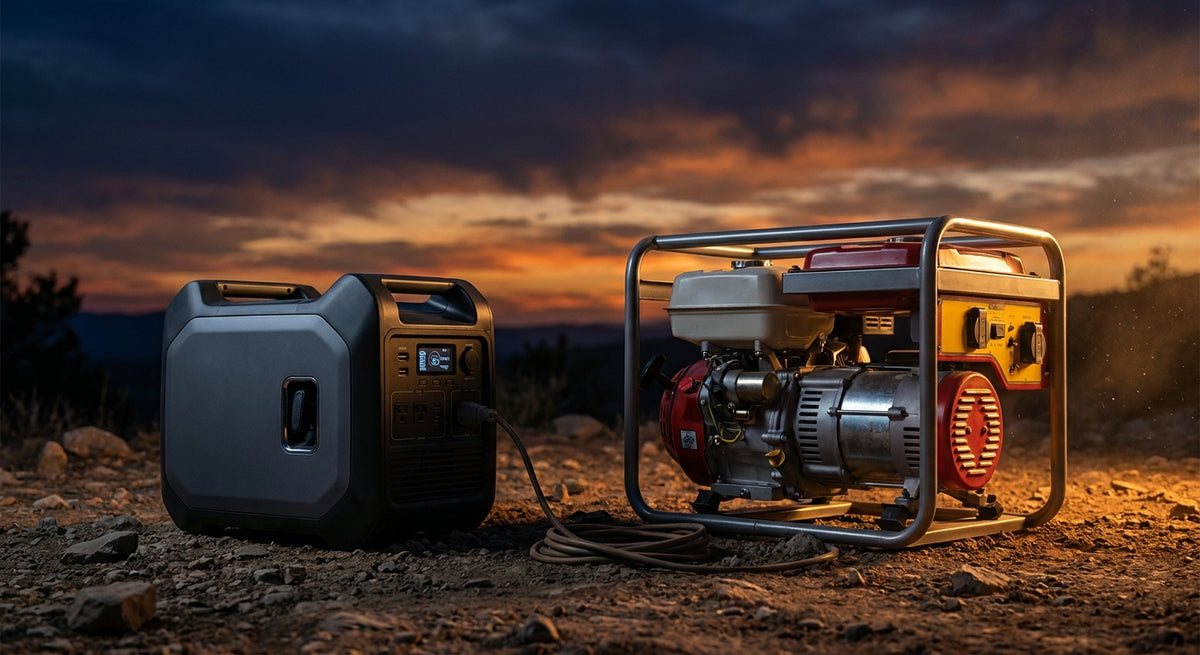
Choosing between an inverter generator and a conventional generator is now urgent preparedness planning, not a hypothetical exercise. The right answer depends entirely on your use case, and this guide maps each type to the right buyer across every dimension that matters: power quality, noise, fuel efficiency, wattage, portability, and cost.
How Each Generator Type Works: The Core Difference
A conventional generator runs its engine at a fixed speed of approximately 3,600 RPM, regardless of how much power you are actually drawing. Charging a phone or running a refrigerator, the engine spins at the same rate. That fixed speed is the root cause of three major tradeoffs: higher noise, greater fuel consumption, and rougher power output.
An inverter generator takes a fundamentally different approach. Its engine throttles up and down to match actual demand. When you are pulling only 25% of rated capacity, the engine slows down accordingly. This variable-speed operation is why inverter generators are quieter, burn less fuel, and produce significantly cleaner electricity.
The key metric for power quality is total harmonic distortion (THD). Think of THD as a measure of how smooth and stable the electrical waveform is. Inverter generators produce less than 3% THD. Conventional generators typically land between 5% and 25% THD.
Worth noting: open-frame inverter generators have emerged as a hybrid category. These units deliver higher wattage than enclosed inverter models while producing much cleaner power than conventional generators, bridging the gap between the two traditional types.
Power Quality: Why THD Matters for Your Devices
THD measures how unstable the AC power waveform is. In plain terms, higher THD means more electrical noise that can interfere with or damage your equipment.
Conventional generators at 5–25% THD can degrade laptops, smartphones, smart TVs, and medical devices over time. The damage is not always immediate; it accumulates with repeated exposure to unstable power.
Inverter generators produce pure sine wave output with sub-3% THD, which is safe for all sensitive electronics. For CPAP users and anyone relying on a home oxygen concentrator, an inverter generator is a safety requirement, not a preference. Dirty power can cause these devices to malfunction or shut down entirely.
Erayak's inverter models deliver THD below 1.2%, well exceeding the industry sub-3% standard. That level of power quality matches or beats what comes out of your wall outlet on a good day.
Noise Levels: What the Decibel Numbers Actually Mean
Inverter generators operate at 50–65 dB. Conventional generators run at 65–95 dB. Those numbers need context to mean anything useful.
60 dB is a normal conversation. 75 dB is a vacuum cleaner. 90 dB approaches a gas-powered lawnmower. The difference between 60 dB and 90 dB is not subtle; decibels are logarithmic, so 90 dB is roughly eight times louder than 60 dB in perceived volume.
During an overnight neighborhood outage, a 90 dB conventional generator is a neighbor complaint waiting to happen. A 60 dB inverter is barely noticeable from the next yard over. Most campgrounds enforce quiet hours at 60–65 dB. Run a conventional generator during those hours and you will be asked to leave. This difference is immediately perceptible, not marginal.
Fuel Efficiency: The Math That Changes the Total Cost Equation
A conventional generator running at just 30–40% of its rated load still consumes 70–80% of its full-load fuel rate. The engine cannot slow down, so it burns fuel whether you need the power or not.
Inverter generators can use up to 40% less fuel than conventional models at equivalent loads. A concrete example: a 2,000W inverter generator at 25% load may consume as little as 0.1 gallons per hour, giving you 8–10 hours of runtime per gallon. A conventional model at the same load burns 0.2–0.3 gallons per hour.
Project that over a hurricane season or a winter with multiple multi-day outages, and the fuel cost difference can offset the inverter's higher upfront price within one to two seasons. At current gas prices, that is real money back in your pocket.
Dual-fuel and tri-fuel inverter generators add another layer of cost control. Models that run on gasoline, propane, and natural gas let you switch to whichever fuel is cheapest or most available during an emergency. This fuel flexibility has become one of the most sought-after features in 2026, and for good reason. When gas stations lose power during a major outage, having a propane or natural gas option can be the difference between running your generator and sitting in the dark.
Wattage & Power Output: Closing the Gap
The most common misconception about inverter generators is that they are only for small loads. That was true five years ago. It is not true now.
Conventional generators still range from 3,000 to 17,500+ watts, making them the go-to for whole-home backup through a transfer switch or heavy jobsite loads where you are running a compressor and circular saw simultaneously. That raw power advantage is real.
But modern inverter generators now reach 7,000 to 16,000 watts in tri-fuel configurations, enough to run most home essential circuits, including a refrigerator, well pump, lights, and a window AC unit. Most comparison articles still treat inverters as a small-load-only option and miss this entirely.
Parallel capability further closes the gap. Two compatible inverter generators can be linked to double their wattage output while retaining quiet operation and clean power. This feature is rarely available on conventional open-frame models. Two 4,000W inverter units running in parallel deliver 8,000W of clean, quiet power.
Practical load guidance to help you size your needs:
- A 30-amp RV typically needs 3,000–3,600W
- A jobsite running a compressor plus circular saw may need 4,000–6,000W
- Whole-home backup for essential circuits typically requires 5,000–8,000W
Calculate your actual wattage needs before choosing a generator type. Add up the running watts of everything you need to power simultaneously, then account for startup surges on motors and compressors.
Portability, Weight & Use-Case Fit
Inverter generators average 30–60 lbs. Conventional portable generators often exceed 100 lbs. If you are loading and unloading a generator from an RV, truck bed, or campsite regularly, that weight difference is decisive.
The enclosed design of most inverter generators also protects internal components better in outdoor and travel environments, reducing exposure to dust, rain, and road vibration.
Conventional generators, despite their weight, remain the practical choice for stationary jobsite use where portability matters less and maximum wattage is the priority.
A quick use-case reference:
- RV and camping: Inverter generator
- Home emergency backup (essential circuits): Inverter or high-wattage inverter
- Whole-home or heavy jobsite: Conventional or high-wattage tri-fuel inverter
Erayak's inverter lineup includes models operating as low as 60.5 dB, suited for RV parks and residential neighborhoods alike. With US-based warehouse shipping, you can have a unit at your door quickly when outage season hits. If you need help choosing or setting up, Erayak's US-based customer support and warranty guidance team is available throughout the entire ownership experience.
Maintenance & Repair: The Tradeoff Most Buyers Overlook
Conventional generators have simpler mechanical designs. Most owners can handle oil changes, spark plug swaps, and carburetor cleaning with basic tools and a video tutorial. That DIY serviceability is a genuine advantage.
Inverter generators contain sophisticated electronics. When those electronics fail, you will need a qualified technician, and the repair bill can be significant. This is a real tradeoff that belongs in your long-term ownership cost calculation.
The mitigating factor: inverter engines do not run at full RPM constantly, which means less mechanical stress and potentially less wear over time. Before purchasing any generator, evaluate the warranty coverage and parts availability. These are meaningful differentiators between brands and can save you hundreds of dollars down the road.
Which Generator Is Right for Your Use Case?
Choose an inverter generator if:
- You need to power laptops, phones, CPAP machines, or medical devices
- You camp or travel by RV
- You live in a neighborhood with noise ordinances
- You want fuel efficiency and extended runtime over raw wattage
- You want parallel capability for scalable power as your needs grow
Choose a conventional generator if:
- You need maximum wattage for a whole-home transfer switch or heavy jobsite equipment
- Upfront budget is your primary constraint
- You prefer simple DIY maintenance
- Portability is not a concern
Choose a high-wattage dual-fuel or tri-fuel inverter generator if:
- You want clean power, fuel flexibility, and enough wattage for most home circuits
- You want the ability to switch fuels based on availability and cost
- You want the 2026 sweet spot for most homeowners
Keep in mind: the average outage in 2026 lasted 5.5 hours, with some stretching into multi-day events. Reliability and runtime matter just as much as peak wattage. The global portable inverter generator market reached $5.5 billion in 2025, with the residential segment accounting for 55.6% of that total. Homeowners are investing in this category at record levels because the grid reality demands it.
Make the Right Call Before the Next Outage Hits
59% of U.S. homeowners expect outages to become more frequent. Average customer outage time has risen 46% over the past decade. This trend is not reversing anytime soon.
The decision comes down to this: if clean power, quiet operation, and fuel efficiency matter most, go with an inverter generator. If raw wattage and low upfront cost are the priority, go conventional. If you want both, a high-wattage tri-fuel inverter generator is the strongest option available right now.
Start by calculating your wattage needs. Identify your most critical devices, especially medical equipment. Match those requirements to the right generator type. The generator market has never offered more options at more price points. The right choice exists for every use case and every budget. The only wrong move is waiting until the lights go out to start looking.
