

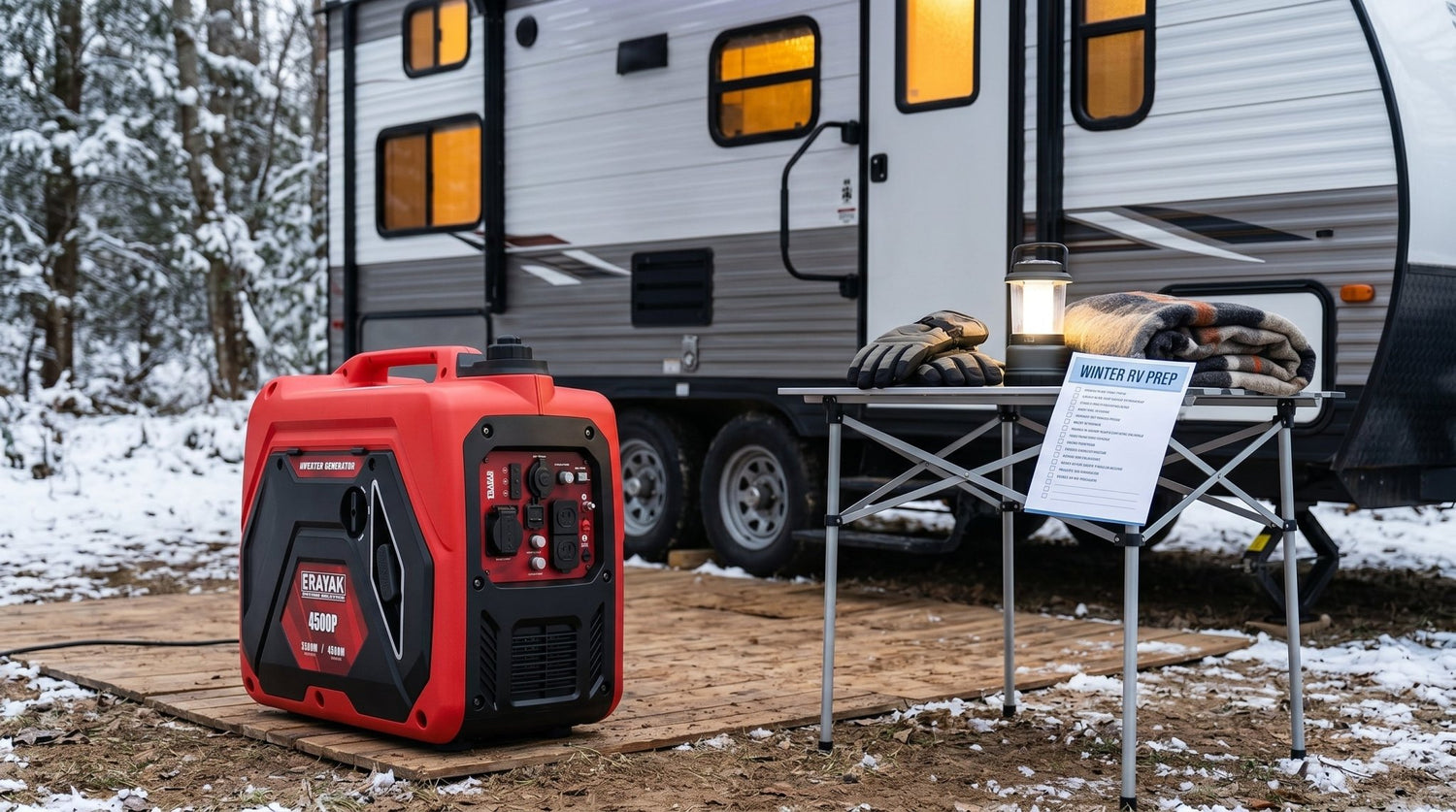
What Size Generator Do You Need for an RV Furnace?
An RV furnace can keep your camper or travel trailer warm during cold-weather camping, but it still needs electrical power for the blower, controls, and ignition system. This guide explains how RV furnace power works, how generator sizing changes when you add battery charging and other appliances, and which Erayak generator fits your winter camping setup.
Quick Answer
A generator can support an RV furnace, but in many RVs the furnace blower and controls run from the 12V DC battery system, while propane provides the heat. The generator usually powers the RV converter/charger, which keeps the battery charged so the furnace blower can run reliably.
For RV furnace support plus lights, phone charging, router, laptop, and basic battery charging, a 2,400W-class inverter generator is often a practical fit. For furnace support plus RV refrigerator, coffee maker, microwave load management, and broader RV comfort loads, a 4,500W-class inverter generator is usually the stronger starting point. For heavier RV and home backup loads, choose the Erayak 6800 series.
How RV Furnace Power Works
Most RV furnaces use propane for heat, but they still need electricity. The 12V system powers the control board, ignition sequence, safety circuits, and blower motor that moves warm air through the RV.
Propane Provides Heat
The furnace burns propane to create heat, so propane supply and regulator condition matter.
Battery Runs Controls
The RV battery powers the blower, thermostat call, ignition, and control board.
Generator Recharges Battery
The generator powers the RV converter/charger, which helps keep the battery ready for furnace operation.
How Many Watts Does an RV Furnace Use?
The RV furnace itself is usually not the biggest generator load. The blower motor and controls are typically much smaller than an RV air conditioner, microwave, or electric space heater. However, the furnace can run for long periods in cold weather, so battery charging and fuel planning matter.
| RV Furnace / Winter Load | Typical Load Level | Generator Planning Note |
|---|---|---|
| 12V furnace blower | Low to moderate, recurring | Usually powered through RV battery system |
| Control board and ignition | Low | Requires reliable battery voltage |
| RV converter/charger | Low to moderate | Load depends on battery state of charge |
| RV refrigerator | Low to moderate | Depends on absorption, compressor, propane, or electric mode |
| Microwave, coffee maker, electric heater | High temporary or continuous load | These appliances drive generator sizing more than the furnace blower |
RV Furnace Generator Size Chart
Use this chart as a practical planning guide. Exact requirements depend on your RV converter, battery condition, furnace blower draw, and other appliances.
| RV Setup | Typical Load Level | Recommended Generator Class | Erayak Fit |
|---|---|---|---|
| Furnace support + lights | Low | 2,000W–2,400W class | Erayak 2400P |
| Furnace + battery charging + phone charging | Low to moderate | 2,400W class | Erayak 2400P |
| Furnace + RV refrigerator | Low to moderate | 2,400W–4,500W | Erayak 2400P or 4500P |
| Furnace + coffee maker | Moderate temporary load | 2,400W–4,500W | Erayak 2400P or 4500P |
| Furnace + microwave load management | Moderate to high temporary load | 4,500W-class recommended | Erayak 4500P or 4500PD |
| Furnace + heavier RV or home backup loads | Higher total load | 4,500W–6,800W | Erayak 4500PD or 6800 Series |
RV Furnace and Battery Charging
Battery charging is the key generator connection point for RV furnace use. If the battery is charged, the furnace can often cycle without the generator running continuously. If the battery is low, the generator can help by powering the RV converter/charger.
For basic furnace support and small electronics, the Erayak 2400P is a compact and practical choice. It gives enough room for battery charging, lights, router, phones, and other small camping loads when total wattage is managed.
RV Furnace + Refrigerator Backup
Heat and food cooling are two of the most important cold-weather camping essentials. An absorption-style RV refrigerator running on propane may use relatively little electrical power, while a residential compressor-style RV refrigerator may require more generator headroom.
For furnace support plus RV refrigerator and battery charging, the Erayak 2400P may work in lighter setups. For more comfort, appliance flexibility, coffee maker use, microwave load management, or compressor fridge support, the Erayak 4500P or 4500PD is a stronger fit.
Winter Camping Load Management
The furnace blower may be modest, but cold-weather RV camping often adds other loads: battery charging, tank heaters, heated blankets, coffee maker, microwave, electric water heater controls, router, lights, and electronics.
Avoid running multiple high-wattage heating appliances on a small generator. Propane furnace heat plus generator-supported battery charging is often more efficient than trying to heat the RV with electric space heaters.
Best Erayak Generator for RV Furnace Support
Erayak 2400P: Compact Generator for Furnace + Small Loads
The Erayak 2400P is a compact inverter generator for RV furnace support through battery charging, plus lights, phone charging, router, laptop, and small camping electronics.
- Good for RV battery charging and furnace support
- Useful for lights, charging, router, and electronics
- Best when microwave, coffee maker, and high-wattage appliances are managed separately
Erayak 4500P: Gas-Only RV Generator for Heat + Essentials
The Erayak 4500P is a strong match for RV owners who want a 4,500W-class inverter generator for furnace support plus refrigerator, battery charging, coffee maker, microwave load management, and broader RV comfort loads.
- Gas-only portable inverter generator
- Manual recoil start
- 55 lb lightweight design
- 2.25 gal fuel tank
- Up to 8 hours runtime
- THD < 1.2% for sensitive electronics
- 60.5 dB noise level
Erayak 4500PD: Dual-Fuel Flexibility for Winter RV Camping
The Erayak 4500PD is a practical 4,500W-class option for RV furnace support and cold-weather camping essentials when you want gasoline and propane flexibility for boondocking, storm backup, and longer road trips.
- Useful for furnace support plus RV essentials
- Dual-fuel flexibility for RV and outage preparedness
- Good match for travel trailers, camping, and portable power needs
Erayak 6800PD / 6800PT: More Headroom for Larger RV Power Plans
Choose the Erayak 6800 series when you need more surge margin, 120V/240V flexibility, or a larger RV and home backup plan.
- 6800W peak power
- 5000W rated power on gasoline at 100% output
- 30A L5-30R outlet
- 30A 120V/240V L14-30R outlet
- Dual 120V household outlets
- TT-30R RV adapter accessory included
Runtime and Heating Tips
Furnace runtime depends on outdoor temperature, insulation, thermostat setting, battery capacity, propane supply, and how often the blower cycles. In cold weather, the furnace may cycle often, so keep the battery charged and monitor propane.
Charge Before Night
A charged RV battery helps the furnace blower run reliably overnight.
Reduce Heat Loss
Use window covers, skirting, rugs, and realistic thermostat settings to reduce furnace cycling.
Manage Big Appliances
Microwave, coffee maker, electric heaters, and high-wattage loads matter more than the furnace blower itself.
RV Generator and Furnace Safety Tips
A generator must run outdoors only, with exhaust directed away from RV windows, doors, roof vents, tents, people, pets, and neighboring campsites. The RV furnace must also be used according to the RV and furnace manufacturer instructions, with working carbon monoxide and propane alarms.
- Operate the generator outdoors only.
- Never run a generator inside an RV, storage compartment, truck bed with a cover, tent, garage, or enclosed space.
- Keep exhaust away from RV windows, doors, roof vents, and neighboring campers.
- Use working carbon monoxide alarms inside the RV.
- Use working propane alarms and smoke alarms.
- Do not block furnace vents or return air openings.
- Use properly rated cords and adapters.
- Do not overload the generator.
- Keep the generator dry and away from standing water or snow buildup.
- Let the generator cool before refueling.
Keep Your RV Warm and Batteries Charged
For furnace support, battery charging, and small loads, the Erayak 2400P is a compact option. For practical winter RV camping with heat, refrigerator support, electronics, coffee maker, and microwave load management, choose the Erayak 4500P or 4500PD. For heavier RV and home backup loads, choose the Erayak 6800 series.
FAQ: Generator for RV Furnace
Can a generator run an RV furnace?
Yes. In many RVs, the generator supports the furnace indirectly by powering the RV converter/charger, which keeps the 12V battery system charged for the furnace blower and controls.
What size generator do I need for an RV furnace?
For furnace support plus small loads, a 2,400W-class inverter generator may work well. For furnace support plus refrigerator, coffee maker, microwave load management, and broader RV comfort loads, a 4,500W-class generator is often more practical.
Can a 2,000 watt generator support an RV furnace?
Yes, many 2,000 watt generators can support RV furnace operation through battery charging, but total RV load matters. Microwaves, coffee makers, electric heaters, and other appliances may require more capacity.
Does an RV furnace run on propane or electricity?
Most RV furnaces use propane for heat, but they still need 12V electricity for the blower, ignition, control board, thermostat, and safety circuits.
Can I run an RV furnace overnight on battery?
It may be possible if the battery is healthy and charged, but furnace blower runtime depends on battery capacity, temperature, thermostat setting, and cycling frequency. Many campers use a generator during allowed hours to recharge batteries before night.
Can I run RV furnace and refrigerator on the same generator?
Yes, if the generator has enough capacity for the converter/charger, refrigerator type, and other loads. The Erayak 2400P may fit lighter setups, while the 4500P or 4500PD gives more headroom.
Is an inverter generator good for RV furnace support?
Yes. An inverter generator is a good choice because it can provide stable power for the RV converter, battery charger, electronics, and camping appliances when properly sized.
What is the best Erayak generator for RV furnace support?
For furnace support plus small loads, consider the Erayak 2400P. For furnace support plus RV essentials, consider the Erayak 4500P or 4500PD. For heavier RV and home backup loads, consider the Erayak 6800 series.
