

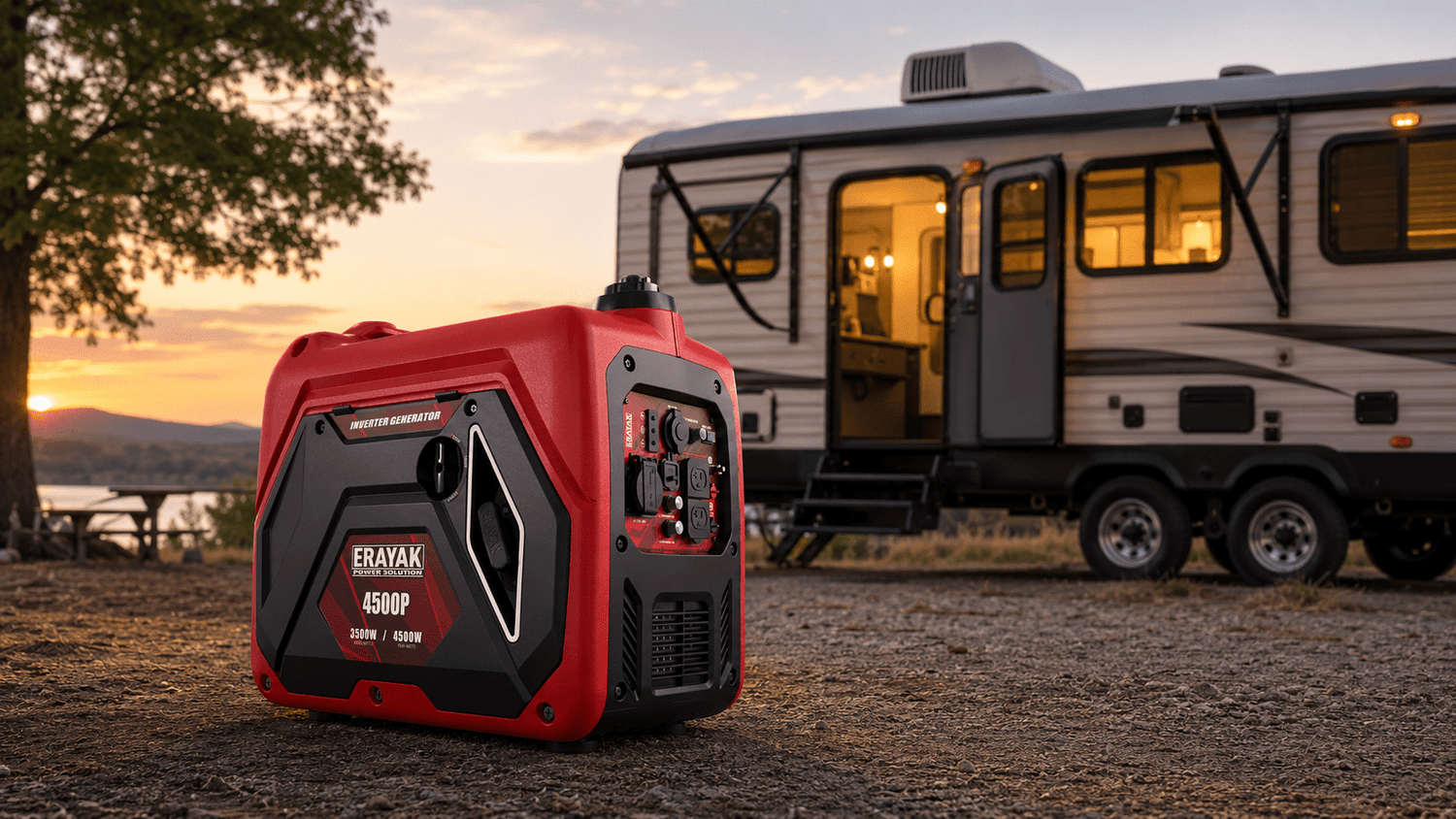
What Size Generator Do You Need for an RV Air Conditioner?
Running an RV air conditioner from a portable generator is one of the most common off-grid camping questions. The right generator size depends on your AC BTU rating, compressor startup surge, soft starter, altitude, temperature, and what else you want to power inside the RV.
Quick Answer
For many RV air conditioners, a 4,500W-class inverter generator is the most practical starting point. It gives enough headroom for a 13,500 BTU RV AC in many setups and can also support basic RV essentials such as lights, battery charging, phone charging, TV, microwave use management, and small electronics.
A 15,000 BTU RV AC or an RV AC without a soft starter may need more startup headroom. For larger RVs, multiple air conditioners, selected 120V/240V loads, or more demanding backup plans, consider the Erayak 6800 series.
How Many Watts Does an RV Air Conditioner Use?
RV air conditioner power use depends on BTU rating, compressor design, outdoor temperature, altitude, age of the AC unit, maintenance condition, and whether a soft starter is installed. The running watts are important, but the startup surge is usually the bigger generator-sizing challenge.
Running Watts
The power the RV AC uses after the compressor is already running. This is usually lower than startup demand.
Starting Watts
The brief surge needed when the compressor starts. This can be the difference between smooth cooling and generator overload.
Other RV Loads
Microwave, converter/charger, refrigerator, water heater controls, TV, lights, and chargers all share generator capacity.
RV Air Conditioner Generator Size Chart
Use this chart as a practical planning guide. Exact requirements vary by RV AC model, soft starter, temperature, altitude, and other connected loads.
| RV AC / Backup Setup | Estimated Running Watts | Estimated Starting Watts | Recommended Generator Class |
|---|---|---|---|
| Small RV AC or efficient 11,000 BTU unit | 1,000–1,500W | 2,000–3,500W | 2,400W–4,500W depending on model |
| 13,500 BTU RV AC | 1,200–1,800W | 3,000–4,500W | 4,500W-class recommended |
| 15,000 BTU RV AC | 1,500–2,200W | 3,500–5,500W | 4,500W–6,800W planning range |
| RV AC + battery charging + lights + electronics | 1,800–2,800W running possible | AC surge still matters | 4,500W-class recommended |
| RV AC + microwave use management | High temporary load | Avoid starting both at once | 4,500W–6,800W |
| Multiple RV AC units | High | High | 6,800W-class or larger planning range |
What Size Generator for a 13,500 BTU RV AC?
A 13,500 BTU RV air conditioner is one of the most common rooftop AC sizes for travel trailers, campers, and smaller motorhomes. For many 13,500 BTU RV AC setups, a 4,500W-class inverter generator is a practical choice because it provides startup headroom while leaving room for basic RV loads.
Load management still matters. Avoid starting the AC compressor while the microwave, electric water heater, or other high-demand appliances are running.
What Size Generator for a 15,000 BTU RV AC?
A 15,000 BTU RV AC usually needs more startup capacity than a 13,500 BTU unit. A 4,500W-class generator may work in some setups, especially with a soft starter and careful load management, but a larger generator gives more room for hot-weather starts and additional RV loads.
For a 15,000 BTU RV AC plus more appliances, the Erayak 6800 series is the stronger planning choice.
Do You Need a Soft Starter for RV AC?
A soft starter can reduce the compressor startup surge, which may help an RV AC start more smoothly on generator power. This can be especially helpful for 13,500 BTU and 15,000 BTU rooftop AC units, hot-weather starts, and smaller generator setups.
A soft starter does not eliminate the need for proper generator sizing. You still need enough running capacity for the AC and any other RV appliances connected at the same time.
RV AC + Microwave, Fridge, and Battery Charging
The real camping question is rarely “Can the generator run the AC only?” Most RV owners also want battery charging, lights, refrigerator operation, phone charging, Wi-Fi, TV, and occasional microwave use.
The microwave and RV AC can both be high-demand loads. If you are using a 4,500W-class generator, turn off or avoid high-load appliances while the AC compressor is starting.
| RV Scenario | What You Want to Power | Recommended Erayak Size |
|---|---|---|
| Small RV AC only | Basic cooling | Erayak 2400P only if AC specs and startup demand allow |
| 13,500 BTU RV AC + small essentials | Cooling, lights, charging, electronics | Erayak 4500P |
| 13,500 BTU RV AC + fuel flexibility | Cooling plus longer camping/outage planning | Erayak 4500PD |
| 15,000 BTU RV AC or heavier RV loads | Cooling plus more headroom | Erayak 6800 Series |
| Larger RV or multiple AC units | Higher-demand RV power plan | Erayak 6800 Series or larger planning range |
Why Inverter Generators Are Popular for RV AC
Inverter generators are popular for RV use because they provide stable power for air conditioners, chargers, electronics, laptops, TVs, and sensitive devices. They are also typically preferred for camping because RV owners care about noise, portability, and fuel efficiency.
For RV AC use, choose an inverter generator with enough startup capacity, the right RV outlet or adapter setup, and enough running power for your realistic camping load.
Best Erayak Generator for RV Air Conditioner Backup
Erayak 2400P: Compact Backup for Small Verified RV AC Loads
The Erayak 2400P may fit smaller RV AC or camping loads only when the AC running watts and startup demand are confirmed to be within capacity. It is best for carefully managed small-load setups.
- Good for compact camping power
- Useful for lights, charging, router, and small electronics
- Verify AC startup demand before relying on it for RV cooling
Erayak 4500P: Gas-Only RV AC Generator for Camping
The Erayak 4500P is a strong match for many RV owners who want a 4,500W-class inverter generator for a 13,500 BTU RV AC plus basic camping essentials.
- Gas-only portable inverter generator
- Manual recoil start
- 55 lb lightweight design
- 2.25 gal fuel tank
- Up to 8 hours runtime
- THD < 1.2% for sensitive electronics
- 60.5 dB noise level
Erayak 4500PD: Dual-Fuel Flexibility for RV AC
The Erayak 4500PD is a practical 4,500W-class option for RV AC use when campers want gasoline and propane flexibility for boondocking, RV parks, storm backup, and longer trips.
- Useful for RV AC plus camping essentials
- Dual-fuel flexibility for RV and outage preparedness
- Good match for travel trailers, camping, and portable power needs
Erayak 6800PD / 6800PT: More Headroom for Larger RV Loads
Choose the Erayak 6800 series when you need more surge margin, 120V/240V flexibility, or a larger RV and home backup plan.
- 6800W peak power
- 5000W rated power on gasoline at 100% output
- 30A L5-30R outlet
- 30A 120V/240V L14-30R outlet
- Dual 120V household outlets
- TT-30R RV adapter accessory included for RV connection
Runtime Tips for RV Air Conditioner Use
RV AC runtime depends on generator load, fuel capacity, outdoor temperature, insulation, shade, thermostat setting, and other RV appliances. Hot afternoons, poor shade, and high humidity can make the AC cycle more often and reduce runtime.
Pre-Cool the RV
Cool the RV before the hottest part of the day when possible.
Manage Big Loads
Avoid microwave, electric water heater, and AC compressor startup at the same time.
Reduce Heat Gain
Use shade, awnings, window covers, and realistic thermostat settings to reduce generator load.
RV Generator Safety Tips
Generator safety is critical around RVs, campsites, and travel trailers. A generator must run outdoors only, with exhaust directed away from people, RV windows, vents, doors, tents, and neighboring campsites.
- Operate the generator outdoors only.
- Never run a generator inside an RV, truck bed with cover, storage compartment, tent, or enclosed space.
- Keep exhaust away from RV windows, doors, roof vents, and neighboring campers.
- Use working carbon monoxide alarms inside the RV.
- Use properly rated cords and adapters.
- Do not overload the generator.
- Keep the generator dry and away from standing water.
- Let the generator cool before refueling.
- Follow campground generator-hour rules.
Power Your RV Air Conditioner with More Confidence
A 13,500 BTU RV AC usually points many campers toward a 4,500W-class inverter generator, while 15,000 BTU units and heavier RV loads may need more headroom. Choose the Erayak 4500P for gas-only RV AC power, the 4500PD for dual-fuel flexibility, or the 6800 series for larger RV and home backup plans.
FAQ: Generator for RV Air Conditioner
Can a generator run an RV air conditioner?
Yes. A generator can run an RV air conditioner if it has enough running watts, enough starting watts, and the correct RV connection setup.
What size generator do I need for an RV air conditioner?
For many RV AC setups, a 4,500W-class inverter generator is a practical starting point. Larger 15,000 BTU AC units, multiple ACs, or heavier RV loads may need more headroom.
What size generator for a 13,500 BTU RV AC?
For many 13,500 BTU RV AC units, a 4,500W-class inverter generator is a practical choice, especially when you want to run basic RV essentials at the same time.
What size generator for a 15,000 BTU RV AC?
A 15,000 BTU RV AC often needs more startup capacity. A 4,500W-class generator may work in some setups with load management or a soft starter, but a larger generator gives more margin.
Can a 2,000 watt generator run an RV AC?
A 2,000 watt generator is often too small for many standard RV rooftop air conditioners, especially without a soft starter. It may be suitable for smaller loads, but not most common RV AC setups.
Do I need a soft starter for RV AC generator use?
A soft starter can reduce compressor startup surge and may help an RV AC start more smoothly on generator power. It does not replace proper generator sizing.
Can I run RV AC and microwave on the same generator?
It depends on generator size and the exact loads. On a 4,500W-class generator, avoid running the microwave while the AC compressor is starting. Manage large loads one at a time.
What is the best Erayak generator for RV AC?
For many 13,500 BTU RV AC setups, consider the Erayak 4500P or 4500PD. For larger RV AC loads, 15,000 BTU units, or more headroom, consider the Erayak 6800 series.
