

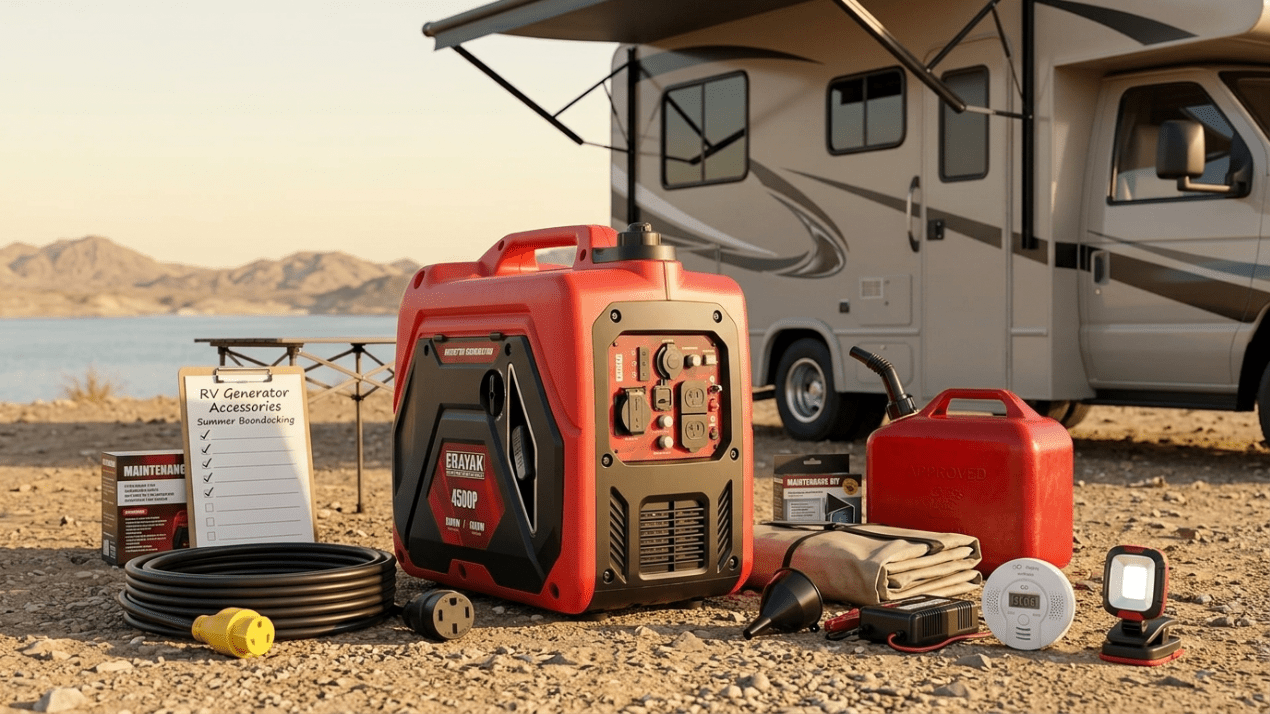
Best Inverter Generator for RV Use: 2026 Size, Noise & Power Guide
The best inverter generator for RV use is quiet enough for campgrounds, clean enough for sensitive electronics, and sized for the way you actually camp. For light RV loads, a 2,000W to 2,500W inverter can work well. For most 30 amp RVs with one rooftop AC, the practical range is usually 3,500W to 4,500W.
Quick Answer: What RV Inverter Generator Do You Really Need?
Choose a 2,000W to 2,500W inverter generator if you mainly charge batteries, run lights, fans, routers, laptops, and small appliances one at a time. Choose a 3,500W to 4,500W inverter generator if your RV has 30 amp service and you want to run one rooftop AC with managed essentials. Step up to a larger 120V/240V platform only when RV use overlaps with 50 amp selected loads, home backup, or larger pumps and circuits.
2,000W-2,500W for charging, electronics, small appliances, and quiet portability.
3,500W-4,500W is the most useful range for AC startup plus managed loads.
Use a selected-load plan and do not assume one portable unit replaces full shore power.
Why RV Owners Choose Inverter Generators
Inverter generators are popular for RV use because they electronically regulate output, allowing cleaner power and quieter operation than many conventional open-frame generators. That matters in campgrounds, around sensitive RV electronics, and during long boondocking stays.
Helpful for RV control boards, chargers, laptops, routers, TVs, and sensitive electronics.
Enclosed inverter models are usually more campground-friendly than open-frame generators.
Eco Mode can reduce engine speed under lighter loads, saving fuel and lowering sound.
RV Inverter Generator Size Chart
Do not size an RV generator by trailer length alone. Air conditioner size, 30A vs 50A service, altitude, temperature, converter charging, and appliance habits all matter.
| RV Use Case | Practical Inverter Generator Size | Best Fit | What to Watch |
|---|---|---|---|
| Battery charging, lights, fan, router, laptops, phone charging | 2,000W-2,500W | Light camping and boondocking | Usually not enough for standard rooftop AC. |
| Small camper, no AC, or AC with verified soft-start setup | 2,500W-3,500W | Compact RV power | AC startup can still overload smaller units. |
| 30 amp RV with one 13,500 or 15,000 BTU rooftop AC | 3,500W-4,500W | Most common full-RV comfort range | Manage microwave, coffee maker, electric heater, and water heater loads. |
| 50 amp RV, two ACs, or RV plus home backup use | 5,000W+ selected-load plan | Larger upgrade path | Portable generators usually do not replace full 50A shore power. |
What RV Appliances Actually Need
RV air conditioners and microwaves usually dominate generator sizing. Small electronics matter for clean power, but they rarely decide the generator class by themselves.
| RV Load | Typical Running Range | Startup Concern | Generator Planning Tip |
|---|---|---|---|
| Rooftop RV AC | Often 1,300W-1,800W depending on BTU and conditions | High compressor surge | Start AC before adding large appliances. |
| Microwave | Often 1,000W-1,500W input | High running draw | Use separately from AC startup when possible. |
| RV refrigerator | Varies by mode and model | Compressor or heating element behavior varies | Check the manual and current mode. |
| Converter charging, lights, routers, laptops, TV | Usually smaller combined loads | Converter draw changes with battery state | Still include them in your total load plan. |
Load sequencing matters: a generator that can run your AC may still overload if the microwave, coffee maker, and electric water heater are added at the wrong time.
Do You Need a 30A RV Outlet?
Most 30 amp RV owners should prioritize a generator or generator setup that supports a safe RV connection path. A standard 30 amp RV service is usually 120V, so the basic math is:
120V x 30A = 3,600 watts
That is the RV service limit. Generator peak watts can help with startup surge, but your RV inlet and breaker still limit continuous use.
A native RV-style outlet can simplify setup, but outlet shape is not enough. Confirm rated output, cord rating, adapter quality, grounding/neutral instructions, and the RV manual before plugging in.
Clean Power, Noise, and Fuel Choice
The best RV inverter generator is not just the one with the biggest wattage number. Look at clean power, noise level, fuel type, and how often you will move it.
Low-THD inverter output is better for electronics, chargers, control boards, CPAP devices, and entertainment systems.
Enclosed inverter generators are better for RV parks, crowded campsites, and quiet-hour compliance.
Gas-only is simple. Dual fuel adds propane flexibility for RV trips and outage planning.
Best Erayak Inverter Generator Matches for RV Use
Choose by your RV load pattern, not just by the biggest advertised wattage.
 Erayak 2400P: Light RV and Boondocking Loads
Choose the 2400P for battery charging, lights, fans, routers, laptops, phone charging, and smaller camping loads. It is the portable choice when you do not need to run a standard rooftop RV AC.
Compare the Erayak 2400P for Light RV Loads
Erayak 4500P: Gas-Only 30A RV Inverter Fit
The Erayak 4500P is the gas-only 4,500W-class fit for many 30 amp RV owners. It is gas only, manual recoil start, 55 lb class, with a 2.25 gal fuel tank, up to 8 hours runtime, 60.5 dB, and THD below 1.2%.
Compare the Erayak 4500P Gas Inverter Generator
 Erayak 4500PD: Dual-Fuel RV Comfort and Backup
The 4500PD is the main Erayak fit when RV inverter-generator shopping overlaps with propane flexibility, storm backup, refrigerator support, and longer off-grid trips. It is the better fit when fuel flexibility matters.
Compare the Erayak 4500PD Dual-Fuel Generator
Erayak 6800PD/PT: Larger RV and Home Backup Upgrade
Choose the 6800PD or 6800PT series when your RV generator plan overlaps with 120V/240V selected circuits, larger RV loads, sump pump, well pump, or home-backup planning.
See the Erayak 6800PD/PT 120V/240V UpgradeGenerator Safety for RV Camping
Never run a fuel generator indoors, inside an RV, in a tent, in a garage, in a storage compartment, under an awning, or near open windows, doors, or vents. Always operate outdoors with proper ventilation and follow the generator manual, RV manual, campground rules, and local safety requirements.
Use working carbon monoxide alarms inside the RV. Keep cords dry, rated for the load, and undamaged. Let the generator cool before refueling, and never use improvised wiring, unsafe adapters, or undersized extension cords.
FAQ: Best Inverter Generator for RV Use
What size inverter generator is best for RV use?
For light RV loads, a 2,000W to 2,500W inverter generator can work well. For most 30 amp RVs with one rooftop AC, a 3,500W to 4,500W inverter generator is usually the more practical range.
Will a 2,000 watt inverter generator run an RV air conditioner?
Usually not as a default expectation. A 2,000W-class inverter generator is better for battery charging, lights, fans, electronics, and smaller loads. Some special AC/soft-start setups may work, but verify before relying on it.
Is an inverter generator better for an RV than a regular generator?
Usually yes. Inverter generators are typically quieter, provide cleaner power for electronics, and can adjust engine speed under lighter loads. Conventional open-frame generators may cost less per watt but are often louder and less campground-friendly.
Do I need pure sine wave power for an RV?
Pure sine wave inverter power is strongly preferred for modern RV electronics, chargers, control boards, routers, laptops, TVs, CPAP machines, and sensitive devices.
Is dual fuel worth it for an RV inverter generator?
Dual fuel is useful if you want gasoline output plus propane storage flexibility. Gasoline often provides the strongest output, while propane can be convenient for camping and outage planning. Leave sizing margin for AC-heavy loads.
Can I parallel two inverter generators for an RV?
Only if the generators and parallel kit are manufacturer-approved for that setup. Do not use DIY parallel cables or mix incompatible models. In many cases, one properly sized RV inverter generator is simpler.
Can a portable inverter generator power a 50 amp RV?
It can power selected loads if connected through the correct rated equipment, but most portable inverter generators are not full 50 amp shore-power replacements. Plan around one AC or selected circuits unless the whole system is designed for more.
The Best RV Inverter Generator Matches Your Real Load
If you camp light, choose a smaller inverter generator for portability and quiet charging. If you want one rooftop AC plus normal 30 amp RV comfort loads, the 3,500W to 4,500W inverter class is the practical target. If RV power overlaps with home backup or 120V/240V planning, step up carefully and plan selected loads.


