

Why Your RV Generator Trips the GFCI: Floating Neutral, Open Ground & Safe Fixes
If your RV generator keeps tripping a GFCI outlet, the real cause might be a wet cord, a leaking appliance, a faulty RV circuit, or a floating-neutral generator that your RV surge protector reads as an open ground. The fix depends on which one you actually have.
Quick Answer: Why Does an RV Generator Trip a GFCI?
An RV generator usually trips a GFCI because the GFCI senses current leaking somewhere it should not, or because the generator and RV protection system do not agree on the neutral-ground reference. Common causes include moisture in a cord or outlet, a damaged adapter, a faulty RV appliance, a neutral-to-ground fault inside the RV, or a floating-neutral generator that triggers an RV EMS or surge protector open-ground warning.
A 30A RV neutral-ground bonding plug may help only when the problem is a compatible floating-neutral generator setup and your RV EMS or surge protector requires a bonded-neutral reference. It is not a cure for damaged wiring, real ground faults, wet connections, overloaded circuits, or unsafe modifications.
GFCI Trip or Breaker Trip: Why the Difference Matters
Many RV owners say their generator “trips the GFCI” when the real symptom may be different. A GFCI trip, a breaker trip, and an RV surge protector error point to different problems.
Shock-protection problem
A GFCI watches the current on hot and neutral. If current leaves one path and does not return on the expected path, the GFCI trips quickly to reduce shock risk.
Overload or short problem
A breaker usually trips because the load is too high, a short exists, or a motor/compressor surge is too much for the circuit or generator outlet.
Power-quality or wiring check
An RV EMS or surge protector may block power before the RV is energized if it detects open ground, reverse polarity, voltage problems, or a neutral-ground issue.
This is why the safest first step is not “buy a part.” The safest first step is identifying which protection device is stopping power and what message, button, light, or error code it shows.
Common Reasons an RV Generator Trips GFCI Power
The old assumption is that “the generator must be bad.” In many cases, the generator is producing power normally. The shutdown happens because the RV electrical system, cord, adapter, appliance, or protection device is detecting something it does not like.
1. Moisture in cords, adapters, or outlets
Rain, campground humidity, wet grass, or condensation can create leakage paths that a GFCI detects. This is especially common with extension cords, dogbone adapters, exterior RV receptacles, and shore-power inlets.
2. A damaged cord or adapter
A cracked plug, crushed cord, loose blade, heat-damaged adapter, or worn 30A connector can cause intermittent faults. If the trip happens when you move the cord, inspect that cord carefully and stop using damaged parts.
3. A faulty RV appliance or branch circuit
If the GFCI trips only after the refrigerator, water heater, converter, microwave, battery charger, or one outlet circuit is turned on, the issue may be inside that load or branch circuit rather than at the generator.
4. Neutral-to-ground leakage inside the RV
RVs should not randomly bond neutral and ground downstream of the proper bonding point. A wiring fault, pinched conductor, or appliance issue can create a path that makes a GFCI trip.
5. Floating-neutral generator compatibility
Many portable inverter generators use a floating neutral. That can be normal for portable use, but some RV EMS or surge protectors interpret it as open ground and refuse to pass power.
6. Trying to power the RV through the wrong outlet path
Using a small household GFCI receptacle, several adapters, or a long light-duty extension cord can add nuisance trips and voltage drop. A 30A RV setup should use properly rated cords and connectors.

Fast Diagnosis Table: Match the Symptom Before Choosing a Fix
Use this table as a practical first pass. It does not replace an electrician, but it helps separate a real fault from a compatibility issue.
| What You See | Likely Cause | What to Check First | Best Next Step |
|---|---|---|---|
| GFCI trips immediately with nothing plugged into the RV | Possible wiring fault | Generator outlet, cord, adapter, RV shore-power inlet, visible moisture | Stop and inspect. If it repeats with known-good cords, get qualified electrical help. |
| GFCI trips only when one RV appliance turns on | Load-specific fault | Refrigerator, converter, water heater, microwave, battery charger, affected circuit | Leave that load off and troubleshoot the appliance or branch circuit. |
| RV surge protector or EMS shows “open ground” on generator power | Floating neutral compatibility | Generator manual, EMS manual, whether the generator is floating neutral | A listed 30A RV neutral-ground bonding plug may help if your setup is compatible. |
| Breaker trips, but GFCI does not | Overload or surge | RV air conditioner, microwave, electric heater, converter charging load | Reduce load, start large appliances one at a time, or use a generator with more headroom. |
| Trip happens after rain or on wet ground | Moisture leakage | Cords, plug ends, adapters, outdoor receptacles, RV inlet cover | Dry and replace suspect parts. Do not keep resetting a wet GFCI circuit. |
| GFCI trips on one outlet but not another | Outlet or wiring difference | Which device is GFCI protected, adapter chain, outlet rating | Compare with a properly rated RV connection and avoid overloaded household outlet paths. |
Floating Neutral, Bonded Neutral, and “Open Ground” Warnings
This is the part that makes RV generator GFCI problems confusing. A floating-neutral generator can be normal, but some RV protection systems expect to see a neutral-ground reference before they allow power into the RV.
What a floating neutral means
In a floating-neutral generator, the neutral conductor is not bonded to the generator frame ground. Many portable inverter generators are built this way for standalone portable use. The generator can still make power, but an RV EMS may read the setup differently than campground shore power.
What a bonded neutral means
In a bonded-neutral system, neutral and ground are connected at the intended bonding point. Some RV surge protectors and EMS units look for that reference and may show “open ground” or refuse power if they do not see it.
Why this can look like a GFCI problem
Some owners describe every shutdown as a GFCI trip, but an EMS open-ground lockout is different. A GFCI reacts to leakage current. An EMS can block power during its pre-check because the neutral-ground relationship does not match what it expects. The result feels the same because your RV has no power, but the fix is not always the same.
Safety note: Do not guess the neutral configuration of your generator or RV. Check the generator manual, the RV EMS or surge protector instructions, and your RV electrical documentation. If you are unsure, ask a qualified electrician before adding any bonding device or changing how the RV is powered.
When a 30A RV Neutral-Ground Bonding Plug May Help
A neutral-ground bonding plug is not a bypass and not a universal repair. It is a specific accessory for a specific situation: a compatible floating-neutral portable generator feeding an RV setup where the RV EMS or surge protector requires a bonded-neutral reference.

ERAYAK 30A RV Neutral-Ground Bonding Plug
The ERAYAK 30A RV Neutral-Ground Bonding Plug is designed for compatible 30A floating-neutral generator setups. It helps certain RV EMS or surge protector systems clear an open-ground type error by creating the neutral-ground reference those systems expect.
Use it only when the setup matches
- Best fit: compatible floating-neutral portable generator plus RV EMS/open-ground error.
- Not for campground shore-power pedestals or household outlets.
- Not for a generator that already has the required neutral bond unless the manual says it is appropriate.
- Not a fix for wet cords, damaged adapters, faulty RV appliances, or real ground faults.
When it makes sense to consider one
Consider a 30A RV bonding plug only after you confirm that the shutdown is not caused by moisture, cord damage, an appliance fault, or a breaker overload. The strongest clue is an RV surge protector or EMS showing “open ground” when the generator is running normally and the generator manual identifies the unit as floating neutral.
When it is the wrong fix
If the GFCI trips because current is leaking through a wet connection, damaged cord, faulty appliance, or incorrect RV wiring, adding a bonding plug does not solve the real problem. It may mask the symptom while the unsafe condition remains. In those cases, stop using the setup until the fault is found.

Safe Troubleshooting Steps Before Your Trip
Use this sequence before assuming the generator, the GFCI, or the RV is the only problem.
Step 1: Identify what actually trips
Look at the generator outlet, RV GFCI outlet, RV breaker panel, and any EMS or surge protector display. Write down whether the symptom is a GFCI reset button popping, a breaker opening, or an EMS error code.
Step 2: Remove the RV load
Disconnect the RV and test the generator with a small known-good load according to the generator manual. If the generator outlet trips with a simple load, the issue may be at the generator outlet or cord path.
Step 3: Inspect cords and adapters
Look for heat marks, loose blades, cracks, crushed insulation, moisture, corrosion, or undersized extension cords. Replace suspect cords instead of repeatedly resetting protection devices.
Step 4: Turn RV loads on one at a time
Start with the main breaker off, then energize branch circuits gradually. If one appliance or circuit causes the trip, that area deserves closer inspection.
Step 5: Check generator neutral guidance
Read the generator manual for floating-neutral or bonded-neutral language. Also check your RV EMS or surge protector instructions for generator use and open-ground behavior.
Step 6: Use the right accessory only if confirmed
If your setup is a compatible 30A floating-neutral generator and the problem is an EMS/open-ground lockout, a listed RV neutral-ground bonding plug may be the correct accessory.
What Not to Do When a GFCI Keeps Tripping
A tripping GFCI is annoying, but it is also doing an important job. Treat repeat trips as information, not as something to defeat.
Do not bypass the GFCI
Do not remove ground pins, use cheater adapters, tape down reset buttons, or intentionally defeat shock-protection devices. If a GFCI trips repeatedly, find the cause.
Do not build an improvised bonding plug
Use a properly made product intended for the job, and only in the correct setup. Improper wiring can create shock hazards or equipment damage.
Do not modify generator wiring casually
Permanent neutral bonding changes can affect generator safety, warranty, transfer equipment, and code compliance. Leave internal generator wiring changes to qualified professionals.
Do not run a fuel generator indoors
Fuel-powered generators must run outdoors with proper ventilation. Never operate one inside an RV, home, garage, shed, enclosed porch, or near open windows, doors, or vents.
Choosing RV Generator Power With Fewer Compatibility Surprises
If you are shopping for an RV generator, do not look only at wattage. Also look at outlet type, cord rating, RV EMS behavior, fuel preference, noise expectations, and whether your setup needs a neutral-ground reference accessory.
| RV Power Question | Why It Matters | What to Look For |
|---|---|---|
| Do you need 30A RV-style power? | A 30A RV connection is cleaner than running several adapters through small household outlets. | A generator setup with properly rated 30A RV connection support and cords. |
| Will you use an RV EMS or surge protector? | Some protection devices check for open ground or neutral-ground reference before passing power. | Read both the generator manual and the EMS manual before the first trip. |
| Are you running an RV air conditioner? | Air conditioners need startup surge headroom, not just running watts. | Choose enough wattage margin and avoid starting microwave, heater, and AC together. |
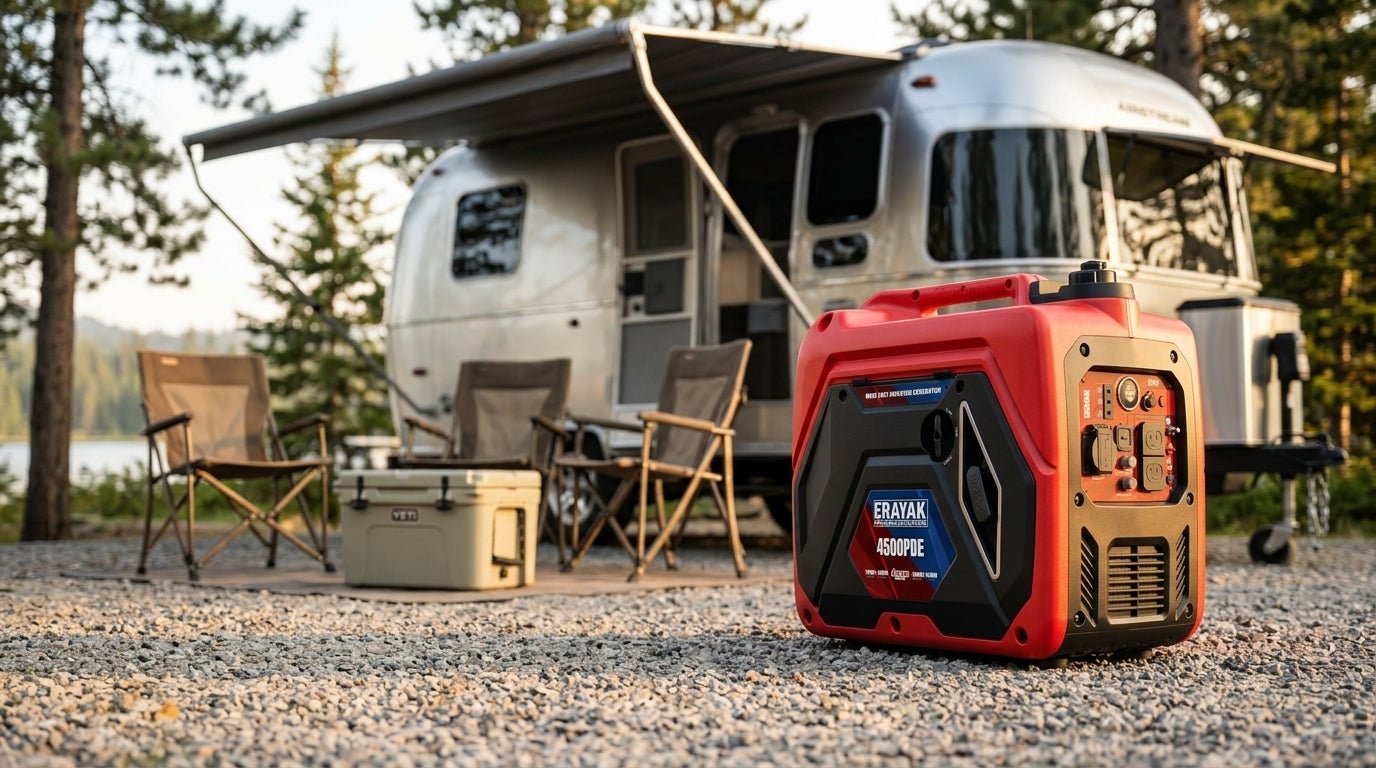
| Do you want propane flexibility? | Propane can be useful for camping storage and storm readiness, but output and runtime planning still matter. | A dual-fuel inverter generator such as the Erayak 4500PD can fit many 30A RV camping scenarios. |

Erayak 4500PD for 30A RV Camping Setups
For RV owners who want portable inverter power with gasoline and propane flexibility, the Erayak 4500PD is a natural match for many 30A RV camping and boondocking scenarios. Pair the generator with properly rated RV cords, follow the generator manual, and confirm EMS or surge protector requirements before relying on the setup in the field.
Important compatibility reminder
Generator wattage and generator grounding are separate questions. A generator can have enough power and still need the right cord, EMS setup, or neutral-ground guidance for your RV system.
Bottom Line
If your RV generator trips the GFCI outlet, do not assume the generator is defective and do not bypass safety protection. Start by identifying whether you have a real GFCI trip, a breaker overload, or an RV EMS open-ground warning.
For wet cords, damaged adapters, faulty appliances, or RV wiring faults, fix the fault. For a compatible floating-neutral generator that triggers an RV EMS open-ground warning, a 30A RV neutral-ground bonding plug may be the right accessory. The safer answer is always the one that matches the actual symptom.
FAQ: RV Generator GFCI Trips, Open Ground, and Bonding Plugs
Why does my generator keep tripping the GFCI?
Your generator may trip a GFCI because the GFCI detects leakage current, moisture, a damaged cord, a faulty appliance, or a wiring fault. In RV setups, some owners also confuse an RV EMS open-ground lockout with a GFCI trip, especially when using a floating-neutral portable generator.
Can a floating-neutral generator cause an RV power problem?
Yes. A floating-neutral generator can be normal for portable use, but some RV surge protectors or EMS units require a neutral-ground reference before they allow power into the RV. That may show up as an open-ground warning or no power at the RV.
Will a neutral-ground bonding plug fix every GFCI trip?
No. A bonding plug is only for compatible floating-neutral generator setups where the RV EMS or surge protector requires a bonded-neutral reference. It will not fix wet cords, damaged adapters, faulty appliances, overloaded circuits, or real ground faults.
Is it safe to bypass a GFCI on an RV generator?
No. Do not bypass a GFCI, remove a ground pin, or defeat safety protection. A repeat GFCI trip should be treated as a warning that needs diagnosis.
Can I use a 30A RV bonding plug at a campground pedestal?
No. A 30A RV neutral-ground bonding plug is intended for compatible portable generator setups, not campground shore-power pedestals, household outlets, or unknown electrical systems.
What should I check first if my RV GFCI keeps tripping with nothing plugged in?
Check for moisture, damaged cords, bad adapters, and visible issues at the RV inlet or generator outlet. If it still trips with known-good cords and no loads connected, stop using the setup and get qualified electrical help.
Does a breaker trip mean the same thing as a GFCI trip?
No. A breaker usually trips because of overload, short circuit, or high startup surge. A GFCI trips because it detects current imbalance that may indicate leakage or shock risk. The troubleshooting path is different.


