

What Size Generator Do I Need?
The right generator size depends on what you want to power at the same time, how much startup wattage your appliances need, and whether your backup plan is for light electronics, home essentials, pumps, cooling, tools, or selected circuits.
Quick Answer
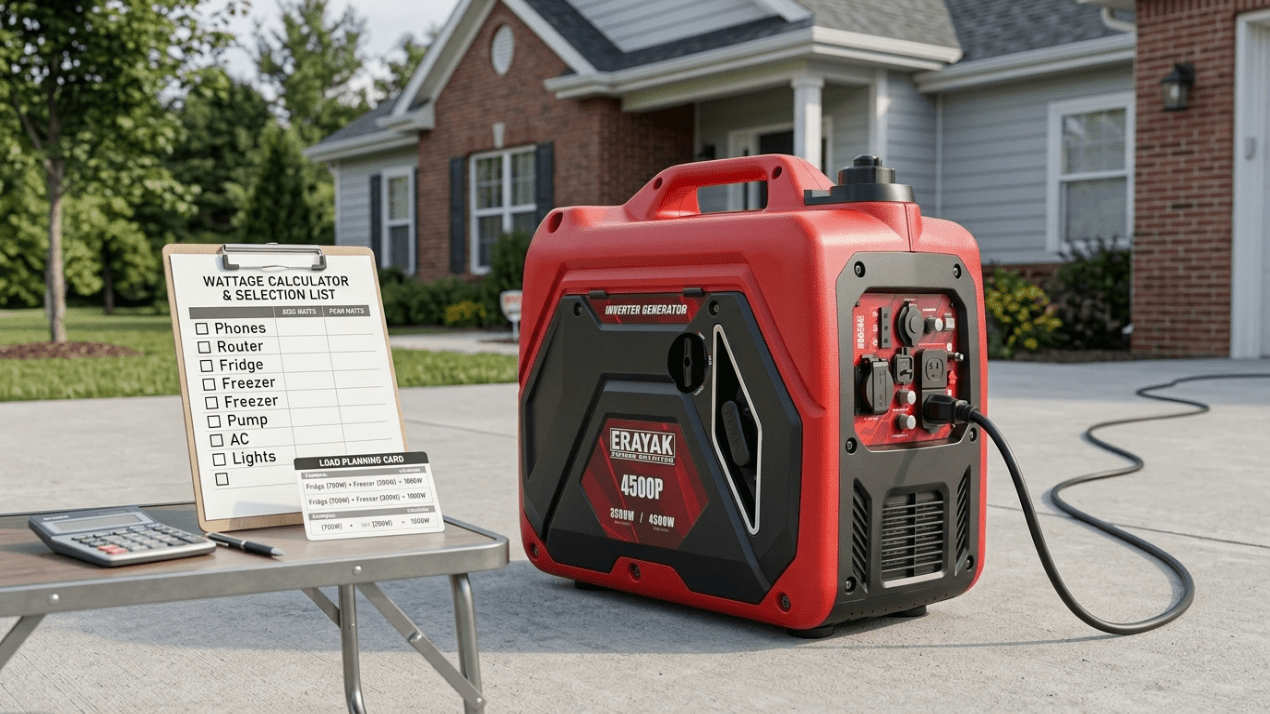
For phones, router, modem, laptop, TV, LED lights, and small fans, a 2,400W-class inverter generator is often enough. For refrigerator, freezer, lights, router, sump pump, coffee maker rotation, and basic home essentials, a 4,500W-class inverter generator is usually a better starting point.
For selected circuits, larger pump loads, 120V/240V planning, refrigerator, freezer, lights, communication, and more surge headroom, consider a 6,800W-class generator. The best choice is not the biggest generator; it is the generator that matches your real load list with enough margin for startup watts.
The Simple Generator Sizing Formula
Start by listing every appliance or device you want to run at the same time. Add the running watts, then identify the largest startup load that may turn on while everything else is running.
A phone charger or LED light uses very little power. A refrigerator, freezer, sump pump, air conditioner, or power tool may need extra startup watts. This is why two homes with the same number of appliances may need different generator sizes.
Running Watts vs Starting Watts
Running watts are the power a device uses after it is already operating. Starting watts are the temporary extra power needed when a motor or compressor starts. Generator sizing should consider both.
| Load Type | Examples | Sizing Note |
|---|---|---|
| Low-power electronics | Phones, router, modem, LED lights | Usually easy to combine with other loads |
| Sensitive electronics | Laptop, TV, monitor, computer, UPS | Inverter generators are a good fit |
| Compressor loads | Refrigerator, freezer, window AC, portable AC | Allow extra startup wattage |
| Motor loads | Sump pump, well pump, power tools | Startup watts can be much higher than running watts |
| Heating loads | Coffee maker, microwave, electric heater | Often high wattage; rotate separately when possible |
Generator Size Chart by Use Case
| Use Case | Typical Loads | Recommended Class | Erayak Fit |
|---|---|---|---|
| Light outage backup | Phones, router, modem, laptop, lights | 2,000W–2,400W | Erayak 2400P |
| Home office backup | Router, laptop, monitor, UPS, phone charging | 2,400W | Erayak 2400P |
| Refrigerator and freezer backup | Fridge, freezer, lights, router, charging | 4,500W-class | Erayak 4500P or 4500PD |
| Storm essentials | Fridge, freezer, sump pump, lights, communication | 4,500W-class or larger | Erayak 4500P / 4500PD / 6800 Series |
| Winter essentials | Heating controls, pellet stove, boiler pump, heat tape, lights | 2,400W–4,500W | Erayak 2400P or 4500P |
| Selected circuits | Pumps, refrigerator, freezer, lights, router, selected home circuits | 6,800W-class | Erayak 6800 Series |
What Can 2400W, 4500W, and 6800W Generators Run?
Light Essentials
Best for router, modem, phones, laptop, LED lights, TV, small fan, battery chargers, and compact emergency backup.
Home Essentials
Better for refrigerator, freezer, lights, router, phone charging, TV, fans, sump pump planning, and rotating convenience loads.
More Headroom
Useful for selected circuits, larger pump loads, refrigeration, communication, lighting, and 120V/240V backup planning.
The same generator can support different load combinations depending on timing. For example, a 4,500W-class generator may run refrigerator, freezer, lights, router, TV, and charging loads, but microwave or coffee maker use should usually be rotated instead of stacked with compressor startup.
Common Generator Sizing Mistakes
| Mistake | Why It Matters | Better Approach |
|---|---|---|
| Ignoring startup watts | Motors and compressors may overload the generator when starting | Plan for the largest startup load |
| Running everything at once | High-watt loads can stack quickly | Rotate microwave, coffee maker, pumps, and AC loads |
| Choosing only by peak watts | Peak watts are temporary, not continuous | Size around rated running watts |
| Using cords that are too small | Undersized cords can overheat | Use properly rated outdoor extension cords |
| Buying without checking outlets | The generator may not match your plug or circuit plan | Check outlet type, amperage, and voltage needs first |
Best Erayak Generator by Wattage Need
Erayak 2400P: For Light Essentials and Electronics
Choose the Erayak 2400P for phones, router, modem, laptop, TV, LED lights, small fans, and compact emergency backup.
- Good for small essential loads
- Useful for communication and electronics backup
- Best when larger appliances are limited or rotated carefully
Erayak 4500P: For Gas-Only Home Essentials
Choose the Erayak 4500P for refrigerator, freezer, lights, router, phone charging, TV, fans, and managed home essentials.
- Gas-only portable inverter generator
- Manual recoil start
- 55 lb lightweight design
- 2.25 gal fuel tank
- Up to 8 hours runtime
- THD < 1.2% for sensitive electronics
- 60.5 dB noise level
Erayak 4500PD: For Dual-Fuel Flexibility
Choose the Erayak 4500PD if you want 4,500W-class inverter generator capacity with gasoline and propane flexibility for outages and home essentials.
- Gasoline and propane flexibility
- Useful for refrigerator, freezer, lights, router, charging, and fans
- Good fit when fuel availability may change during an outage
Erayak 6800PD / 6800PT: For Selected Circuits and More Headroom
Choose the Erayak 6800 series when your backup plan includes selected circuits, larger pump loads, refrigerator, freezer, communication, lighting, and more surge margin.
- 6800W peak power
- 5000W rated power on gasoline at 100% output
- 30A L5-30R outlet
- 30A 120V/240V L14-30R outlet
- Dual 120V household outlets
- TT-30R RV adapter accessory included
Generator Safety Basics
Generator sizing matters, but safe operation matters more. Portable generators produce carbon monoxide and must be used outdoors only.
- Run the generator outdoors only.
- Keep it far away from doors, windows, vents, garages, crawlspaces, and attached structures.
- Point exhaust away from your home and neighboring homes.
- Use working carbon monoxide alarms on every level of the home and near sleeping areas.
- Keep the generator dry and away from standing water.
- Use properly rated outdoor extension cords.
- Do not plug a generator into a wall outlet.
- Use a professionally installed transfer switch for home circuit connection.
- Let the generator cool before refueling.
- Store fuel in approved containers away from living areas and ignition sources.
Choose the Right Generator Size
For light essentials, choose the Erayak 2400P. For refrigerator, freezer, lights, router, charging, and home essentials, choose the Erayak 4500P or 4500PD. For selected circuits and more headroom, choose the Erayak 6800 series.
FAQ: What Size Generator Do I Need?
What size generator do I need for basic home backup?
For phones, router, laptop, LED lights, TV, and small fans, a 2,400W-class inverter generator may work well. For refrigerator, freezer, lights, router, charging, fans, and managed home essentials, a 4,500W-class generator is often more practical.
What size generator do I need for refrigerator and freezer?
A 4,500W-class inverter generator is a practical starting point for refrigerator, freezer, lights, router, phone charging, TV, and small essentials. Start compressor loads one at a time.
Can a 2400 watt generator run home essentials?
It can run light essentials such as router, modem, phones, laptop, TV, LED lights, and small fans. Larger appliances such as refrigerator, freezer, pumps, AC, microwave, and coffee maker require more careful load management.
What can a 4500 watt generator run?
A 4,500W-class generator can often support refrigerator, freezer, lights, router, phone charging, TV, fans, and managed convenience loads. Startup loads should be staggered.
What can a 6800 watt generator run?
A 6,800W-class generator provides more headroom for selected circuits, larger pump loads, refrigerator, freezer, lighting, communication, and 120V/240V planning.
Should I choose a generator based on peak watts or rated watts?
Use rated watts for continuous load planning and peak watts for temporary startup surge planning. Do not size your generator only by peak watts.
What is the best Erayak generator size for me?
Choose the Erayak 2400P for light essentials, the Erayak 4500P for gas-only home essentials, the Erayak 4500PD for dual-fuel flexibility, and the Erayak 6800 series for selected circuits and more headroom.
