

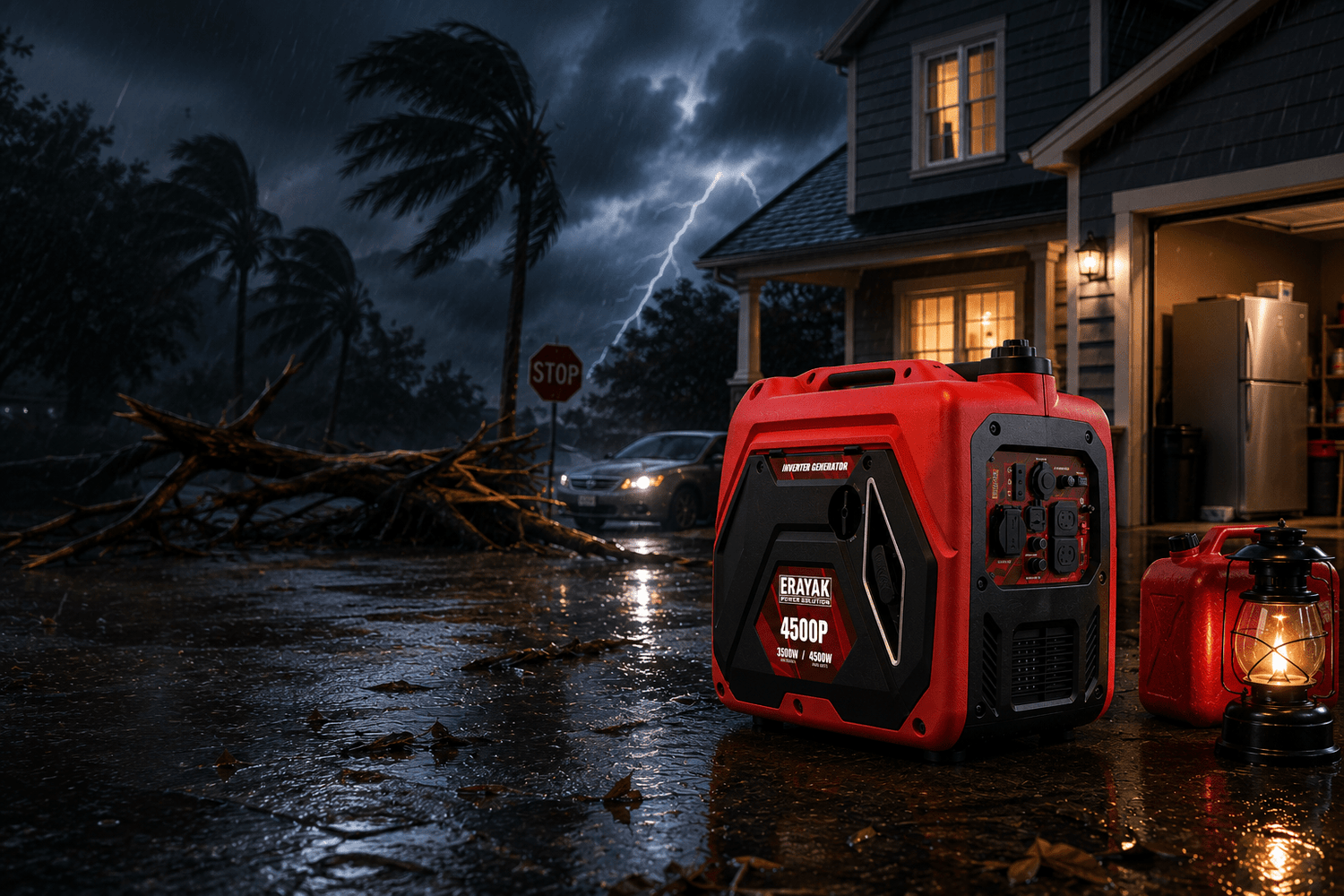
What Can a 4500 Watt Generator Run During a Hurricane Outage?
A 4500 watt generator can be one of the most practical sizes for hurricane season because it can cover food storage, communication, lighting, charging, fans, and one carefully managed larger load. The key is knowing what to run first, what to rotate, and what should be left off.
Quick Answer
During a hurricane outage, a 4500 watt generator can often run a refrigerator, freezer, LED lights, Wi-Fi router or modem, phone charging, laptop, TV, small fans, and one managed larger load such as a window AC, portable AC, sump pump, or microwave used briefly.
A 4500W-class generator should not be treated like whole-house power. Avoid starting several motor-driven appliances at once. Refrigerators, freezers, sump pumps, window AC units, and portable AC units can all have startup surge. Start large loads one at a time, let them stabilize, then add smaller electronics and lights.
What a 4500 Watt Generator Can Run During a Hurricane
A 4500W-class generator is best for a smart emergency load plan, not for powering every circuit in the house. In a real hurricane outage, the most important loads are usually food preservation, communication, basic lighting, device charging, air movement, and limited cooling or water management.
Refrigerator + Freezer
A 4500 watt generator can often support a refrigerator and freezer together when startup surges are managed carefully.
Router + Phones + Laptop
Communication loads are usually small and important for weather alerts, emergency updates, and contacting family.
Fan or Small Cooling Load
A fan is easy to run. A window AC or portable AC may also fit, but compressor startup watts must be checked.
Hurricane Priority Load List
The best hurricane generator plan starts with priorities. Instead of asking, “Can I run my whole house?” ask, “Which loads must stay on, which can rotate, and which should stay off?”
| Priority Level | Example Loads | How to Use Them |
|---|---|---|
| Must-have essentials | Refrigerator, freezer, phone charging, LED lights, medical or safety essentials | Plan these first before adding comfort appliances |
| Communication | Router, modem, laptop, radio, TV for updates | Usually easy to run with essentials |
| Water and storm protection | Small sump pump, utility pump, dehumidifier after storm | Check startup watts and run one large motor load at a time |
| Cooling comfort | Fans, small window AC, portable AC | Use one cooling zone instead of trying to cool the entire house |
| Rotating convenience loads | Microwave, coffee maker, small cooking appliance | Use briefly and turn off other large loads first |
| Usually avoid | Central AC, electric range, electric water heater, clothes dryer | These are usually too large for a 4500W-class portable generator |
4500W Hurricane Appliance Chart
Use this as a practical planning guide. Exact wattage depends on appliance model, age, efficiency, voltage, motor size, and startup surge.
| Appliance / Load | Load Type | 4500W-Class Fit | Planning Note |
|---|---|---|---|
| Refrigerator | Low running load, higher startup surge | Yes | Start before adding AC, pump, or microwave |
| Deep freezer | Low running load, startup surge | Yes | Good hurricane priority load for food storage |
| LED lights | Low | Yes | Use efficient bulbs to preserve capacity |
| Router / modem | Low | Yes | Useful when internet service remains available |
| Phones / laptop | Low | Yes | Charge devices while generator is already running |
| Small fan | Low | Yes | Good hot-weather storm comfort load |
| Small sump pump | Moderate running load, high startup surge | Often yes | Confirm pump HP, voltage, and starting watts |
| Window AC | Moderate running load, compressor startup surge | Often yes | Best used as one-room cooling with load management |
| Portable AC | Moderate running load, compressor startup surge | Often yes | Check BTU rating and appliance label |
| Microwave | High temporary load | Yes, with timing | Use briefly; avoid AC or pump startup at the same time |
| Coffee maker | High heating load | Yes, with timing | Run separately from microwave, AC, and pump startup |
| Central AC | Very high startup and running load | Usually no | Use a window AC or portable AC instead |
| Electric water heater | High continuous load | Usually no | Not a good fit for a 4500W emergency setup |
| Electric range or clothes dryer | Very high load | No | Use alternative storm cooking and drying plans |
Why Startup Watts Matter During Hurricane Outages
Many hurricane essentials use motors or compressors. A refrigerator, freezer, sump pump, window AC, or portable AC may run at a moderate wattage after it starts, but it can demand a short surge of power at startup.
That startup surge is why load timing matters. Start the refrigerator first. Add the freezer next. Then add lights, router, phone charging, and fans. Use the microwave, coffee maker, pump, or cooling appliance as managed loads instead of starting everything at once.
Sample 4500W Hurricane Backup Plans
These examples show how a 4500W-class generator can be used during a hurricane outage. The exact result depends on your appliance labels and startup watts.
| Backup Plan | Example Loads | Best Use Case |
|---|---|---|
| Food + Communication | Refrigerator, freezer, LED lights, router, phones, laptop | Best basic hurricane outage setup |
| Food + Flood Protection | Refrigerator, freezer, small sump pump, lights, charging | Good for homes with basement or storm-water risk |
| Food + Cooling Room | Refrigerator, lights, router, small window AC or portable AC | Good hot-weather hurricane plan |
| Communication + Comfort | Router, phones, laptop, TV, lights, fans, refrigerator | Good for staying informed and comfortable |
| Cooking Rotation | Refrigerator, lights, charging, microwave used briefly | Turn off AC or pump while using microwave |
| Larger Selected-Circuit Backup | Multiple essentials, larger pump, selected circuits, 120V/240V needs | Step up to Erayak 6800 series |
What Not to Run on a 4500 Watt Generator
A 4500 watt generator can cover a strong emergency setup, but it is not a full whole-house standby generator. Some appliances are too demanding, especially during startup or continuous heating.
For larger selected circuits, 120V/240V planning, or more surge margin, move up to a larger generator platform such as the Erayak 6800 series and use a professionally installed transfer switch where home circuits are involved.
Gasoline vs Dual-Fuel Hurricane Planning
Fuel planning is part of hurricane preparedness. Gasoline is common and easy to use, but fuel stations may be closed or crowded after a storm. Propane stores longer and can be useful for preparedness, but runtime and output depend on the generator and propane setup.
Simple Storm Backup
Choose a gas-only generator when you want straightforward operation and easy refueling before a storm.
More Fuel Flexibility
Choose dual-fuel when you want the option to use gasoline or propane during extended outages.
Plan Before Landfall
Test your generator, inspect cords, prepare fuel safely, and decide which appliances matter most before the storm arrives.
Best Erayak Generator for Hurricane Power Outages
Erayak 2400P: Compact Backup for Light Storm Essentials
The Erayak 2400P is a compact inverter generator for lights, router, phone charging, laptop, TV, small fans, and carefully verified light emergency loads.
- Good for communication and small electronics
- Useful for light emergency backup
- Best when refrigerator, pump, AC, and microwave loads are limited or rotated carefully
Erayak 4500P: Best Starting Point for Hurricane Essentials
The Erayak 4500P is a strong gas-only 4500W-class inverter generator for hurricane power outages, including refrigerator, freezer, lights, router, phone charging, small fans, and managed pump or cooling loads.
- Gas-only portable inverter generator
- Manual recoil start
- 55 lb lightweight design
- 2.25 gal fuel tank
- Up to 8 hours runtime
- THD < 1.2% for sensitive electronics
- 60.5 dB noise level
Erayak 4500PD: Dual-Fuel Flexibility for Hurricane Season
The Erayak 4500PD is a practical 4500W-class option for storm preparedness when you want the flexibility to switch between gasoline and propane.
- Useful for refrigerator, freezer, lights, router, and charging
- Dual-fuel flexibility for emergency planning
- Good match for hurricane season and extended outage preparation
Erayak 6800PD / 6800PT: More Headroom for Selected-Circuit Backup
Choose the Erayak 6800 series when your hurricane plan includes larger selected circuits, 120V/240V flexibility, or more surge margin.
- 6800W peak power
- 5000W rated power on gasoline at 100% output
- 30A L5-30R outlet
- 30A 120V/240V L14-30R outlet
- Dual 120V household outlets
- TT-30R RV adapter accessory included
Hurricane Generator Safety Checklist
Hurricane outages create extra generator risks because of rain, flooding, heat, damaged power lines, fuel shortages, and carbon monoxide danger. Safety should come before convenience.
- Run the generator outdoors only.
- Keep the generator at least 20 feet away from doors, windows, vents, crawlspaces, garages, and attached structures.
- Point exhaust away from your home and neighboring homes.
- Never run a generator indoors, in a garage, in a basement, on a porch, or in any partially enclosed area.
- Use working carbon monoxide alarms on every level of the home and near sleeping areas.
- Keep the generator dry and away from standing water.
- Use properly rated outdoor extension cords.
- Do not plug a generator into a wall outlet.
- Use a professionally installed transfer switch for home circuit connection.
- Let the generator cool before refueling.
- Store fuel in approved containers away from living areas and ignition sources.
Build a Smarter Hurricane Backup Plan
A 4500W-class inverter generator can cover many storm essentials when loads are managed correctly. Choose the Erayak 4500P for gas-only hurricane backup, the 4500PD for dual-fuel flexibility, or the 6800 series for larger selected-circuit backup plans.
FAQ: 4500 Watt Generator for Hurricane Outages
What can a 4500 watt generator run during a hurricane?
A 4500 watt generator can often run a refrigerator, freezer, LED lights, router, phones, laptop, TV, small fan, and one managed larger load such as a window AC, portable AC, sump pump, or microwave used briefly.
Can a 4500 watt generator run a refrigerator and freezer?
Yes, in many setups. Refrigerator and freezer startup surges must be managed, and you should avoid starting them at the same time as a pump, AC compressor, or microwave.
Can a 4500 watt generator run a window air conditioner?
Often yes, depending on the window AC size and startup watts. A small or mid-size 120V window AC is a common hurricane comfort load, but you should manage other appliances carefully.
Can a 4500 watt generator run a portable air conditioner?
Often yes, depending on portable AC size, compressor startup watts, and other loads. Run the AC after refrigerator and freezer loads have stabilized, and avoid using the microwave or coffee maker at the same time.
Can a 4500 watt generator run a sump pump?
Often yes for smaller 120V sump pumps, but pump horsepower, voltage, and starting watts matter. Check the pump label before relying on generator power during storm flooding.
Can a 4500 watt generator run central AC?
Usually no. Central air conditioning typically requires much more startup and running power than a portable 4500W-class generator can provide.
Is a 4500 watt inverter generator good for hurricane season?
Yes. A 4500W-class inverter generator is a practical size for many hurricane essentials because it balances usable capacity, portability, electronics-friendly power, and fuel planning.
Should I choose gas or dual-fuel for hurricane backup?
Gas-only generators are simple and widely supported. Dual-fuel generators add flexibility because they can use gasoline or propane, which may help with fuel planning during storm season.
What is the best Erayak generator for hurricane outages?
For light essentials, consider the Erayak 2400P. For refrigerator, freezer, lights, router, charging, and managed pump or AC loads, consider the Erayak 4500P or 4500PD. For selected circuits and more headroom, consider the Erayak 6800 series.

