

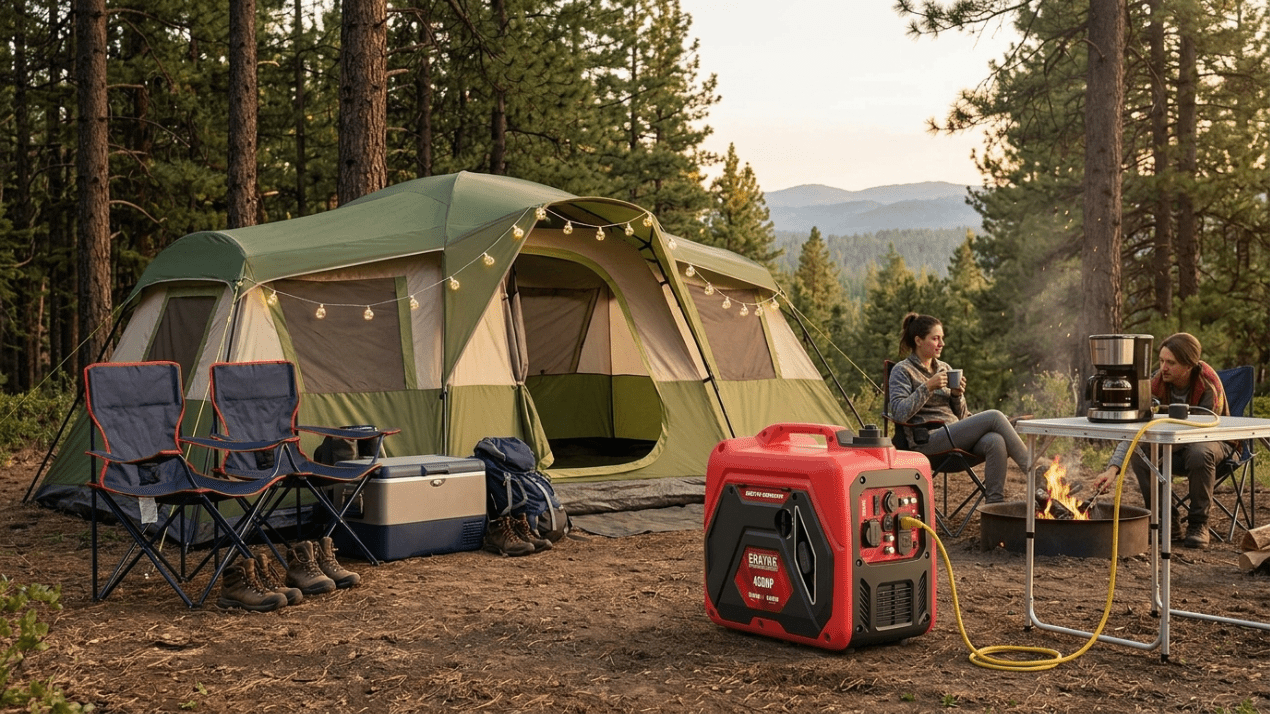
Weekend Campsite Power Setup: Generator Solution for Camping
A good weekend campsite power setup is not just about plugging things in. It is about building a simple system: safe generator placement, a charging table, efficient lighting, planned cooking windows, cooler support, quiet-hour strategy, and a clear routine for Friday night, Saturday, and Sunday morning.
Quick Answer
For a weekend campsite, set up the generator away from tents, vehicles, sleeping areas, and fire. Run one outdoor-rated extension cord to a central power table. Use that table for LED lights, phone charging, camera batteries, laptop charging, a small fan, and portable speaker. Use higher-watt camp kitchen appliances such as coffee makers or electric griddles only during planned cooking windows.
The Erayak 2400P is a strong match for a compact campsite charging station, lights, fans, and basic comfort loads. The Erayak 4500P or 4500PD is better for family campsites, portable cooler support, coffee maker rotation, outdoor kitchen use, and longer weekend setups.
The Ideal Campsite Power Layout
Think of your campsite as three zones: the generator zone, the power table, and the living area. The generator stays outdoors and away from tents, sleeping areas, vehicles, and enclosed spaces. The power table sits closer to camp activity, and the living area uses lights, fans, and charging devices from that table.
Generator Zone
Place the generator outdoors on dry stable ground, with exhaust pointed away from tents, people, vehicles, and neighboring campsites.
Power Table
Use a folding table as the central charging station for phones, cameras, lights, power banks, fans, and small electronics.
Living Area
Keep tents, chairs, cooking gear, and sleeping areas separate from generator exhaust, fuel, and hot engine parts.
Friday Night Setup Plan
Friday night is usually about arrival, tent setup, basic lighting, phone charging, and getting comfortable. Keep it simple: place the generator safely, set up the charging table, connect low-power essentials, and avoid high-watt cooking loads until the camp is fully organized.
| Friday Task | Power Setup | Why It Works |
|---|---|---|
| Set up camp lighting | LED lanterns and string lights | Low load, high usefulness, easy to run with charging |
| Charge phones and power banks | Use the central power table | Keeps cords organized and reduces overnight generator use |
| Run a small fan | Use only where needed | Comfort load that pairs well with lights and charging |
| Inflate air mattress | Use air pump briefly | Short-use load; finish before quiet hours |
| Prepare for overnight | Charge devices before bed | Reduces the need to run the generator late |
Saturday Power Routine
Saturday is when most campsite power demand happens. Breakfast, coffee, cooler support, camera charging, phones, fans, and evening lighting all compete for power. The solution is not to run everything at once; it is to use time blocks.
| Time Block | Power Priority | Recommended Approach |
|---|---|---|
| Morning | Coffee maker or kettle | Run coffee first, then return to lights, phones, and cooler support |
| Late morning | Charging station | Charge phones, camera batteries, power banks, and laptop |
| Afternoon | Fan and cooler support | Run comfort loads and food storage devices as needed |
| Dinner prep | Outdoor cooking appliances | Use one high-watt appliance at a time |
| Evening | Lighting and final charging | Top off devices before quiet hours |
Camp Kitchen Power Solution
A camp kitchen works best when generator power is used for specific tasks, not for everything. Use propane, charcoal, or a camp stove for most cooking when possible. Use generator power for coffee, cooler support, charging, lights, fans, and short-use appliances.
| Camp Kitchen Item | How to Use It | Generator Strategy |
|---|---|---|
| Coffee maker | Run briefly in the morning | Use by itself or with only low-power loads |
| Electric kettle | Use for short heating windows | Do not stack with coffee maker or griddle |
| Electric griddle | Use for planned meal prep | Better with 4,500W-class headroom |
| Portable cooler | Use as needed for food storage | Check model requirements and avoid stacking with high-watt cooking |
| LED work light | Use for cooking after dark | Low-load and easy to combine |
Night Lighting and Quiet-Hour Strategy
The best nighttime power plan is prepared before dark. Charge phones, power banks, cameras, lanterns, and fans during allowed generator hours. Then use battery-powered lights and charged devices later at night.
Top Off Devices
Charge phones, power banks, camera batteries, and lanterns before quiet hours begin.
Use Efficient Lighting
LED lanterns and string lights help reduce power demand while keeping camp usable.
Respect the Campground
Follow local generator rules and avoid running high-watt loads late at night.
What to Pack for a Campsite Power Station
A reliable campsite power setup needs more than the generator itself. Pack the accessories that make the setup safer, cleaner, and easier to manage.
| Power Station Item | Purpose | Camping Note |
|---|---|---|
| Outdoor-rated extension cord | Connects generator to power table | Use properly rated cords for the connected load |
| Power strip rated for outdoor use | Organizes low-power charging | Keep dry and off the ground |
| Folding power table | Creates a central charging station | Keeps phones, batteries, and lights organized |
| Cable ties or cord clips | Reduces trip hazards | Keep cords away from fire, stoves, and walkways |
| Fuel container | Supports weekend runtime | Store away from flames, tents, and sleeping areas |
| Work gloves | Helps with handling and refueling preparation | Let generator cool before refueling |
Recommended Erayak Setup by Camping Scenario
Erayak 2400P: Compact Weekend Campsite Power Station
Choose the Erayak 2400P for a simple weekend campsite power station built around LED lights, phones, camera batteries, laptop charging, small fans, portable speakers, air pumps, and simple coffee maker rotation.
- Best for compact camping power stations
- Strong fit for charging, lighting, fans, and small electronics
- Good for simple coffee maker use when loads are rotated carefully
Erayak 4500P: Family Campsite and Outdoor Kitchen Setup
Choose the Erayak 4500P when your campsite includes a portable cooler, coffee maker, lights, fans, multiple phones, laptop charging, camera batteries, and occasional outdoor cooking appliance rotation.
- Gas-only portable inverter generator
- Manual recoil start
- 55 lb lightweight design
- 2.25 gal fuel tank
- Up to 8 hours runtime
- THD < 1.2% for sensitive electronics
- 60.5 dB noise level
Erayak 4500PD: Longer Weekend Trips With Fuel Flexibility
Choose the Erayak 4500PD when you want 4,500W-class campsite power with gasoline and propane flexibility for longer weekends, group campsites, basecamp cooking, and more flexible fuel planning.
- Gasoline and propane flexibility
- Useful for longer camping trips and basecamp planning
- Good fit for campers who already carry propane for outdoor cooking
Camping Generator Safety Checklist
A campsite power setup is only useful if it is safe. A fuel-powered generator must never be operated inside a tent, vehicle, camper shell, cabin, screen room, enclosed shelter, or near sleeping areas.
- Run the generator outdoors only.
- Keep it far away from tents, vehicles, doors, windows, vents, and sleeping areas.
- Point exhaust away from people, tents, neighboring campsites, and enclosed spaces.
- Never run a generator inside a tent, SUV, van, truck bed cap, cabin, or screen room.
- Use working carbon monoxide alarms when camping in RVs, cabins, or enclosed sleeping areas.
- Keep the generator dry and away from standing water.
- Use properly rated outdoor extension cords.
- Keep cords away from stoves, grills, fire pits, hot cookware, and foot traffic.
- Do not overload the generator.
- Let the generator cool before refueling.
- Store fuel away from flames, stoves, grills, heaters, and sleeping areas.
- Follow campground generator rules and quiet-hour restrictions.
Build a Better Weekend Campsite Power Setup
For a simple power table with lights, phones, fans, camera batteries, laptop charging, and small campsite electronics, choose the Erayak 2400P. For family camping, cooler support, coffee maker rotation, camp kitchen loads, and more weekend headroom, choose the Erayak 4500P or 4500PD.
FAQ: Weekend Campsite Power Setup
How do I set up generator power at a campsite?
Place the generator outdoors away from tents, vehicles, sleeping areas, and enclosed spaces. Run an outdoor-rated extension cord to a central power table, then use that table for lights, phones, camera batteries, fans, and small electronics.
What should I power first at a campsite?
Power the essentials first: LED lights, phones, power banks, camera batteries, and fans. Use high-watt camp kitchen appliances such as coffee makers or griddles during planned time blocks.
Can I use a generator as a campsite charging station?
Yes. A generator can support a campsite charging station when it is placed safely outdoors and connected with properly rated outdoor cords. Keep the charging table organized and dry.
Can I run campsite lights all night from a generator?
It is usually better to charge LED lanterns, power banks, and rechargeable lights before quiet hours, then use battery-powered lighting overnight instead of running the generator all night.
Where should I place a generator at camp?
Place it outdoors, away from tents, vehicles, cabins, enclosed spaces, sleeping areas, and other campers. Point exhaust away from people and camp areas.
What Erayak generator is best for a weekend campsite?
Choose the Erayak 2400P for a compact weekend campsite power station with lights, phones, fans, and charging. Choose the Erayak 4500P or 4500PD for family camping, cooler support, coffee maker rotation, and outdoor kitchen loads.
