

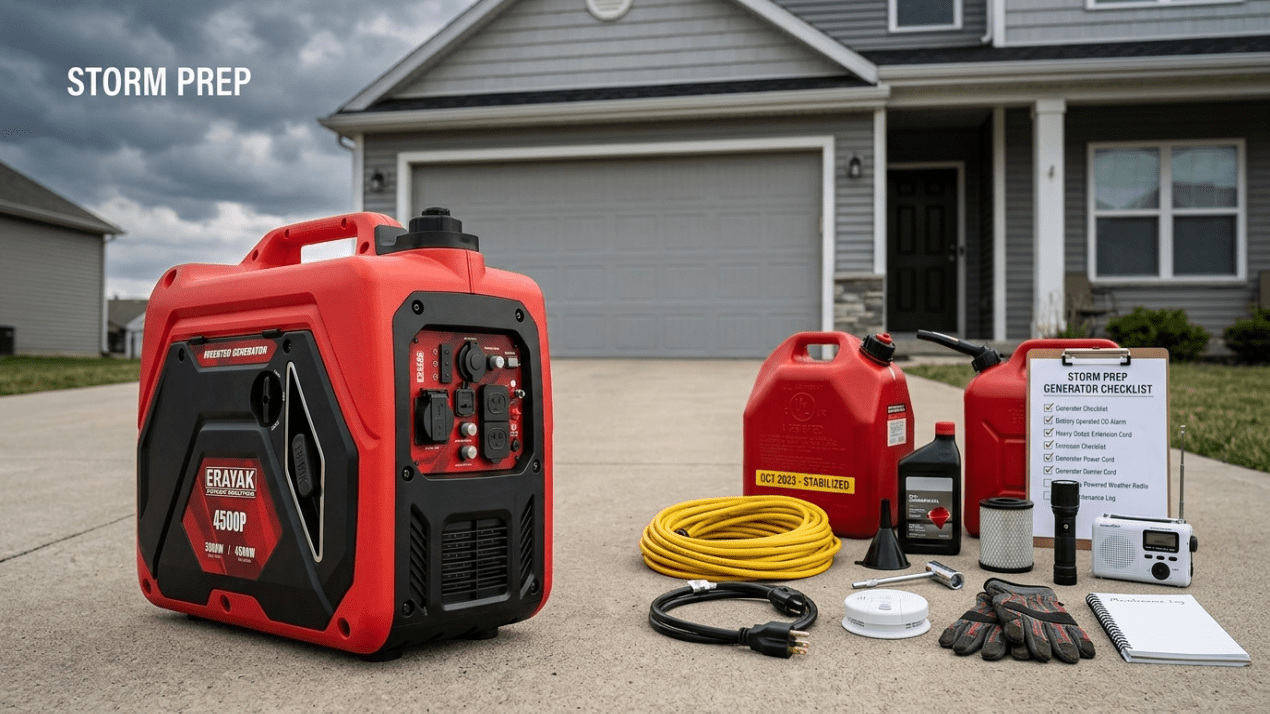
Storm Prep Generator Checklist: Maintenance, Fuel and Safe Connections
A storm prep generator checklist helps you avoid the worst time to discover problems: after the power goes out. Before hurricane season, winter storms, or severe weather, check maintenance, fuel, oil, cords, safe connections, carbon monoxide alarms, load priorities, and your emergency power plan.
Quick Answer
A complete storm prep generator checklist should include oil level, fuel condition, air filter, spark plug, battery if equipped, extension cords, transfer equipment if installed, CO alarms, fuel storage, generator placement, weather protection, and a written emergency power load list.
For hurricane generator prep, do not wait until the storm arrives. Test the generator outdoors, check that it starts smoothly, verify your cords and adapters, label your fuel, and decide which essentials will run first: refrigerator, freezer, lights, phones, WiFi, fans, sump pump, and other critical devices.
What to Check Before Storm Season
Storm preparation is not just buying a generator. It is building a complete emergency power system before weather alerts start. That system includes the generator, fuel, cords, adapters, maintenance tools, CO alarms, appliance list, and a safe outdoor placement plan.
Test Before You Need It
Start the generator outdoors before storm season, listen for rough running, check outlets, and confirm it can support your essential loads.
Prepare Runtime
Use approved fuel containers, label fuel dates, rotate stored fuel, and plan how long you need to support refrigerator, lights, phones, and fans.
Verify Cords and Adapters
Check that cords are outdoor-rated, undamaged, properly sized, and compatible with your generator outlets and appliance loads.
Maintenance Checklist Before a Storm
Maintenance should happen before the forecast becomes urgent. A generator that has been stored for months may need fresh fuel, oil inspection, filter checks, cord inspection, and a safe test run.
| Maintenance Item | What to Check | Storm Prep Action |
|---|---|---|
| Engine oil | Level, color, smell, contamination, and service interval | Top off or change oil according to the manual before storm season |
| Fuel system | Fuel age, tank condition, fuel valve, fuel lines, leaks | Use fresh fuel and inspect before relying on the generator |
| Air filter | Dirt, blockage, oil saturation, or damage | Clean or replace according to the manual |
| Spark plug | Wear, carbon buildup, gap, corrosion, cracked ceramic | Inspect or replace with a model-compatible part if needed |
| Battery if equipped | Charge level, terminals, corrosion, cable security | Charge or service before the storm arrives |
| Cooling vents | Leaves, dust, grass, rodent nests, blocked airflow | Clear debris before running under load |
| Outlets and panel | Cracks, corrosion, loose covers, damaged switches | Do not use damaged outlets until inspected |
| Test run | Start, warm-up, light load, shutdown, unusual noise | Confirm readiness before outage conditions begin |
Fuel and Runtime Preparation
Fuel planning is one of the biggest parts of emergency power. Storm outages can last longer than expected, and fuel may become harder to find after severe weather. Plan fuel around your actual essential loads instead of guessing.
| Fuel Prep Item | Why It Matters | Checklist Detail |
|---|---|---|
| Approved gas can | Stores emergency fuel safely | Use approved containers and label purchase date |
| Fresh fuel | Reduces hard-start and rough-running problems | Rotate stored fuel before storm season |
| Fuel stabilizer | Helps manage stored gasoline when used correctly | Follow stabilizer label and generator manual |
| Fuel funnel or spout | Reduces spills during refueling | Refuel only after the generator is off and cool |
| Runtime plan | Prevents unnecessary fuel waste | Run essentials in cycles instead of powering everything continuously |
| Dual-fuel planning | Provides flexibility on compatible models | Inspect propane hose, regulator, and cylinder condition before use |
Safe Generator Connections
Safe connections are just as important as generator size. During an outage, you may connect appliances directly with extension cords, or use a professionally installed transfer switch or inlet system for selected home circuits.
| Connection Method | Use Case | Safety Check |
|---|---|---|
| Direct appliance cord | Refrigerator, freezer, lights, fans, chargers, router | Use outdoor-rated cords sized for the load and distance |
| Heavy-duty generator cord | Higher-output generator outlets where applicable | Match plug type, voltage, amperage, and outlet rating |
| Manual transfer switch | Selected home circuits | Should be installed by a qualified electrician |
| Generator inlet box | Exterior connection point for transfer-ready homes | Use only with compatible transfer equipment |
| Adapter | Matching compatible plugs and outlets | Confirm voltage, amperage, plug shape, and intended use |
| Wall outlet backfeed | Unsafe and not allowed | Never plug a generator into a wall outlet to power home wiring |
Emergency Power Load Plan
Emergency power is about priorities. A storm prep generator checklist should include a written load plan so your family knows what runs first, what runs later, and what should not run at the same time.
| Priority | Typical Loads | Power Strategy |
|---|---|---|
| Priority 1: Communication | Phones, power banks, battery radio, modem/router if service is available | Charge in batches whenever the generator is running |
| Priority 2: Food protection | Refrigerator, freezer, chest freezer | Run in planned intervals and avoid simultaneous compressor startups |
| Priority 3: Lighting | LED lanterns, LED bulbs, task lights | Use efficient lighting to reduce fuel use |
| Priority 4: Comfort | Fans, laptop, small TV, charging station | Add after refrigerator and communication needs are stable |
| Priority 5: Water or flood control | Sump pump, utility pump, well-related equipment where applicable | Check starting requirements and avoid stacking with other motor loads |
| Priority 6: High-demand appliances | Microwave, coffee maker, portable AC, heaters, cooking appliances | Use one at a time and only after critical loads are managed |
Storm-Day Setup Checklist
When power goes out, do not rush the setup. Use a simple storm-day routine so the generator is placed safely, connected correctly, and loaded gradually.
| Storm-Day Step | What to Do | Why It Matters |
|---|---|---|
| 1. Choose safe location | Outdoors, far from doors, windows, vents, garage, porch, and enclosed spaces | Reduces carbon monoxide risk |
| 2. Check ground condition | Dry, stable, away from standing water and flooding | Reduces electrical and equipment risk |
| 3. Inspect cords | No cuts, fraying, crushed insulation, missing ground pins, or heat damage | Prevents unsafe connections |
| 4. Start with no load | Disconnect appliances before starting | Helps the generator stabilize |
| 5. Add essentials first | Phones, lights, router, refrigerator, freezer, fans | Protects the most important loads first |
| 6. Monitor operation | Watch for overload, rough running, unusual smell, cord heat, or shutdowns | Helps prevent equipment damage and unsafe conditions |
| 7. Refuel safely | Turn off generator and let it cool before refueling | Reduces fire risk |
After-Storm Inspection Checklist
Storm prep does not end when power returns. After using the generator, inspect it, clean it, log runtime, check oil, manage leftover fuel, and store cords and accessories for the next event.
| After-Storm Item | What to Check | Next Step |
|---|---|---|
| Runtime log | Total hours used and load types | Record for future oil change and maintenance planning |
| Oil condition | Level, color, smell, contamination | Change oil if due, dirty, low, or contaminated |
| Fuel | Remaining fuel, fuel age, storage plan | Store or rotate according to manual and local rules |
| Cords and adapters | Heat marks, cracks, loose plugs, water exposure | Dry, inspect, and replace damaged items |
| Generator exterior | Mud, dust, water exposure, leaves, debris | Clean after cooling and store dry |
| Accessory bin | Gloves, funnel, CO alarm batteries, flashlight, checklist | Repack the storm prep kit before storing |
Recommended Erayak Setup by Storm Prep Need
Erayak 2400P: Compact Emergency Power Kit
Choose the Erayak 2400P for light emergency power such as phones, power banks, LED lights, WiFi router, laptop, battery radio, and small fans during short outages or compact storm prep.
- Good fit for communication, lighting, and low-load emergency power
- Accessory focus: small fuel kit, outdoor extension cord, oil funnel, CO alarm, and charging station
- Best when refrigerator, pump, and high-demand appliances are limited or rotated carefully
Erayak 4500P: Practical Storm Prep for Home Essentials
Choose the Erayak 4500P when your storm prep plan includes refrigerator rotation, freezer support, phones, WiFi, LED lights, fans, laptop, battery chargers, and basic household essentials.
- Gas-only portable inverter generator
- Manual recoil start
- 55 lb lightweight design
- 2.25 gal fuel tank
- Up to 8 hours runtime
- THD < 1.2% for sensitive electronics
- 60.5 dB noise level
Erayak 4500PD: Fuel Flexibility for Hurricane Generator Prep
Choose the Erayak 4500PD when your storm prep plan needs gasoline and propane flexibility. It is useful for longer outages, emergency fuel planning, refrigerator and freezer rotation, lights, fans, phones, and managed home essentials.
- Gasoline and propane flexibility
- Useful for hurricane generator prep and longer emergency power planning
- Fuel checklist should include gasoline condition, propane hose, regulator, and safe storage
Erayak 6800PD / 6800PT: More Headroom for Larger Storm Loads
Choose the Erayak 6800 series when your emergency power plan includes larger household loads, sump pump support, selected 120V/240V planning, RV adapter support, or multiple essential power zones.
- 6800W peak power
- 5000W rated power on gasoline at 100% output
- 30A L5-30R outlet
- 30A 120V/240V L14-30R outlet
- Dual 120V household outlets
- TT-30R RV adapter accessory included
Storm Generator Safety Checklist
Storm conditions make generator safety even more important. Rain, flooding, darkness, high winds, damaged cords, and rushed decisions can increase risk. Keep the checklist visible with your emergency power kit.
- Run the generator outdoors only.
- Keep it away from doors, windows, vents, garages, porches, sheds, crawlspaces, and enclosed spaces.
- Point exhaust away from people, homes, neighbors, doors, windows, and air intakes.
- Use working carbon monoxide alarms inside the home.
- Never run a generator in a garage, even with the door open.
- Never place the generator where floodwater, storm surge, or standing water can reach it.
- Use properly rated outdoor extension cords.
- Inspect cords for cuts, fraying, crushed insulation, missing ground pins, loose plugs, or heat damage.
- Keep plugs, adapters, and cord connections dry and elevated.
- Disconnect all loads before starting the generator.
- Add appliances gradually after the generator stabilizes.
- Do not overload the generator.
- Never plug a generator into a wall outlet to power home wiring.
- Use only properly installed transfer equipment for home circuit backup.
- Turn off the generator and let it cool before refueling.
- Store fuel in approved containers away from living areas, flame, sparks, and heat.
Build Your Storm Prep Generator Kit Before the Outage
A reliable storm prep generator checklist covers maintenance, fuel, safe connections, load planning, CO alarms, cords, adapters, and after-storm inspection. Choose the Erayak 2400P for compact emergency essentials, the 4500P or 4500PD for broader home backup, and the 6800 series for larger storm loads and outlet flexibility.
FAQ: Storm Prep Generator Checklist
What should be on a storm prep generator checklist?
A storm prep generator checklist should include oil, fuel, air filter, spark plug, battery if equipped, cooling vents, cords, adapters, CO alarms, safe placement plan, load list, fuel storage, and a test run before storm season.
How do I prepare a generator for hurricane season?
For hurricane generator prep, test the generator outdoors, use fresh fuel, check oil, inspect cords and outlets, prepare approved fuel containers, confirm CO alarms work, and write down which essentials will run first.
What should I power first during a storm outage?
Prioritize phones, power banks, LED lights, refrigerator, freezer rotation, WiFi router if service is available, fans, battery radio, and any critical pump or charging needs.
Should I test my generator before a storm?
Yes. Test the generator outdoors before storm season or before expected severe weather. Confirm it starts, warms up, supports a light load, and shuts down normally.
What extension cord should I use during a storm outage?
Use outdoor-rated, grounded, properly sized extension cords that match the load and distance. Replace any cord with cuts, fraying, crushed insulation, loose plugs, missing ground pins, or heat damage.
Can I plug a generator into a wall outlet during a storm?
No. Never plug a generator into a wall outlet to power home wiring. This unsafe backfeeding can injure utility workers and damage equipment. Use direct appliance cords or properly installed transfer equipment.
Where should I place a generator during a storm outage?
Place it outdoors on dry stable ground, away from doors, windows, vents, garages, porches, sheds, crawlspaces, enclosed spaces, standing water, and flood-prone areas. Point exhaust away from people and buildings.
What Erayak generator is best for storm prep?
Choose the Erayak 2400P for compact emergency essentials, the Erayak 4500P for practical home storm backup, the Erayak 4500PD for fuel flexibility, and the Erayak 6800 series for larger loads, selected 120V/240V planning, and outlet flexibility.
