

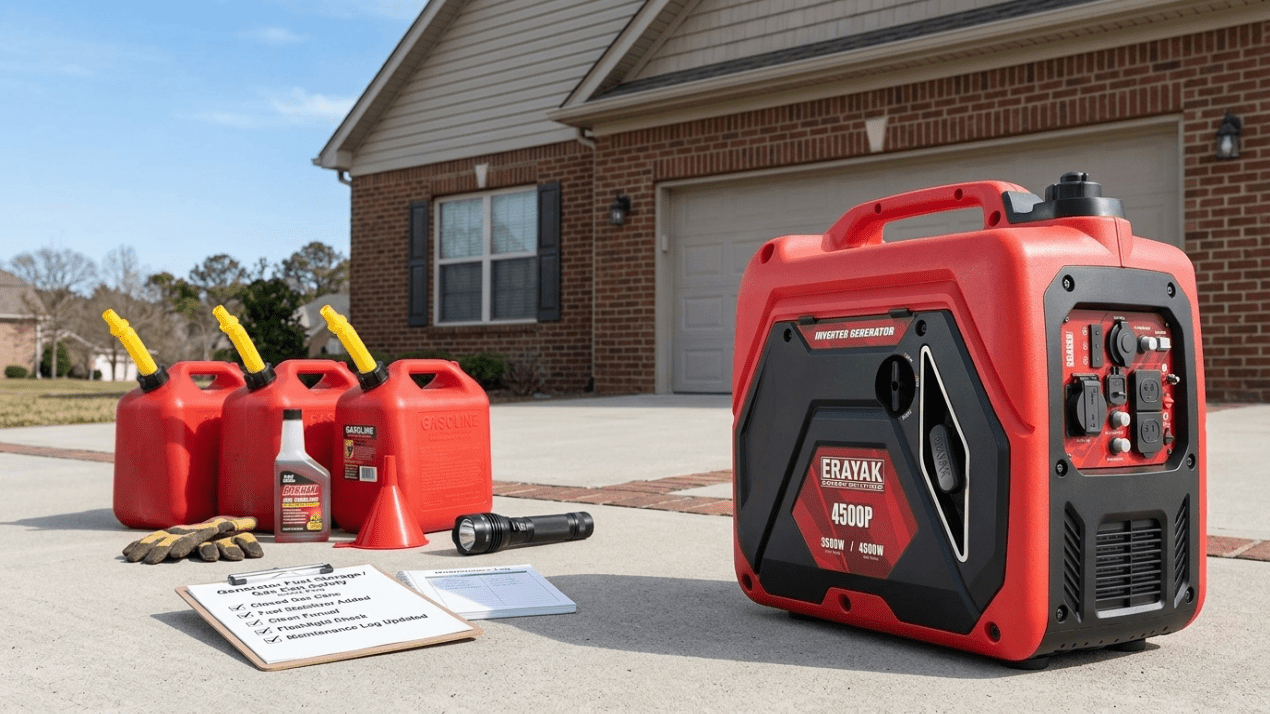
Generator Fuel Storage Safety: Gas Can Tips for Backup Power
Generator fuel storage is one of the most overlooked parts of backup power planning. A generator can only help during a storm outage if you have safe, usable fuel ready. The right gas can, storage location, labeling system, fuel rotation plan, and refueling routine can make your storm prep generator setup safer and more reliable.
Quick Answer
For safe generator fuel storage, use approved gas cans, label each container with the purchase date and fuel type, store fuel away from living spaces and ignition sources, keep containers closed, rotate old fuel, and never refuel a hot generator.
A good gas can safety plan for backup power should include fuel stabilizer when appropriate, a clean spill-safe funnel, gloves, a flashlight, a fuel log, and a storm-season checklist. Your storm prep generator plan should also include where the generator will run outdoors, how far the fuel is stored from the generator, and how much runtime you realistically need.
Why Generator Fuel Storage Matters
Most homeowners think about generator watts first, then fuel later. In a real outage, fuel planning becomes just as important as generator size. Poor fuel storage can lead to hard starting, short runtime, emergency fuel runs, fire hazards, spills, and unsafe refueling habits.
Fuel Equals Backup Time
A generator cannot support refrigerators, lights, phones, fans, or pumps if you do not have enough safe fuel available.
Fresh Fuel Starts Better
Fuel that is old, contaminated, or stored poorly can cause starting problems, rough running, and fuel-system issues.
Storage Reduces Risk
Safe gas can handling helps reduce spill, fire, vapor, refueling, and storage hazards during stressful outage conditions.
Gas Can Safety Checklist
Gas can safety starts with the container itself. Use approved fuel containers, keep them closed, inspect them regularly, and never use damaged or unlabeled containers for generator fuel storage.
| Gas Can Item | What to Check | Why It Matters |
|---|---|---|
| Approved gasoline container | Use a container designed and approved for gasoline | Reduces leak, vapor, spill, and handling risk |
| Cap and spout | Check for cracks, loose fit, damaged seals, or missing parts | Prevents leaks during storage and transport |
| Label | Mark fuel type and purchase date clearly | Prevents fuel mix-ups and helps with rotation |
| Container condition | Look for swelling, dents, cracks, fading, or soft plastic | Damaged containers should be replaced before storm season |
| Storage position | Keep cans upright, closed, and stable | Reduces spills, vapor release, and accidental tipping |
| Funnel or pour spout | Use a clean, controlled pouring tool | Helps prevent spilled fuel during refueling |
| Gloves and rags | Keep cleanup items nearby | Useful for safe handling and small drips |
| Fuel log | Record purchase date, amount, and rotation plan | Makes outage preparation easier and more reliable |
Where to Store Generator Fuel
Generator fuel should be stored away from living areas, ignition sources, heat, direct sun, electrical equipment, children, pets, and anything that could create sparks or flames. Choose a cool, dry, ventilated, secure location that follows local rules and product labels.
| Storage Location Factor | Better Choice | Avoid |
|---|---|---|
| Ventilation | Well-ventilated storage area | Living spaces, closets, basements, and enclosed rooms |
| Heat exposure | Cool shaded location | Direct sun, heaters, furnace areas, and hot surfaces |
| Ignition sources | Away from sparks, flame, and electrical tools | Grills, pilot lights, smoking areas, welders, and open flame |
| Stability | Flat shelf or floor area where cans stay upright | Unstable shelves, crowded corners, or vehicle passenger areas |
| Access control | Secure area away from children and pets | Open walkways, play areas, or high-traffic spaces |
| Distance from generator | Stored away from hot generator and exhaust area | Fuel cans beside a running generator |
Fuel Labeling and Rotation Plan
Fuel rotation is a simple habit that prevents confusion. Every gas can should have a label with fuel type, purchase date, and whether stabilizer was added. This helps you know what to use first and what should be refreshed before storm season.
| Fuel Log Item | What to Write | Why It Helps |
|---|---|---|
| Purchase date | Month, day, and year | Shows which can should be rotated first |
| Fuel type | Gasoline type used for the generator | Prevents mixing the wrong fuel with other equipment |
| Stabilizer status | Yes or no, plus product date if useful | Helps you follow the stabilizer label and storage plan |
| Amount stored | Gallons per can and total gallons | Helps estimate backup runtime |
| Rotation reminder | Next check date | Prevents old fuel from being forgotten in storage |
| Generator hours | Hours used during outage or test run | Helps connect fuel use with oil-change and maintenance timing |
Storm Prep Generator Fuel Planning
A storm prep generator plan should answer three questions before the storm arrives: what will you power, how long do you need backup power, and how much fuel can you safely store and rotate?
| Storm Prep Step | What to Plan | Fuel Storage Tip |
|---|---|---|
| List essential loads | Refrigerator, freezer, phones, WiFi, lights, fans, sump pump | Power essentials first to stretch fuel runtime |
| Estimate runtime windows | Decide if loads run continuously or in rotation | Running only critical loads can reduce fuel use |
| Prepare fuel containers | Inspect gas cans before storm season | Replace damaged cans before an emergency |
| Check fuel age | Use labels and fuel log | Rotate older fuel before relying on it |
| Plan refueling timing | Refuel during safe daylight windows when possible | Shut down and cool generator before refueling |
| Keep backup light ready | Flashlight or headlamp near fuel kit | Helps avoid spills during nighttime outage conditions |
Safe Refueling Routine During Outages
Refueling is one of the highest-risk moments in generator use. Fuel, hot engine parts, darkness, rain, stress, and fatigue can combine quickly during outages. Create a routine before you need it.
| Refueling Step | Action | Safety Reason |
|---|---|---|
| 1. Turn off loads | Disconnect or shut down connected appliances as appropriate | Prepares for safe generator shutdown |
| 2. Shut down generator | Follow the generator manual’s shutdown procedure | Never pour fuel into a running generator |
| 3. Let it cool | Wait before opening the fuel cap or handling fuel nearby | Hot engine parts and fuel vapors are a dangerous combination |
| 4. Move fuel can carefully | Keep the gas can upright and stable | Reduces spills and vapor release |
| 5. Use a controlled pour | Use the proper spout or clean funnel | Prevents splashing and overfilling |
| 6. Close fuel cap and can | Secure both before restarting | Reduces vapor and spill risk |
| 7. Move fuel away | Store the gas can away from the running generator | Keeps fuel away from heat and exhaust |
| 8. Restart outdoors only | Start the generator in the safe outdoor location | Maintains CO safety and proper ventilation |
Common Fuel Storage Mistakes to Avoid
Fuel storage mistakes often happen before the outage starts. Avoid these common problems so your generator is safer and more reliable when the grid goes down.
| Mistake | What Can Go Wrong | Better Approach |
|---|---|---|
| Using unapproved containers | Leaks, spills, vapor release, unsafe storage | Use approved gasoline containers only |
| No fuel date labels | Old fuel gets forgotten | Label every can with purchase date and fuel type |
| Storing fuel near living areas | Fire, vapor, and exposure risk | Store fuel in a secure, ventilated, non-living area according to local rules |
| Fuel cans beside generator | Heat, exhaust, and spill hazard | Keep fuel stored away from the running generator |
| Refueling immediately after shutdown | Fuel can contact hot surfaces or vapor ignition risk | Let the generator cool first |
| Overbuying fuel with no rotation plan | Stale fuel and storage clutter | Store only what you can safely manage and rotate |
| Ignoring propane checks on dual-fuel models | Damaged hoses, loose connections, or storage issues | Inspect propane equipment according to the manual before use |
Recommended Erayak Setup by Fuel Planning Need
Erayak 2400P: Compact Fuel Planning for Essentials
Choose the Erayak 2400P for compact backup power focused on phones, LED lights, WiFi router, laptop, power banks, and small emergency electronics. Pair it with a small approved gas can, fuel label system, extension cord kit, and maintenance log.
- Good fit for compact outage support and low-load emergency setups
- Fuel planning focus: essential loads, fuel rotation, and short runtime windows
- Best when refrigerator, pump, and high-demand appliance loads are limited or rotated carefully
Erayak 4500P: Gas-Only Backup Power Fuel Planning
Choose the Erayak 4500P when your storm prep generator plan includes refrigerator, freezer rotation, phones, WiFi, lights, fans, chargers, and basic household essentials. Because it is a gas-only generator, gasoline storage and rotation should be part of your outage checklist.
- Gas-only portable inverter generator
- Manual recoil start
- 55 lb lightweight design
- 2.25 gal fuel tank
- Up to 8 hours runtime
- THD < 1.2% for sensitive electronics
- 60.5 dB noise level
Erayak 4500PD: Gasoline and Propane Flexibility
Choose the Erayak 4500PD when you want 4,500W-class backup power with gasoline and propane flexibility. It can help broaden your storm prep fuel plan, but gasoline and propane each require their own safe storage and inspection routine.
- Gasoline and propane flexibility
- Useful for longer outage planning and fuel flexibility
- Fuel planning focus: gas can safety, propane connection checks, storage separation, and load rotation
Erayak 6800PD / 6800PT: Larger Outage Fuel Planning
Choose the Erayak 6800 series when your outage plan includes larger essential loads, sump pump support, selected 120V/240V planning, or multiple backup zones. More load capacity can mean more fuel planning discipline, so track runtime, load rotation, and fuel storage carefully.
- 6800W peak power
- 5000W rated power on gasoline at 100% output
- 30A L5-30R outlet
- 30A 120V/240V L14-30R outlet
- Dual 120V household outlets
- TT-30R RV adapter accessory included
Generator Fuel Storage Safety Checklist
Fuel storage safety should be part of every backup power plan. Review this checklist before storm season, after buying fuel, and before running your generator during an outage.
- Use approved gasoline containers only.
- Label every gas can with purchase date and fuel type.
- Store fuel away from living areas, children, pets, heat, flame, sparks, and smoking areas.
- Keep gas cans closed, upright, and stable.
- Inspect cans for cracks, leaks, loose caps, damaged spouts, or swelling.
- Rotate stored fuel according to your plan, fuel stabilizer label, and generator manual.
- Keep fuel cans away from the running generator.
- Never refuel a running generator.
- Let the generator cool before refueling.
- Use a clean funnel or controlled spout to reduce spills.
- Clean up spills immediately and safely.
- Store fuel away from extension cords, electrical panels, chargers, and ignition sources.
- Run the generator outdoors only, away from doors, windows, vents, garages, porches, and enclosed spaces.
- Use working carbon monoxide alarms inside the home.
- Follow local fuel storage rules and your generator owner’s manual.
Build a Safer Storm Prep Generator Plan
Safe backup power starts before the outage. Prepare approved gas cans, label and rotate fuel, plan your generator runtime, store fuel away from heat and living areas, and follow a safe refueling routine. For compact backup power, choose the Erayak 2400P. For home essentials, choose the Erayak 4500P or 4500PD. For larger outage loads, choose the Erayak 6800 series.
FAQ: Generator Fuel Storage Safety
How should I store fuel for a generator?
Store generator fuel in approved gasoline containers, label each can with purchase date and fuel type, keep cans closed and upright, and store them away from living areas, heat, sparks, flame, children, pets, and the running generator.
What gas can should I use for a generator?
Use an approved gasoline container that is in good condition, properly sealed, clearly labeled, and sized for the amount of fuel you can safely store, handle, and rotate.
Is fuel stabilizer necessary for generator fuel storage?
Fuel stabilizer can be useful for stored fuel, but you should follow the stabilizer label and your generator manual. Label the gas can with the date and whether stabilizer was added.
Where should I not store generator fuel?
Do not store gasoline in living spaces, near heaters, flame, sparks, smoking areas, electrical equipment, hot surfaces, children, pets, or beside a running generator. Follow local fuel storage rules.
Can I refuel a generator while it is running?
No. Never refuel a running generator. Shut it down, let it cool, use a controlled pour, secure the cap, move the fuel can away, and then restart the generator outdoors.
How much fuel should I store for storm prep generator use?
Store only the amount you can safely manage, rotate, and keep within local rules. Estimate fuel needs based on essential loads, expected outage duration, generator runtime, and whether you plan to rotate appliances instead of running everything continuously.
What Erayak generator is best for storm prep?
Choose the Erayak 2400P for compact essentials such as phones, lights, WiFi, and small electronics. Choose the Erayak 4500P or 4500PD for refrigerator, freezer rotation, fans, lights, and home essentials. Choose the Erayak 6800 series for larger outage loads, sump pump support, and selected 120V/240V planning.
