

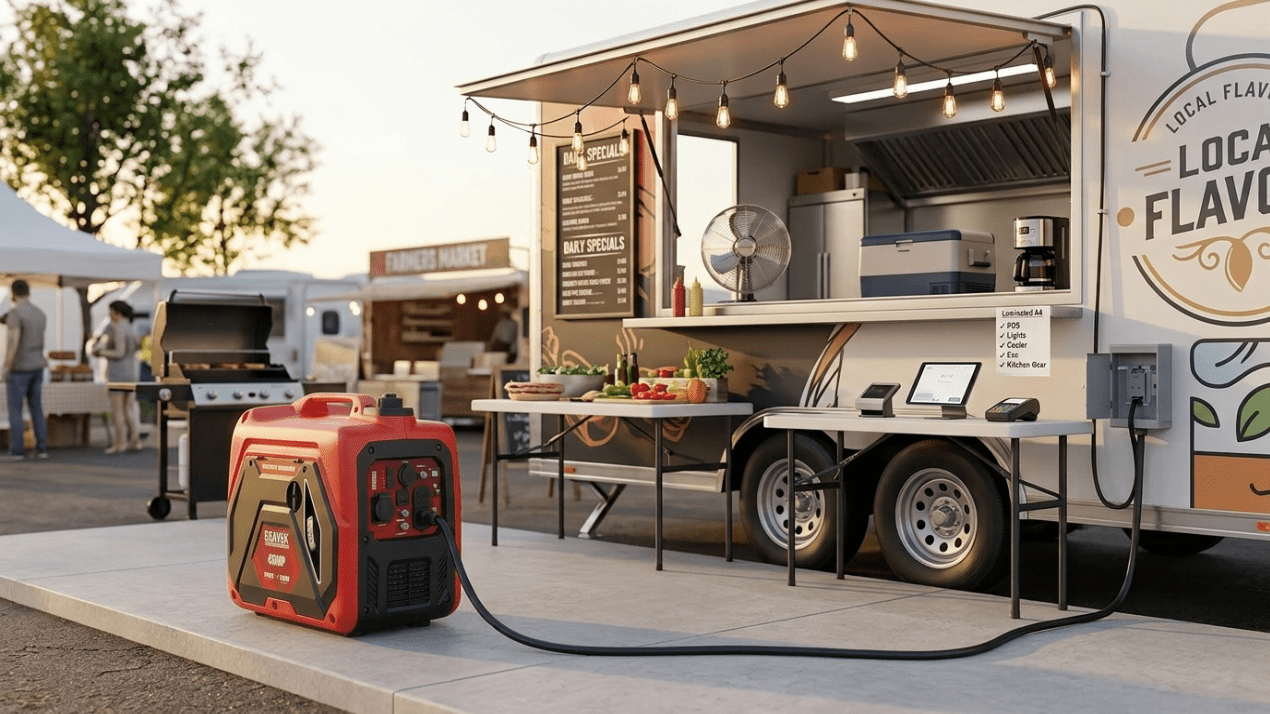
Food Truck Power Setup: Generator Solution for POS, Lights, Cooler, and Kitchen Gear
A food truck or concession stand needs power that keeps service moving. The right generator setup supports checkout, lighting, cooling, ventilation, small appliances, food prep, and customer-facing equipment without overloading cords or creating safety risks around heat, fuel, people, and food-service zones.
Quick Answer
For a small food booth with POS system, phone charging, LED menu light, small fan, tablet, card reader, and limited low-power display equipment, the Erayak 2400P can work as a compact support power station.
For a food truck, concession stand, drink booth, or outdoor food vendor setup with cooler support, refrigerator planning, coffee maker rotation, food warmer timing, fans, lights, and longer service hours, the Erayak 4500P or 4500PD is usually the better starting point. For larger food-service loads, more surge headroom, selected 120V/240V planning, or multiple equipment zones, use the Erayak 6800 series.
Food Truck Power Layout
A reliable food vendor power setup separates the space into zones: generator zone, checkout zone, cold-storage zone, hot-food zone, and customer line. The generator stays outdoors in a safe ventilated location. Checkout and electronics stay dry. Cooling loads are protected from overload. Heating loads are used with careful timing.
Generator Zone
Place the generator outdoors on dry stable ground, away from customer lines, truck openings, serving windows, exhaust paths, tents, enclosed areas, doors, windows, vents, and fuel or cooking zones.
Checkout Zone
Keep POS system, card reader, tablet, phone, receipt printer, and menu lights on a dry, organized power point.
Kitchen Zone
Use cooler, refrigerator, coffee maker, warmer, fan, and prep equipment in a planned sequence instead of running every appliance at once.
POS, Menu Lights, and Customer-Facing Power
Checkout power is mission-critical for a food truck. A dead tablet, phone, card reader, hotspot, or receipt printer can slow down the line even if the kitchen is ready.
| Customer-Facing Load | Role | Power Strategy |
|---|---|---|
| Tablet POS or register | Orders and checkout | Keep charged and plugged into a dry power point when needed |
| Card reader | Payment processing | Charge before service and top off during slow periods |
| Phone or hotspot | Backup checkout, communication, menu updates | Reserve one power bank or cable for payment backup only |
| Receipt printer | Order tickets or receipts | Place near checkout but away from spills and hot surfaces |
| LED menu light or sign | Customer visibility | Low-load and easy to combine with POS and charging |
Cooler, Refrigerator, and Cold-Storage Planning
Cold-storage equipment is often more important than convenience appliances. A portable cooler, compact refrigerator, drink fridge, or freezer may cycle on and off and may require startup headroom depending on the model.
| Cold-Zone Load | Use Case | Generator Strategy |
|---|---|---|
| Portable cooler | Drinks, ingredients, samples, or prep items | Check model requirements and avoid stacking with high-watt heating loads |
| Compact refrigerator | Food-service cold storage | Allow compressor startup headroom and avoid simultaneous motor starts |
| Small freezer | Frozen desserts, ice packs, or frozen ingredients | Plan for startup surge and monitor load timing |
| Drink display cooler | Customer-facing cold drinks | Keep on a stable power path with properly rated cords |
| Ice maker | Event beverage service | Check wattage and startup requirements before relying on it |
Coffee Maker, Warmer, and Kitchen Appliance Timing
Heating appliances can draw high continuous watts. Coffee makers, kettles, food warmers, heat lamps, and countertop appliances should be used with time blocks, not stacked together without confirming the full electrical load.
| Kitchen Load | Load Type | Power Strategy |
|---|---|---|
| Coffee maker | High-watt heating load | Use before rush periods or separately from other heating loads |
| Electric kettle | High-watt heating load | Use one heating appliance at a time |
| Food warmer | Continuous heating load | Confirm wattage and avoid stacking multiple warmers without headroom |
| Heat lamp | Continuous heating or lighting load | Use carefully with cold storage, POS, and fans already running |
| Small prep appliance | Varies by model | Check the appliance label and rotate high-demand equipment |
Cord Routing Around Food, Heat, and Customer Lines
Food-service environments have spills, hot surfaces, customer lines, staff movement, wet pavement, carts, coolers, and food prep tables. Cord routing should be visible, dry, protected, and kept away from heat and foot traffic.
| Cord Problem | Why It Matters | Better Setup |
|---|---|---|
| Cords across customer line | Trip hazard and service disruption | Route behind the booth or along controlled equipment paths |
| Connections near spills or wash buckets | Shock and equipment risk | Keep connections dry, elevated, and away from wet zones |
| Cords near grills, fryers, or hot surfaces | Heat damage and fire risk | Keep power routing away from cooking heat and grease areas |
| Generator too close to serving window | Exhaust, heat, noise, and customer safety issue | Keep generator in a safe outdoor zone and route power properly |
| Too many appliances on one strip | Overload and shutdown risk | Separate critical loads and rotate high-watt equipment |
Recommended Erayak Setup by Food Vendor Scenario
Erayak 2400P: Checkout, Lighting, and Small Booth Support
Choose the Erayak 2400P for POS systems, phones, tablets, card readers, LED menu lights, small fans, receipt printers, and compact low-load booth equipment.
- Strong fit for checkout and customer-facing electronics
- Good for small food booths, sample tables, drink stands, and low-load event setups
- Best when refrigeration and heating appliances are limited or handled separately
Erayak 4500P: Best Starting Point for Food Truck Essentials
Choose the Erayak 4500P when your setup includes POS, LED lights, fans, cooler support, compact refrigerator planning, coffee maker rotation, and managed food-service equipment.
- Gas-only portable inverter generator
- Manual recoil start
- 55 lb lightweight design
- 2.25 gal fuel tank
- Up to 8 hours runtime
- THD < 1.2% for sensitive electronics
- 60.5 dB noise level
Erayak 4500PD: Fuel Flexibility for Longer Food Events
Choose the Erayak 4500PD when you want 4,500W-class food vendor power with gasoline and propane flexibility for longer service windows, outdoor events, and flexible fuel planning.
- Gasoline and propane flexibility
- Useful for full-day food events and mobile vendor setups
- Good fit for POS, lighting, fans, cooler support, coffee maker rotation, and managed appliance loads
Erayak 6800PD / 6800PT: More Headroom for Larger Food-Service Loads
Choose the Erayak 6800 series when your food truck or concession setup needs more surge headroom, selected 120V/240V planning, larger cold-storage loads, multiple equipment zones, or more outlet flexibility.
- 6800W peak power
- 5000W rated power on gasoline at 100% output
- 30A L5-30R outlet
- 30A 120V/240V L14-30R outlet
- Dual 120V household outlets
- TT-30R RV adapter accessory included
Food Truck Generator Safety Checklist
Food-service power setup must account for carbon monoxide, heat, fuel, customer lines, wet areas, grease, and heavy foot traffic. A fuel-powered generator must never be operated inside a food truck, trailer, enclosed canopy, storage area, garage, shed, or customer-facing enclosed space.
- Run the generator outdoors only.
- Keep it away from food truck windows, serving windows, doors, vents, air intakes, tents, trailers, vehicles, and enclosed spaces.
- Point exhaust away from staff, customers, neighboring booths, food prep areas, and buildings.
- Never run a generator inside a food truck, trailer, van, enclosed tent, storage area, garage, or shed.
- Keep the generator dry and away from standing water, wash buckets, spills, and grease areas.
- Use properly rated outdoor extension cords.
- Keep cords away from grills, fryers, hot surfaces, sharp edges, customer lines, and wet zones.
- Do not overload the generator.
- Start compressor and motor loads one at a time.
- Use high-watt heating appliances in planned time blocks.
- Let the generator cool before refueling.
- Store fuel away from food prep areas, customers, flames, heat, cooking equipment, and enclosed spaces.
- Follow venue, health department, fire marshal, market, park, and event organizer rules.
Build a More Reliable Food Truck Power Setup
For POS, phones, tablets, LED menu lights, small fans, and low-load booth equipment, choose the Erayak 2400P. For cooler support, compact refrigerator planning, fans, lights, coffee maker rotation, and food truck essentials, choose the Erayak 4500P or 4500PD. For larger cold-storage loads, multiple equipment zones, and selected 120V/240V needs, choose the Erayak 6800 series.
FAQ: Food Truck Power Setup
Can a portable generator power a food truck?
Yes. A properly sized portable inverter generator can support POS systems, lights, fans, coolers, compact refrigeration, and selected kitchen appliances when loads are managed safely.
How should I set up generator power for a concession stand?
Place the generator outdoors in a safe ventilated area, route properly rated outdoor cords to dry power points, keep customer walkways clear, protect POS equipment, and rotate high-watt kitchen appliances instead of running everything at once.
Can a 2400 watt generator run a food booth?
Yes, for low-load booth equipment such as POS, phones, tablets, card readers, LED menu lights, receipt printer, and small fan. For cooler support, refrigeration, warmers, or coffee makers, a larger generator is usually more practical.
Can a generator run a refrigerator or cooler for a food vendor?
Yes, if the generator is sized for the refrigerator or cooler’s running and startup requirements. Avoid stacking refrigerator startup with coffee makers, kettles, food warmers, and other high-watt appliances.
Can a generator run a coffee maker and food warmer at the same time?
It depends on the wattage of both appliances and the generator capacity. In many mobile food setups, it is better to use high-watt heating appliances one at a time unless the combined load is confirmed.
Where should I place a generator near a food truck?
Place it outdoors on dry stable ground, away from serving windows, doors, vents, air intakes, customer lines, food prep areas, tents, vehicles, trailers, and enclosed spaces. Point exhaust away from people and structures.
What Erayak generator is best for food truck power?
Choose the Erayak 2400P for checkout, lights, and small booth electronics. Choose the Erayak 4500P or 4500PD for cooler support, lights, fans, coffee maker rotation, and food truck essentials. Choose the Erayak 6800 series for larger food-service loads, multiple equipment zones, and selected 120V/240V planning.
