

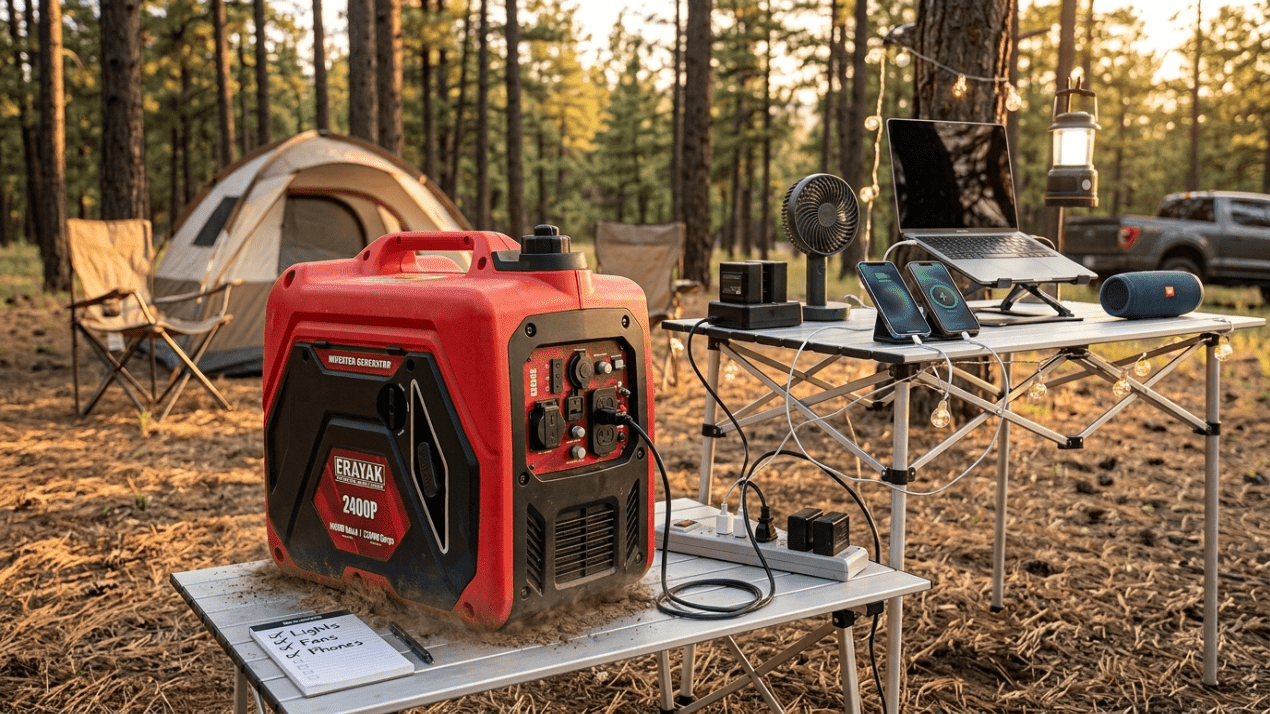
Camping Generator for Lights, Fans, and Phone Charging
For many campers, the most important power needs are simple: keep the lights on, charge phones, run a small fan, recharge camera batteries, power a laptop, and handle a few campsite electronics. These are usually low-to-moderate loads, which makes a compact inverter generator a practical fit.
Quick Answer
For camping lights, phone charging, small fans, camera batteries, portable speakers, laptops, GPS devices, LED lanterns, and air mattress pumps, a 2,400W-class inverter generator is usually more than enough when loads are managed properly.
Choose the Erayak 2400P for compact camping essentials. Move up to the Erayak 4500P or 4500PD when your campsite also includes a portable cooler, coffee maker rotation, electric griddle timing, tools, or a larger family/group charging setup.
Can a Generator Power Camping Lights, Fans, and Phones?
Yes. A properly sized inverter generator can easily power typical camping essentials such as LED lights, string lights, phone chargers, camera batteries, rechargeable fans, laptops, tablets, portable speakers, GPS devices, and small air pumps.
LED Lanterns + String Lights
LED campsite lighting is efficient and easy to support with a compact generator.
Small Fans + Air Pumps
Fans and air pumps are common campsite loads, but air pumps should be used briefly.
Phones + Cameras + Laptops
Phones, camera batteries, tablets, and laptops are low-load devices that pair well with inverter power.
Camping Essentials Wattage Guide
The exact wattage depends on your devices, chargers, battery packs, and accessories. Most charging and lighting loads are small, while heating appliances and compressor-based gear can require much more planning.
| Camping Load | Typical Load Level | Generator Planning Note |
|---|---|---|
| Phone charging | Low | Easy to run with lights, fans, and camera charging |
| LED lanterns / string lights | Low | Efficient campsite lighting option |
| Camera batteries / drone batteries | Low to moderate | Good fit for inverter generator power |
| Laptop charging | Low to moderate | Useful for remote work, photo backup, or trip planning |
| Small camping fan | Low to moderate | Good comfort load for warm-weather camping |
| Air mattress pump | Short-use motor load | Use briefly; avoid stacking with larger loads |
| Portable cooler | Varies by model | Check running and startup requirements |
| Coffee maker / electric kettle | High-watt heating load | Use briefly and separately, preferably with more headroom |
What Size Generator for Lights, Fans, and Charging?
| Campsite Setup | Typical Loads | Recommended Generator Class | Erayak Fit |
|---|---|---|---|
| Basic charging station | Phones, camera batteries, LED lanterns | 2,000W–2,400W class | Erayak 2400P |
| Lights + fan + phones | LED lights, small fan, phone charging, speaker | 2,400W class | Erayak 2400P |
| Comfort camping | Lights, fan, laptop, air pump, camera batteries | 2,400W class | Erayak 2400P |
| Family charging table | Multiple phones, tablets, fans, lights, cooler | 2,400W–4,500W | Erayak 2400P or 4500P |
| Basecamp with cooking rotation | Lights, fan, cooler, coffee maker, griddle timing | 4,500W-class recommended | Erayak 4500P or 4500PD |
Simple Campsite Load Plan
The easiest way to use a generator at camp is to separate always-on essentials from short-use loads. Keep lights, fans, and charging organized on a campsite power table. Use air pumps and cooking appliances briefly and separately.
| Load Group | Examples | Best Practice |
|---|---|---|
| Always-on low loads | LED lights, phone chargers, small fan | Good for compact generator use |
| Batch charging | Camera batteries, power banks, laptop | Charge during allowed generator hours |
| Short-use motor loads | Air mattress pump, small tools | Use briefly and avoid stacking |
| High-watt heating loads | Coffee maker, kettle, electric griddle | Use one at a time and avoid running with other large loads |
When Should You Choose a Larger Camping Generator?
A 2,400W-class inverter generator is a strong fit for lights, fans, and charging. A larger generator makes sense when your campsite includes more high-watt or shared loads.
Family or Group Camping
More phones, tablets, fans, lights, and battery packs can make extra headroom useful.
Coffee Maker or Griddle
Heating appliances can use much more power than charging and lighting loads.
Cooler + Tools + Longer Trips
Portable coolers, tools, and extended outdoor use can benefit from a 4,500W-class setup.
Best Erayak Generator for Camping Essentials
Erayak 2400P: Best Fit for Lights, Fans, and Charging
Choose the Erayak 2400P for phone charging, LED lights, small fans, camera batteries, laptop charging, speakers, air pumps, and compact campsite electronics.
- Practical size for light camping essentials
- Good fit for charging stations and campsite lighting
- Best when high-watt cooking gear is limited or rotated carefully
Erayak 4500P: More Headroom for Family Campsites
Choose the Erayak 4500P when your camping setup includes multiple users, portable cooler, lights, fans, coffee maker rotation, tools, or a larger basecamp setup.
- Gas-only portable inverter generator
- Manual recoil start
- 55 lb lightweight design
- 2.25 gal fuel tank
- Up to 8 hours runtime
- THD < 1.2% for sensitive electronics
- 60.5 dB noise level
Erayak 4500PD: Dual-Fuel Flexibility for Longer Outdoor Trips
Choose the Erayak 4500PD when you want 4,500W-class camping power with gasoline and propane flexibility for longer trips, basecamp setups, and more flexible fuel planning.
- Gasoline and propane flexibility
- Useful for extended camping and basecamp planning
- Good fit for users who already carry propane for camp cooking
Camping Generator Safety Checklist
Even when you are only powering small devices, a camping generator must be placed safely. Never operate a fuel-powered generator inside a tent, vehicle, camper shell, cabin, shed, screen room, or enclosed shelter.
- Run the generator outdoors only.
- Keep it far away from tents, vehicles, doors, windows, vents, and sleeping areas.
- Point exhaust away from people, tents, neighboring campsites, and enclosed spaces.
- Never run a generator inside a tent, SUV, van, truck bed cap, cabin, or screen room.
- Use working carbon monoxide alarms when camping in RVs, cabins, or enclosed sleeping areas.
- Keep the generator dry and away from standing water.
- Use properly rated outdoor extension cords.
- Do not overload the generator.
- Let the generator cool before refueling.
- Store fuel away from flames, stoves, grills, heaters, and sleeping areas.
- Follow campground generator rules and quiet-hour restrictions.
Build a Simple Campsite Charging Station
For lights, phones, fans, laptops, camera batteries, speakers, and compact campsite electronics, choose the Erayak 2400P. For larger camping setups, portable cooler use, coffee maker rotation, tools, and more headroom, choose the Erayak 4500P or 4500PD.
FAQ: Camping Generator for Lights, Fans, and Phone Charging
What size generator do I need for camping lights, fans, and phone charging?
For LED lights, phone charging, small fans, camera batteries, laptop charging, speakers, and compact campsite electronics, a 2,400W-class inverter generator is usually a practical fit.
Can a small generator charge phones while camping?
Yes. Phone charging is a low-power load and is easy to combine with LED lights, small fans, camera batteries, and other small campsite electronics.
Can a camping generator run string lights?
Yes. LED string lights are usually efficient and easy to power with a compact inverter generator. Always use outdoor-rated cords and safe routing.
Can a generator run a camping fan?
Yes. Most small camping fans are low-to-moderate loads. Check your fan’s label or adapter to confirm wattage.
Can I run a generator near my tent to charge phones?
No. Keep the generator outdoors and far away from tents, vehicles, sleeping areas, and enclosed spaces. Use properly rated outdoor cords instead of moving the generator closer.
Do I need a 4500 watt generator for camping lights and phones?
Usually not for lights and phone charging alone. A 4,500W-class generator makes more sense for larger campsites, portable cooler use, coffee maker rotation, tools, or multiple high-demand loads.
What Erayak generator is best for camping lights, fans, and charging?
Choose the Erayak 2400P for compact camping essentials such as lights, fans, phones, laptops, and camera batteries. Choose the Erayak 4500P or 4500PD for larger campsite loads and more headroom.
