

Can You Run Two Generators in Parallel? Camping & RV Guide
Yes, but only when the generators are designed for parallel operation and connected with the correct parallel kit. This guide explains how parallel inverter generators work, whether you can mix brands or wattages, and when two smaller units make more sense than one large generator.
Quick Answer: Can You Run Two Generators in Parallel?
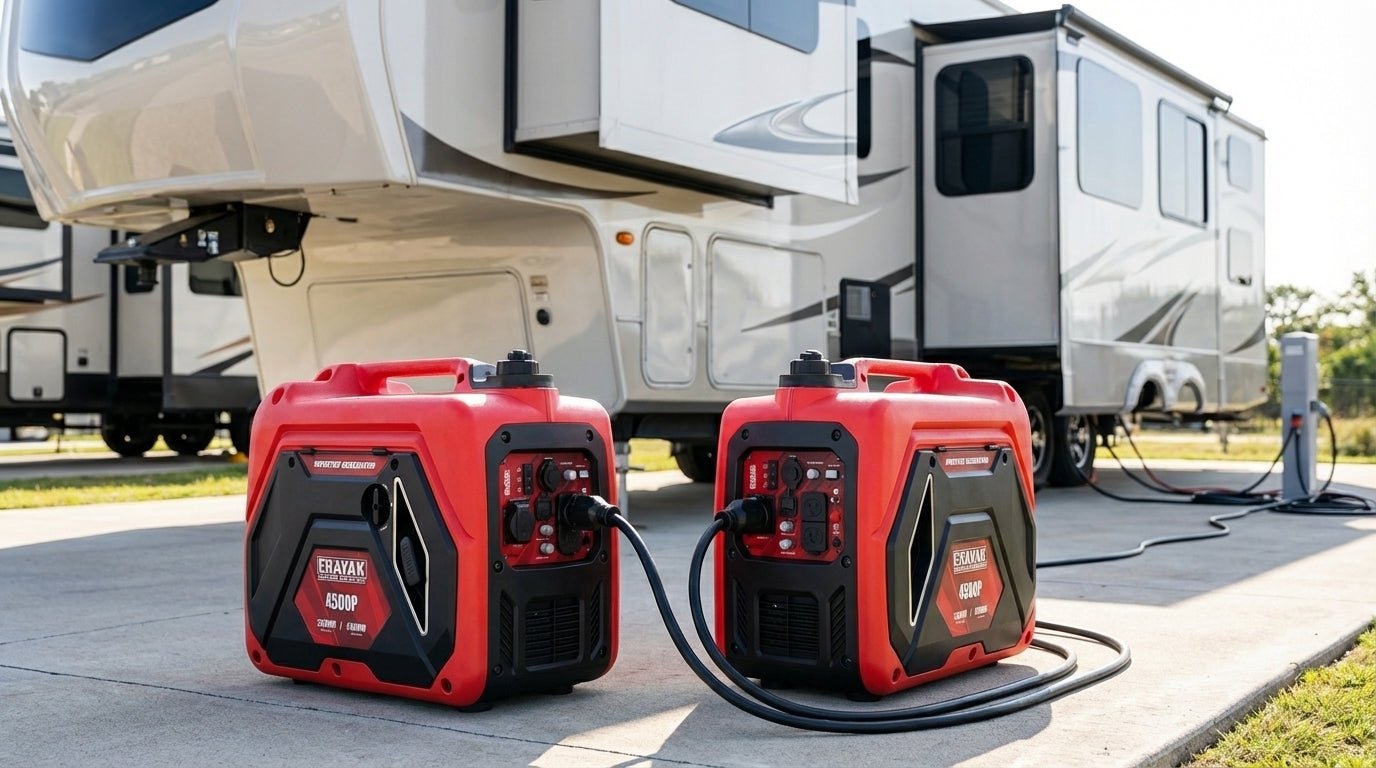
You can run two generators in parallel only if they are parallel-ready inverter generators and you use a compatible parallel kit or manufacturer-approved cable system. The kit lets both inverters synchronize their output so the combined power can be used through the kit's receptacle.
Do not connect two random generators together with ordinary cords, splitter adapters, homemade wiring, or a "daisy chain" setup. Standard open-frame generators, different brands, and different wattage models may not synchronize safely unless the manufacturer specifically allows that exact combination.
What Does a Generator Parallel Kit Actually Do?
A parallel kit is not a simple extension cord. It is the approved connection point that lets compatible inverter generators share load safely.
It synchronizes output
Parallel-ready inverter generators are designed so their inverter systems can coordinate voltage, frequency, and phase through the approved connection.
It combines usable power
The load is taken from the receptacle on the parallel kit or approved cable assembly, not from improvised household splitters or backfed cords.
It limits what is safe
The parallel kit, generator model, outlet rating, breaker rating, and cord all determine how much power you can actually use.
Do not improvise: Never splice generator cords together, connect two generator outlets into one adapter, or backfeed a panel. If a generator is not parallel-ready, treat it as a standalone power source.
Can You Parallel Different Generators?
This is where many searches get risky. The safe answer depends on the exact model, inverter system, and manufacturer-approved kit.
| Question | Short answer | What to check |
|---|---|---|
| Can you run two identical inverter generators in parallel? | Usually yes | Both units must be parallel-ready and connected with the compatible parallel kit listed by the manufacturer. |
| Can you parallel two different wattage generators? | Only if approved | Some systems allow selected mixed models, but many do not. The smaller unit or kit rating may limit output. |
| Can you parallel two different brand generators? | Do not assume | Different brands may use different inverter communication and protection logic. Use only combinations approved by the generator maker. |
| Can you parallel open-frame conventional generators? | Generally no | Most conventional generators are not built for consumer parallel operation. Do not connect them together unless the manual explicitly says how. |
| Can you connect two generators without a parallel kit? | No | Use a manufacturer-approved parallel cable or kit. Homemade wiring can damage equipment and create shock, fire, or backfeed hazards. |
Two Smaller Generators in Parallel vs One Large Generator
For camping and RV use, the best answer depends on how often you need peak power versus how often you want quiet, efficient light-load power.
| Decision point | Two inverter generators in parallel | One larger generator |
|---|---|---|
| Portability | Easier to lift one unit at a time. Helpful for truck beds, campers, and storage compartments. | One machine can be simpler, but larger units are often heavier and harder to move. |
| Light-load efficiency | You can often run one unit for charging, lights, fans, or small appliances, then add the second only for larger loads. | A large unit may be less efficient when powering small loads for long periods. |
| Redundancy | If one unit is down for maintenance, the other may still power basic loads. | If the single generator fails, you lose the whole power source. |
| Setup simplicity | Requires two generators, the correct parallel kit, more startup steps, and more fuel planning. | One fuel system, one engine, one cord path, and fewer connection points. |
| Large 120V/240V loads | Only possible if the exact generators and kit support the required output. | A larger 120V/240V generator may be the cleaner choice for home backup, well pumps, or selected circuits. |
Practical rule: choose two smaller parallel-ready inverter generators when portability, camping flexibility, and part-time high power matter most. Choose one larger generator when you want simpler setup, 120V/240V planning, or home backup loads that need a clearly rated single output.
How to Run Two Inverter Generators in Parallel
Always follow the manual for your exact generator and parallel kit. This is the general safe sequence many parallel-ready inverter systems use.
1. Confirm compatibility
Check that both generators are parallel-ready and that the kit is approved for those exact model numbers.
2. Turn loads off
Unplug RV cords, appliances, and chargers before connecting the parallel kit.
3. Connect the kit
Attach the parallel cables to the correct ports exactly as shown in the manual, with both generators off unless the manual says otherwise.
4. Start each generator
Start the first generator, let it stabilize, then start the second and wait for ready indicators before adding load.
5. Plug into the kit
Connect your RV or appliance load to the approved receptacle on the parallel kit, not to a homemade combined cord.
6. Watch total load
Stay within the lowest rating in the system: generator output, parallel kit, breaker, outlet, cord, and connected appliance.
Best Erayak Options for Parallel Generator Planning
Parallel operation is most useful when you want scalable camping or RV power. Choose based on your actual load, fuel preference, and whether you need 120V-only camping power or broader 120V/240V planning.
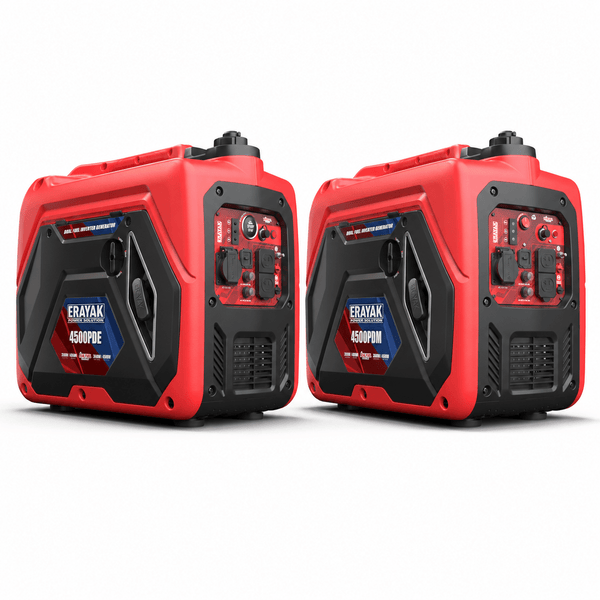
ERAYAK 4500PD Dual-Fuel Inverter Generator
The 4500PD is the strongest Erayak fit for RV campers who want propane flexibility and the option to scale up with a compatible parallel setup. One unit can suit many ordinary camping loads; two compatible units can add headroom for larger RV comfort loads when the kit and load plan support it.
- Best fit for RV camping, 30A-style comfort loads, and propane flexibility.
- Use two matching compatible units when parallel power is the goal.
- Verify the exact parallel kit, output receptacle, and total usable wattage before planning dual-AC operation.

ERAYAK 6800PD / 6800PT Series
If your real need is 120V/240V planning, selected home backup circuits, well or sump pump evaluation, or larger RV loads, the 6800 series may be a better starting point than building a two-generator camping setup.
- 6800W peak output and 5000W gasoline rated running output.
- 6800PD is dual fuel; 6800PT is tri fuel for gasoline, propane, and natural gas planning.
- Includes 30A 120V/240V L14-30R and 30A 120V L5-30R outlet planning. Do not treat it as a 50A generator.
2400P note: The ERAYAK 2400P is best treated as a compact standalone generator for lighter camping loads. Do not buy it expecting to build a parallel setup unless the current product manual and listed accessories explicitly support that use.
Parallel Generator Safety Rules
Parallel power is useful, but it adds connection points and load-planning risk. Keep the setup simple, rated, and outdoors.
Carbon monoxide and placement
- Never run fuel generators indoors, in a garage, inside an RV, or in an enclosed tent or awning area.
- Keep generators outdoors with proper ventilation and away from windows, doors, vents, and neighboring campsites.
- Use working carbon monoxide alarms in RVs and sleeping areas.
Electrical and load safety
- Use only the approved parallel kit for your exact generator models.
- Do not exceed the generator, kit, outlet, cord, breaker, or RV inlet rating.
- For home backup, use proper transfer equipment and qualified electrical guidance. Never backfeed a house outlet.
Parallel Generator Questions
Can you run two generators in parallel?
Yes, if they are compatible parallel-ready inverter generators and you use the correct manufacturer-approved parallel kit. Do not connect random generators together with ordinary cords or homemade adapters.
Can you parallel two different wattage generators?
Only if the manufacturer approves that exact combination. Even then, output may be limited by the smaller generator or the parallel kit. For the cleanest setup, use two identical compatible models.
Can you parallel two different brand generators?
Do not assume this is safe. Different brands may use different inverter controls, ports, protection logic, and cable wiring. Use only the combinations supported by the generator manuals.
Can you connect two generators without a parallel kit?
No. A parallel kit or approved cable system is required for consumer inverter generator parallel operation. Improvised wiring can damage equipment and create shock, fire, or backfeed hazards.
Is it better to buy two generators or one big generator?
Two smaller inverter generators are often better for camping and RV users who value portability, flexible fuel use, and light-load efficiency. One larger generator can be better for simpler setup, larger 120V/240V loads, and home backup planning.
Can two generators in parallel run two RV air conditioners?
Sometimes, but it depends on the air conditioners, soft-start kits, other loads, generator output, parallel kit rating, and RV inlet. Do not assume dual AC will work just because two generators are connected.
Can I parallel generators to power my house?
Only with proper transfer equipment, compatible generator output, and qualified electrical guidance. Never plug a generator into a wall outlet or backfeed a home circuit.
Parallel Generators Are Best When You Need Scalable Camping Power
For RV and camping users, two compatible inverter generators can be easier to move, more flexible at light loads, and useful when occasional high-wattage comfort loads appear. If your needs are mainly home backup, 120V/240V circuits, or large fixed loads, one correctly sized generator may be the cleaner path.


